
Angkor Wat’s stone cosmos at the heart of Angkor
Published on 08/31/2026 at 19:05 | Editorial responsibility: Rafael Müller, Editor-in-Chief AD HOC NEWS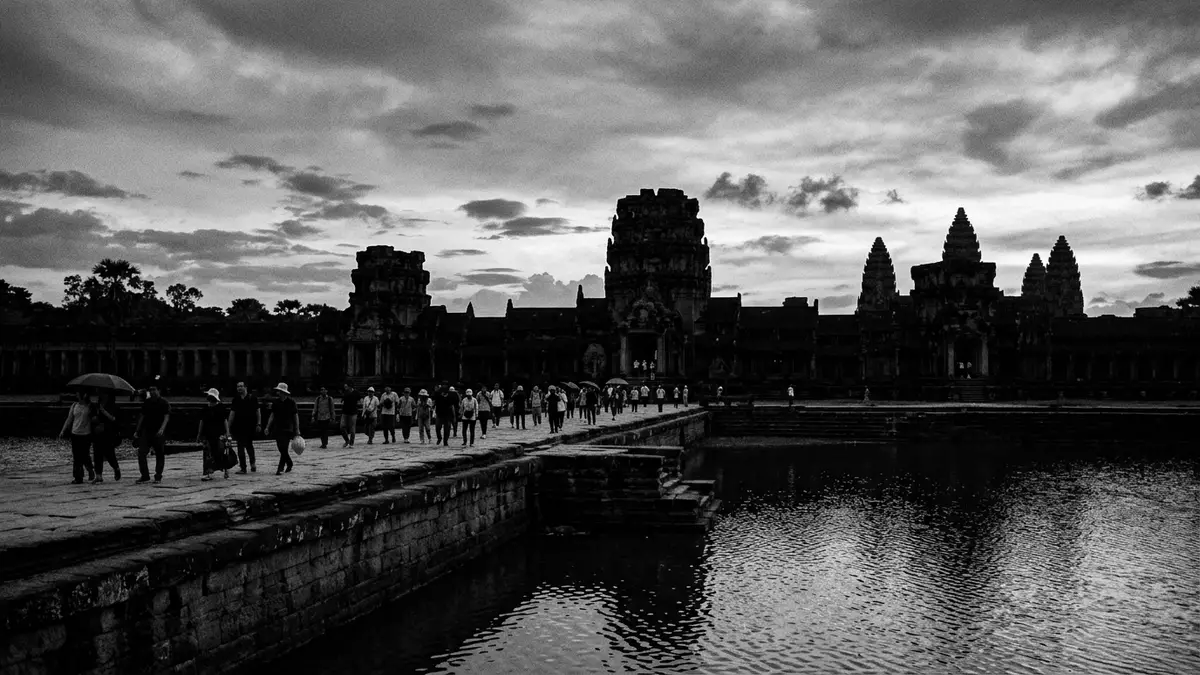
Angkor Wat near Siem Reap in Cambodia is a vast temple complex whose sandstone towers, galleries and enclosing moat form a monumental stone model of the Hindu cosmos. Built in the early twelfth century under the Khmer king Suryavarman II, it became a Theravada Buddhist sanctuary in the centuries that followed and remains one of the defining works of Khmer architecture.
A temple-mountain raised in the Khmer empire
Angkor Wat stands within the historic region of Angkor, the former capital of the Khmer empire that flourished between the ninth and fifteenth centuries. The temple complex lies just north of the modern town of Siem Reap, in a flat lowland landscape punctuated by canals and reservoirs from the imperial period.
Construction of Angkor Wat began shortly after Suryavarman II’s accession around 1113 and was largely complete by about 1150, during the high point of Khmer royal power.Built in the twelfth century The temple was conceived as a state sanctuary dedicated to the Hindu god Vishnu and belongs to the “temple-mountain” type, with a central elevation representing Mount Meru surrounded by lower ranges.Temple-mountain dedicated to Vishnu In later centuries, as royal patronage shifted and religious practice changed, the complex was gradually reoriented towards Buddhist worship while retaining its original Hindu imagery.
Sandstone towers, concentric galleries and a wide moat
Seen from above, Angkor Wat is organised as a series of concentric rectangular enclosures aligned on an east–west axis, rising towards a central cluster of towers. The whole monument forms a large rectangle measuring roughly 1,500 m by 1,300 m, including the surrounding moat, which itself is about 190 m wide on each side.Overall rectangle and moat width This layout gives the temple a self-contained presence, defined by water, walls and causeways.
Inside the outer enclosure, sandstone galleries run around each level, linking stairways and courtyards and framing views towards the inner sanctuary. In the very centre rises a dominant tower that reaches about 62 m above the main western causeway, ringed by smaller towers to form a stepped silhouette against the sky.Central tower height above the causeway The building materials are mainly sandstone blocks, carefully cut and assembled without visible mortar, resting on a foundation of compacted earth and laterite.
Bas-reliefs and the long afterlife of Angkor Wat
One of the most distinctive features of Angkor Wat is the continuous bas-relief carving that lines many of its galleries. These friezes depict episodes from Hindu mythology, including the “churning of the ocean of milk”, as well as processions of soldiers, courtiers and celestial beings.Narrative bas-relief galleries The style of the sculpture is often identified as classical Khmer, with elongated figures, elaborate crowns and a dense yet ordered composition that follows the length of the corridors.
Although Angkor Wat originated as a Hindu temple associated with Suryavarman II, its religious role shifted over the centuries. From the late thirteenth century onward it was progressively adapted for Theravada Buddhist use, with Buddha statues installed among older Hindu images, and it continued as an active monastic site even during periods when other Angkor monuments fell into disrepair.Conversion to Buddhist worship In the twentieth century it became a focus of study and conservation, and in 1992 Angkor, including Angkor Wat, was inscribed on the UNESCO World Heritage List for its outstanding cultural value.Angkor World Heritage listing
Visiting Angkor Wat: what travellers from Western Europe should know
- Angkor Wat stands just north of Siem Reap in north-western Cambodia, reached by road from the town and lying within the larger archaeological park of Angkor.
- The approach to the main entrance uses long stone causeways and involves climbing stairways and walking through extensive galleries, so a visit includes sustained movement on foot.
- The surrounding landscape is low and humid, with forest patches and reservoirs; paved paths and stone steps connect the temple’s courtyards and higher terraces.
- The official language is Khmer and the currency is the Cambodian riel.
- Entry requirements depend on your nationality; UK travellers can check the FCDO travel advice at gov.uk/foreign-travel-advice, Irish travellers the Department of Foreign Affairs at ireland.ie.
Searching for Angkor Wat on social platforms
These links open searches for Angkor Wat on each platform.Frequently asked questions about Angkor Wat
Where is Angkor Wat located?
Angkor Wat is part of the Angkor archaeological area in north-western Cambodia, close to the town of Siem Reap and surrounded by forested lowlands.
What should visitors expect on a visit?
A visit involves crossing long stone causeways, walking through extensive galleries and climbing stairways to higher terraces, all within a large moated enclosure.
What makes Angkor Wat distinctive among temples?
Its combination of temple-mountain layout, wide moat, central tower and continuous narrative bas-reliefs marks Angkor Wat as a major expression of classical Khmer architecture.


