
Angkor Wat’s stone city rising from the Cambodian plain
Published on 09/07/2026 at 18:43 | Editorial responsibility: Rafael Müller, Editor-in-Chief AD HOC NEWS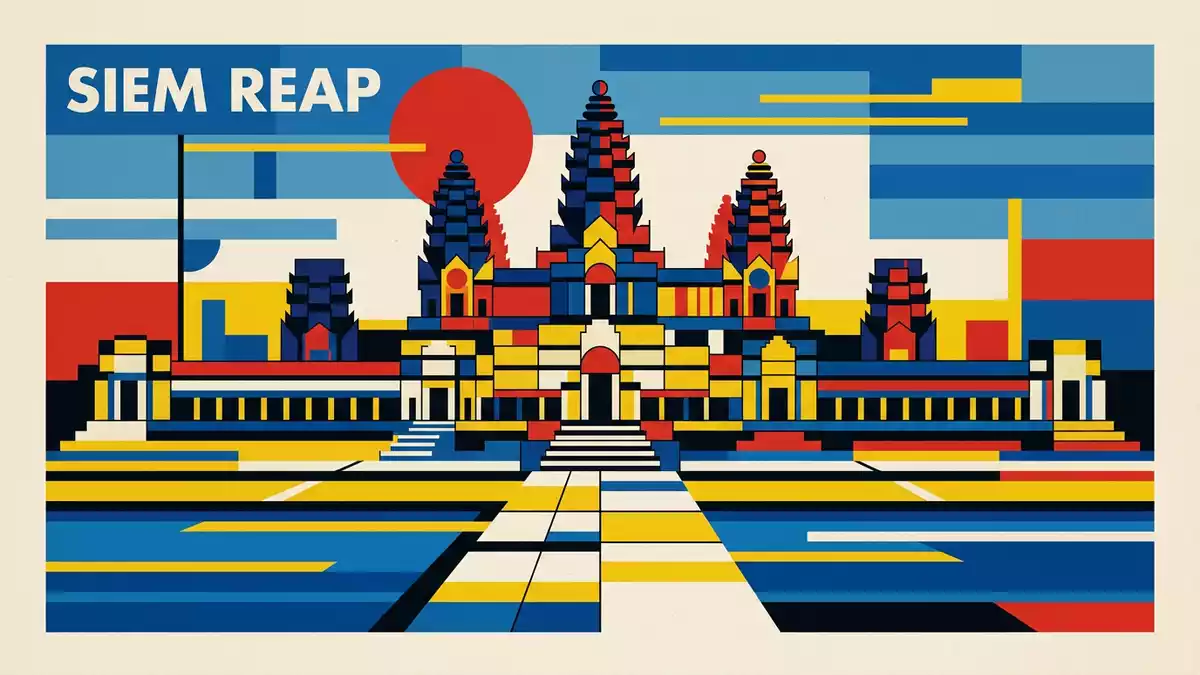
Angkor Wat is a vast temple complex on the plains north of Siem Reap, built in the twelfth century under King Suryavarman II and enclosed by a wide moat and outer walls.King Suryavarman II The complex forms part of the Angkor Archaeological Park, which was inscribed as a UNESCO World Heritage Site in 1992.UNESCO World Heritage Site in 1992
Sandstone towers and concentric enclosures
The defining experience of Angkor Wat is passing through layers of stone enclosure towards the central sanctuary, moving from the outer moat and causeway into galleries and courtyards that rise step by step. The temple stands on a site of more than 160 hectares, laid out as a large rectangle framed by earth embankments and stone walls with the moat beyond.site of more than 160 hectares From the western entrance a long paved causeway crosses the water and leads to the first set of stone gopuras, or gate structures, which in turn open onto courtyards and covered walkways.
Within this outer frame the core of Angkor Wat rises on a series of stepped terraces, crowned by stone towers that have become a symbol of Khmer architecture.Khmer temples constructed in the first half of the 12th century The central sanctuary sits higher than the surrounding galleries, reached by steep staircases cut into the sandstone. Around it, cruciform galleries with colonnades form a continuous circuit, their walls covered with carved scenes, while corner towers mark the edges of the upper platform. Seen from a distance the composition of terraces, galleries and towers reads as a single stone mountain rising above the surrounding forest and water.
From Vishnu temple to Buddhist pilgrimage centre
Angkor Wat was originally dedicated to the Hindu deity Vishnu and formed part of the capital city of the Khmer empire, with the temple at its heart.originally constructed as a Hindu temple dedicated to Vishnu Reliefs along the inner galleries show episodes from Hindu mythology, including battle scenes and processions, carved in low relief across long stretches of stone. The temple’s orientation and axial layout reflect its first role as a major state temple, with the western entrance aligned along the main processional route into the complex.
In later centuries Angkor Wat became a centre of Theravada Buddhist practice, and the sanctuary now houses Buddha images alongside the earlier Hindu carvings.temple complex built by the Khmer empire Monks use parts of the galleries and courtyards for religious observance, and visitors encounter shrines with incense and offerings set among the older stonework. This layered religious history gives the site particular character: the same corridors carry stories carved under Suryavarman II and contemporary Buddhist ritual, all within the enduring fabric of sandstone blocks and laterite foundations.
Angkor within the wider Cambodian landscape
Angkor Wat lies within north?western Cambodia, a short distance north of Siem Reap town, amid flat ground dotted with trees, ponds and other temple remains.near the town of Siem Reap in northwestern Cambodia The complex forms part of a broader archaeological zone that includes Angkor Thom and multiple other temples from the ninth to fifteenth centuries, all set within a grid of ancient roads and waterworks.Angkor Archaeological Park with monuments from the ninth to fifteenth centuries From the upper terraces of Angkor Wat the view takes in the moat, surrounding forest and, in places, distant towers of other temples rising above the canopy.
The temple itself is built largely of sandstone, with laterite used in foundations and some internal structures, giving the complex its warm, weathered colour against the green of the vegetation.massive stone temple complex Bas?relief panels, ornamental lintels and stone balustrades appear throughout the site, from the outer causeway to the inner sanctuaries, and reflect the craftsmanship of Khmer builders and sculptors of the period. Water features, including the moat and large ponds outside the main enclosure, mirror the towers and galleries, especially in the early and late light, and tie the stone city visually to the surrounding plain.
Visiting Angkor Wat: what travellers from Western Europe should know
- Angkor Wat stands within the Angkor Archaeological Park north of Siem Reap in north?western Cambodia, reached by road from the town and the nearby international airport.
- Inside the temple complex, movement involves staircases, uneven stone paving and changes in level, including steep steps up to the higher terraces and towers.
- The surrounding landscape is low?lying and wooded, with water bodies such as the moat and nearby ponds, so routes between different parts of the complex combine open paths and shaded stretches.
- The official language is Khmer and the currency is the Cambodian riel.
- Entry requirements depend on your nationality; UK travellers can check the FCDO travel advice at gov.uk/foreign-travel-advice, Irish travellers the Department of Foreign Affairs at ireland.ie.
Searching for Angkor Wat on social platforms
These links open searches for Angkor Wat on each platform.Frequently asked questions about Angkor Wat
Where is Angkor Wat?
Angkor Wat is a temple complex in the Angkor Archaeological Park north of Siem Reap in north?western Cambodia, set within a wide moat and outer walls.
What should visitors expect on a first visit?
Visitors encounter large stone enclosures, long galleries, steep staircases and extensive carved reliefs, all arranged around courtyards and water features within a vast rectangular site.
What makes Angkor Wat distinctive among temple complexes?
Angkor Wat combines a twelfth?century Khmer temple mountain of sandstone towers with layered Hindu and Buddhist history, all framed by a monumental moat and rectilinear plan.


