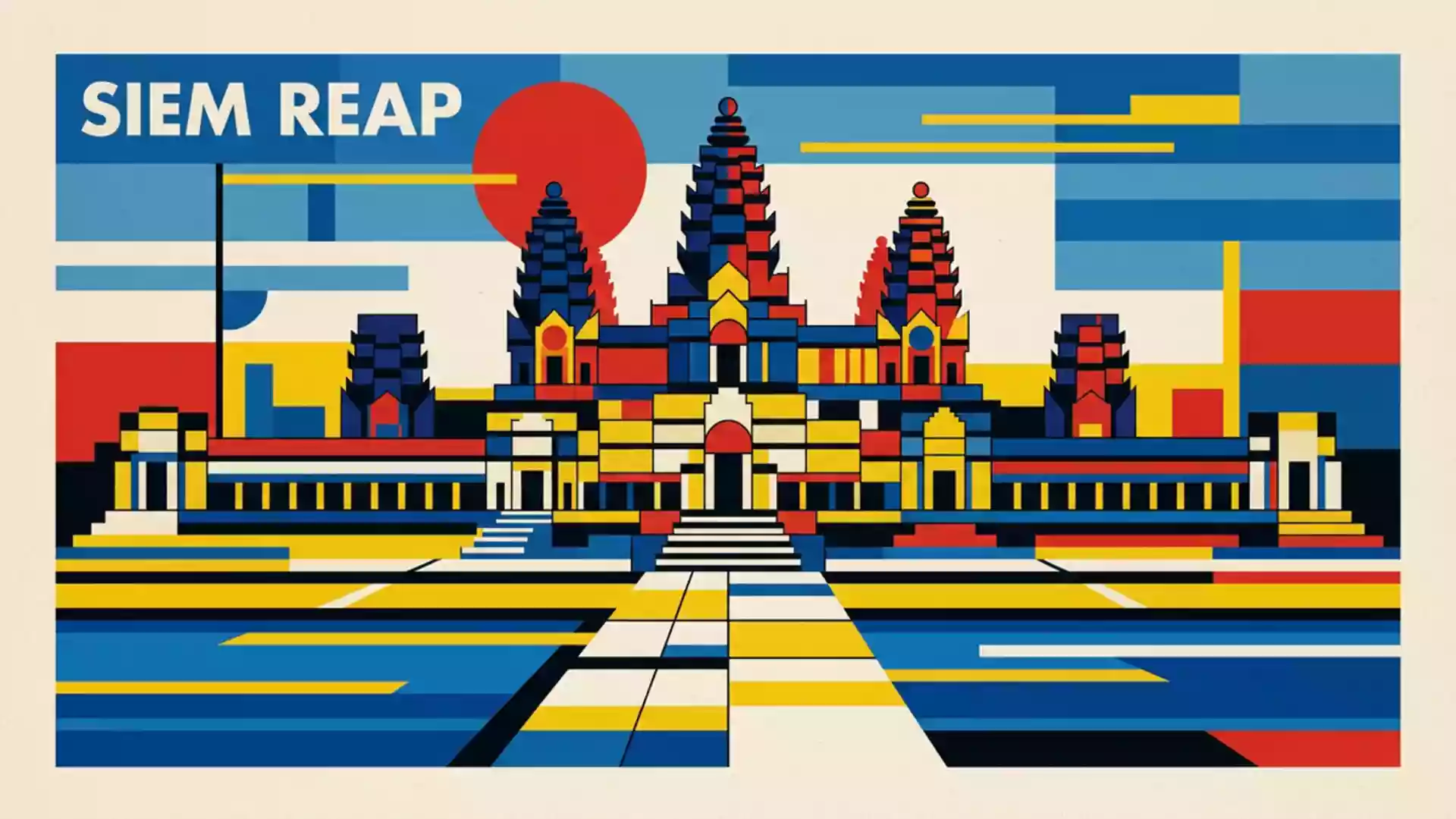
Angkor Wat and its stone universe in Siem Reap
Published on 09/11/2026 at 16:49 | Editorial responsibility: Rafael Müller, Editor-in-Chief AD HOC NEWS
Angkor Wat near Siem Reap in Cambodia is a vast temple complex of sandstone, water and sculpted galleries, laid out as a “temple city” in the early twelfth century. Built during the reign of King Suryavarman II as a Hindu state temple dedicated to Vishnu, it later became a major Buddhist centre and remains one of the defining works of classical Khmer architecture.
A temple city framed by water and walls
The first encounter with Angkor Wat is with its geometry of water and masonry, set within the broader archaeological landscape of Angkor north of the Tonle Sap lake in north-west Cambodia.temple complex at Angkor The entire monument is enclosed by a broad rectangular moat, around 190 m wide, which forms a continuous water boundary around a stone wall more than a kilometre long on each side and defines an area of roughly 160 ha.moat and enclosure dimensions Crossing the moat, travellers follow a long stone causeway towards the temple, with balustrades and guardian figures marking the transition from the outer precinct into the sacred enclosure.
Beyond the outer wall, Angkor Wat unfolds as a sequence of concentric spaces, each slightly elevated, forming a galleried temple around a central sanctuary.concentric galleries within its moat The plan combines the Khmer “temple mountain” form, in which the monument is conceived as a man-made representation of Mount Meru, with long axial galleries that frame views inwards. The west-facing orientation, unusual among Angkor temples, underlines its particular religious character and sets the main entrance along the western causeway rather than at the east.
Sandstone towers, terraces and reliefs in the twelfth century
Angkor Wat was constructed in the first half of the twelfth century during the reign of Suryavarman II, who ruled the Khmer Empire from about 1113 to around 1150.built in the 12th century by King Suryavarman II The temple is built largely from sandstone blocks, transported from quarries at Phnom Kulen north-east of Angkor, and arranged as terraces, galleries and towers rising towards the centre.sandstone from Phnom Kulen quarries At its core stands a temple mountain crowned by five towers in a quincunx arrangement, with the tallest central tower rising to around 65 m (213 ft) above the surrounding courts.central tower height and five towers
The monument’s surfaces carry extensive bas-reliefs and carvings, including long narrative friezes along the inner galleries that depict episodes from Hindu mythology, battles and processions. The composition reflects a fully developed phase of Khmer temple design, where structural clarity, sculptural detail and cosmological symbolism are integrated into a single ensemble.classical Khmer temple architecture In the late thirteenth century, Buddhist images and shrines were introduced, and the complex was gradually adapted from an exclusively Hindu temple into a centre of Theravada Buddhist worship, a religious role it has held for centuries.transition from Hindu to Buddhist devotion
Walking the axial approaches and inner courtyards
For visitors approaching from Siem Reap, Angkor Wat appears first as a distant silhouette of towers rising beyond trees and the moat, then as a sequence of causeways, gatehouses and courtyards. The main western entrance is formed by a gopura, or gate pavilion, leading into the outer enclosure, with subsidiary approaches connecting from the north and south. Inside, raised walkways guide movement towards the central sanctuary, passing libraries, smaller shrines and open courtyards that allow views of the tower group from different angles.axial plan and approaches
The experience of the complex involves frequent changes of level: low steps, terraces and stairways mark the ascent from the outer courts to the inner sanctuary. Within the steep inner staircases and upper galleries, the stonework tightens around the core shrine, while colonnaded walks and corner towers open long perspectives back towards the enclosure and moat. Travellers can observe the contrast between the broad, water-framed setting of the outer precinct and the concentrated vertical emphasis of the temple mountain at the centre, a spatial arrangement that embodies the “temple city” idea in built form.outer precinct and temple mountain layout
Visiting Angkor Wat: what travellers from Western Europe should know
- Angkor Wat lies north of Tonle Sap lake near the town of Siem Reap in north-west Cambodia, reached by road from Siem Reap and forming part of the wider Angkor Archaeological Park.
- Exploring the complex involves extensive walking on stone causeways, terraces and staircases, including steep flights in the inner sanctuary where steps are high and narrow.
- The climate in Siem Reap is tropical, with high temperatures and humidity; the open setting of the temple and its moat means limited shade on the causeways and outer enclosure.
- The official language is Khmer and the currency is the Cambodian riel.
- Entry requirements depend on your nationality; UK travellers can check the FCDO travel advice at gov.uk/foreign-travel-advice, Irish travellers the Department of Foreign Affairs at ireland.ie.
Searching for Angkor Wat on social platforms
These links open searches for Angkor Wat on each platform.
Frequently asked questions about Angkor Wat
Where is Angkor Wat located?
Angkor Wat stands within the Angkor archaeological area near Siem Reap in north-west Cambodia, north of the Tonle Sap lake.
What should visitors expect during a visit?
A visit involves walking along long stone causeways, crossing the moat, passing through gate pavilions and climbing staircases into the inner galleries and towered sanctuary.
What makes Angkor Wat distinctive among temples?
Its combination of a vast moat and enclosure, concentric galleries and a central five-towered temple mountain, all built in the twelfth century from sandstone, gives it an exceptional presence.