
Angkor Wat: a stone city of temples in the forests of Cambodia
Published on 09/14/2026 at 21:04 | Editorial responsibility: Rafael Müller, Editor-in-Chief AD HOC NEWS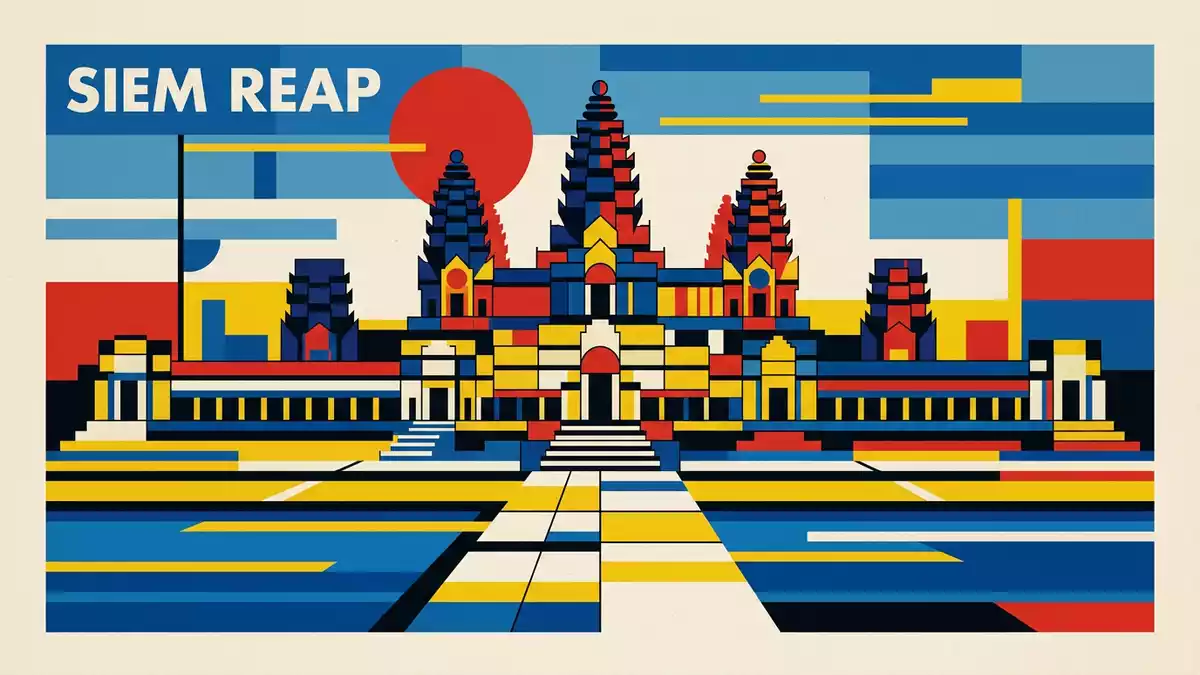
Angkor Wat near Siem Reap in Cambodia is a vast twelfth century stone temple complex whose size and layered plan give it the presence of a walled city rather than a single shrine. Built during the reign of King Suryavarman II of the Khmer Empire, it rises from the forest on a broad platform encircled by water and causeways, with towers and galleries unfolding inwards in successive tiers.
A twelfth century temple city in stone
Angkor Wat stands within the Angkor region of northwestern Cambodia, a landscape of forests, reservoirs and scattered temples north of the Tonlé Sap lake and close to modern Siem Reap.The ruins of Angkor Angkor itself forms the core of what is recognised as the Angkor World Heritage Site, a cultural landscape spanning hundreds of square kilometres and containing the remains of several Khmer capitals.Angkor World Heritage site
The temple complex of Angkor Wat was constructed in the first half of the twelfth century as a Hindu state temple dedicated to Vishnu by King Suryavarman II, who reigned from 1113 to around 1150.King Suryavarman II built the temple Over time it became associated with Theravada Buddhism, and shrines, images and practices connected with Buddhist worship took root within its precincts while the underlying sandstone architecture remained largely intact.Hindu origins and later Buddhist use
Scale, plan and the approach across the moat
Angkor Wat is widely described as the largest religious structure in the world, covering an area of around 160 hectares (about 400 acres) on a rectangular site surrounded by a substantial moat.Largest religious structure The moat defines a broad outer enclosure, with long sandstone causeways bridging the water and leading towards monumental gateways and a processional route lined by balustrades and guardian figures.Moat and causeways
Beyond the outer gateways, the temple’s plan unfolds through a sequence of courts and cloistered galleries that rise gradually towards a central sanctuary, with the profile of the complex dominated by a cluster of towers at the heart.Central tower and plan The whole complex stands on a raised platform, with stairways connecting levels and stone terraces giving access to doorways aligned along the main axes of the temple, creating long sightlines towards the inner sanctum.
Sandstone carvings and the wider Angkor landscape
Angkor Wat is built largely of sandstone blocks, with laterite used in foundation structures, and its surfaces carry extensive bas reliefs and carved decoration that form one of the most concentrated ensembles of classical Khmer art.Sandstone monument with extensive reliefs Long gallery walls are carved with narrative scenes from Hindu mythology and from the royal court, while column bases, lintels and pediments carry patterns and figures worked into the stone.
Angkor Wat stands within the Angkor Archaeological Park, a protected area that contains numerous other temples and hydraulic works, including reservoirs and canals that once supported the Khmer capital and its agriculture.Hydraulic structures and temples Angkor as a whole is inscribed on the UNESCO World Heritage List as a cultural site of outstanding universal value, recognising both the architecture of Angkor Wat itself and the broader ensemble of monuments and landscape features across the region.Angkor World Heritage inscription
Visiting Angkor Wat: what travellers from Western Europe should know
- Angkor Wat lies north of Siem Reap in northwestern Cambodia, within the Angkor Archaeological Park, reached by road from the town and approached over a broad stone causeway.
- The temple complex is extensive, with long galleries, terraces and stairways, and visiting involves walking on uneven stone surfaces and climbing flights of steps between levels.
- The surrounding landscape includes other major Angkor temples and large former reservoirs, so visiting Angkor Wat can be combined with short journeys to nearby sites within the same archaeological park.
- The official language is Khmer and the currency is the Cambodian riel.
- Entry requirements depend on your nationality; UK travellers can check the FCDO travel advice at gov.uk/foreign-travel-advice, Irish travellers the Department of Foreign Affairs at ireland.ie.
Searching for Angkor Wat on social platforms
These links open searches for Angkor Wat on each platform.Frequently asked questions about Angkor Wat
Where is Angkor Wat and what is its wider setting?
Angkor Wat is a large temple complex in the Angkor region north of Siem Reap in northwestern Cambodia, surrounded by forests, reservoirs and other Khmer temples.
What should a visitor expect when exploring Angkor Wat?
A visit involves crossing the moat on a stone causeway, passing through monumental gateways and walking through long sandstone galleries, terraces and stairways rising towards the central sanctuary.
What makes Angkor Wat distinctive among temple sites?
Angkor Wat combines vast scale, a layered city-like plan, twelfth century Khmer sandstone architecture and extensive narrative carvings, all set within a wider landscape of Angkor temples and historic waterworks.


