
Angkor Thom and the ring of Khmer power
Published on 08/31/2026 at 10:27 | Editorial responsibility: Rafael Müller, Editor-in-Chief AD HOC NEWS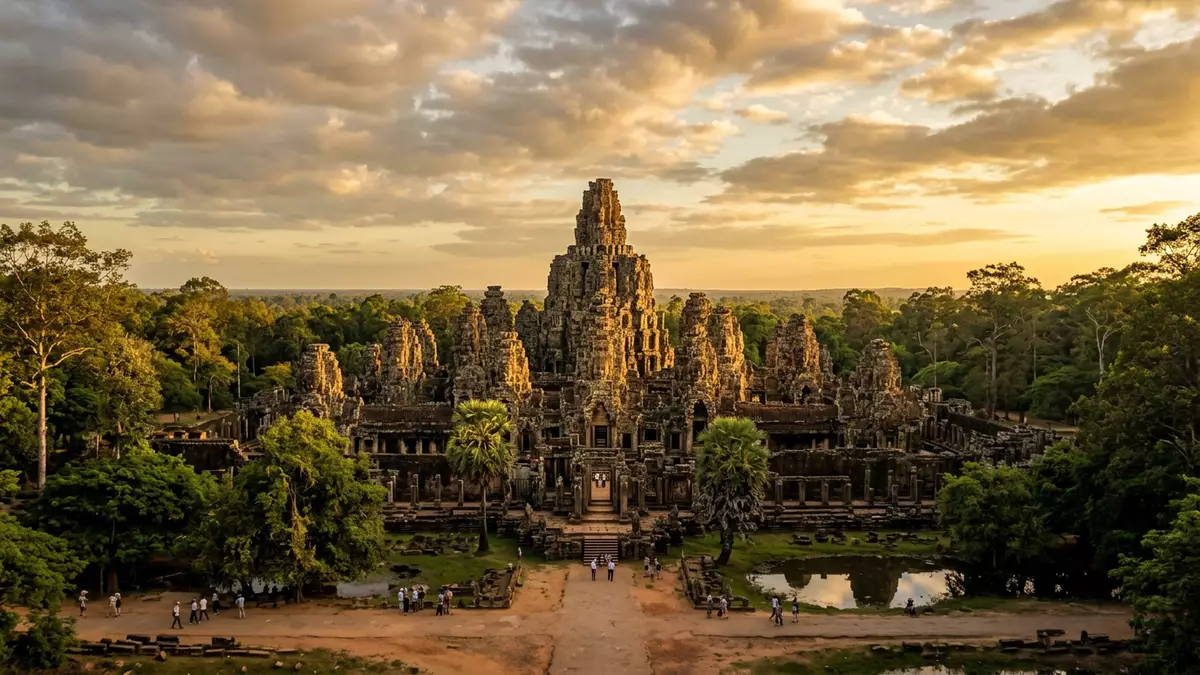
Angkor Thom near Siem Reap is a Khmer royal city enclosed by walls, moats and monumental gates. Its most striking feature is the Bayon, the stone temple at the city’s centre, linked to the Angkor World Heritage site and to the reign of Jayavarman VII.
The Khmer city around Bayon
Jayavarman VII established Angkor Thom in the late twelfth century, and the name means “Great City”. The site belongs to the wider Angkor area, which UNESCO places in Cambodia’s Siem Reap province and dates from the ninth to the fifteenth century as a whole.
The city’s plan is unusually legible on the ground. Bayon sits within a square walled enclosure, and the ensemble includes the South Gate, the Terrace of the Elephants, the Terrace of the Leper King and other stone monuments associated with the capital.
Bayon faces and sandstone reliefs
Bayon is the monument most people associate with Angkor Thom. UNESCO describes it as a temple with countless sculptural decorations, and another UNESCO text identifies it as constructed under Jayavarman VII.
That combination of royal patronage, dense carving and a central position gives the city its visual character. The temple’s towers carry faces, while the surrounding stonework keeps the site firmly in the language of Khmer religious architecture.
Walls, gates and the city plan
The enclosing wall and moat frame Angkor Thom as a closed urban form. The South Gate is the most widely recognised entrance, and the whole site is built as a formal capital rather than a scattered temple group.
The city therefore reads as architecture at the scale of an entire settlement. Sandstone, water, gateways and temple platforms combine into a landscape of courtly power that remains easy to trace on foot.
Visiting Angkor Thom: what travellers from Western Europe should know
- Angkor Thom lies north of Siem Reap in Cambodia, within the Angkor Archaeological Park. The South Gate is the usual approach, and the site is reached by road from the city.
- The ground is level enough for walking, but the monuments are spread across an extensive enclosed area. Stone steps and raised platforms appear at several of the main structures.
- Bayon, the South Gate and the terraces form the clearest cluster for first-time visitors. The site rewards slow movement between stone gateways, courtyards and temple platforms.
- Angkor Thom sits within the UNESCO-listed Angkor complex. The official language is Khmer and the currency is the Cambodian riel.
Searching for Angkor Thom on social platforms
These links open searches for Angkor Thom on each platform.
Frequently asked questions about Angkor Thom
Where is Angkor Thom?
It lies in Cambodia’s Siem Reap province, inside the Angkor Archaeological Park. The city sits north of Siem Reap and close to Angkor Wat within the wider Angkor landscape.
What should a visit include?
Bayon, the South Gate and the terraces form the core of a visit. Their stone walls, reliefs and gateways give the site its strongest sense of scale.
What makes Angkor Thom distinctive?
It is a royal city rather than a single temple, and that remains visible in its walls, moat, gates and central monument. The association with Jayavarman VII and the late twelfth century gives it a clear historical frame.


