
Amphitheatre of El Jem and the Roman scale of Tunisia
Published on 09/14/2026 at 16:26 | Editorial responsibility: Rafael Müller, Editor-in-Chief AD HOC NEWS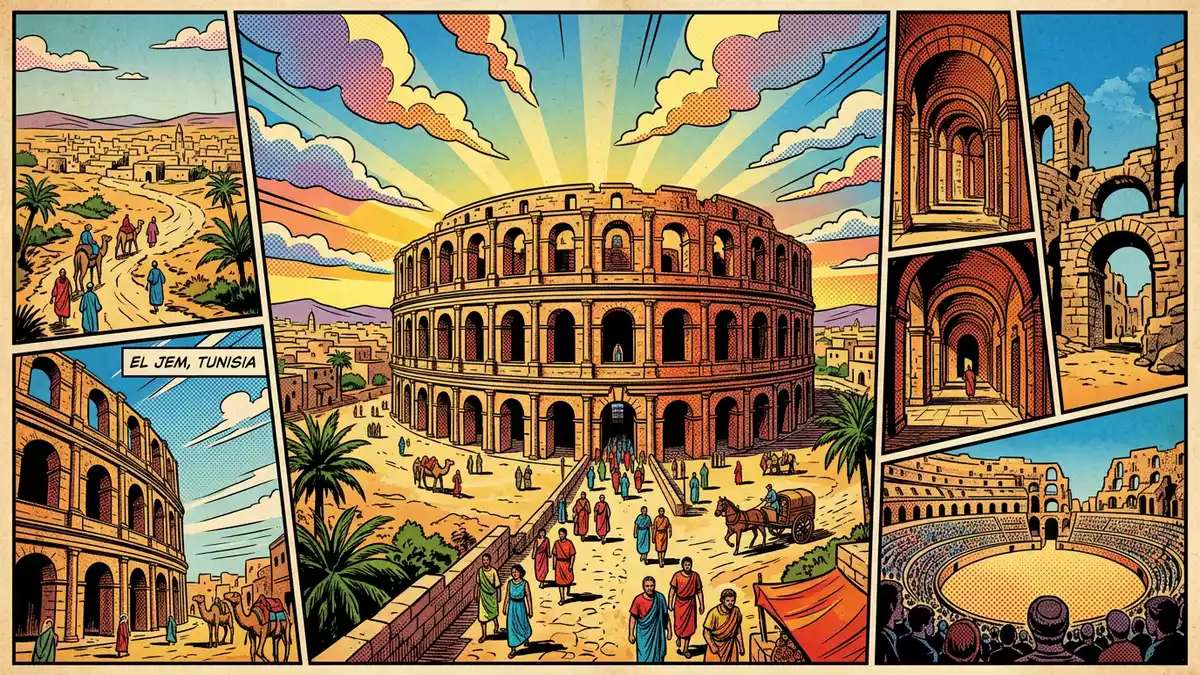
Amphitheatre of El Jem rises in Roman stone at El Jem, in central Tunisia, as an immense elliptical shell. Listed as a UNESCO World Heritage site in 1979, it remains one of the most recognisable Roman monuments in North AfricaUNESCO World Heritage.
Roman stone and an immense ellipse
The building’s outline is unmistakable: an elongated oval with three levels of arcades on the exterior. Its principal axes measure 148 m (486 ft) and 122 m (400 ft), and the arena forms a smaller oval within that frameprincipal axes.
The amphitheatre is a third-century Roman structure, linked with the Severan age and the wider imperial cityscape of Roman Africa. Its survival is visible in the standing outer walls, the tiered arcades and the retained mass of the arena levelthird-century Roman structure.
From spectator monument to heritage landmark
El Jem’s amphitheatre belongs to the tradition of Roman spectacle buildings, with a form that still reads as civic theatre in stone. The UNESCO listing identifies it as a monument that illustrates the reach of Imperial Rome and Roman architectural practice in AfricaImperial Rome.
The site is associated with the ancient name Thysdrus, the Roman settlement that preceded modern El Jem. That historical link, together with the monument’s size and survival, gives the place a clear identity beyond a single town landmarkancient name Thysdrus.
El Jem’s monument in the landscape
The amphitheatre stands free on open ground rather than being folded into a dense street pattern. Its exterior mass, repeated arches and broad oval plan are visible from different angles, and the building reads as a single volume set within the townfree on open ground.
Its height is given as about 36 m (118 ft), which makes the surviving walls and arcades feel monumental without needing any decorative framing. The arena floor and the outer shell remain legible as separate parts of one Roman compositionabout 36 m high.
Visiting Amphitheatre of El Jem: what travellers from Western Europe should know
- The amphitheatre stands in El Jem, in Mahdia Governorate, Tunisia. Rail connections serve the town, and road access links it with the surrounding Sahel region.
- The monument has steep internal circulation and exposed stone surfaces. The arena and the upper tiers are separate levels within the same structure.
- The official language is Arabic and the currency is the Tunisian dinar.
- Entry requirements depend on your nationality; UK travellers can check the FCDO travel advice at gov.uk/foreign-travel-advice, Irish travellers the Department of Foreign Affairs at ireland.ie.
Searching for Amphitheatre of El Jem on social platforms
These links open searches for Amphitheatre of El Jem on each platform.
Frequently asked questions about Amphitheatre of El Jem
Where is Amphitheatre of El Jem?
It stands in El Jem, in central Tunisia, in the governorate of Mahdia. The monument is identified with the Roman site of Thysdrus.
What does a visit involve?
The amphitheatre is a large stone ruin with standing arcades, internal levels and open arena space. The structure is climbed and viewed as a Roman shell rather than as a complete interior.
What makes Amphitheatre of El Jem distinctive?
Its elliptical form, Roman scale and UNESCO listing define it immediately. The monument’s 148 m by 122 m footprint and 36 m height give it a strong presence in the town.


