
Amphitheatre of El Jem, a Roman giant in central Tunisia
Published on 09/10/2026 at 12:17 | Editorial responsibility: Rafael Müller, Editor-in-Chief AD HOC NEWS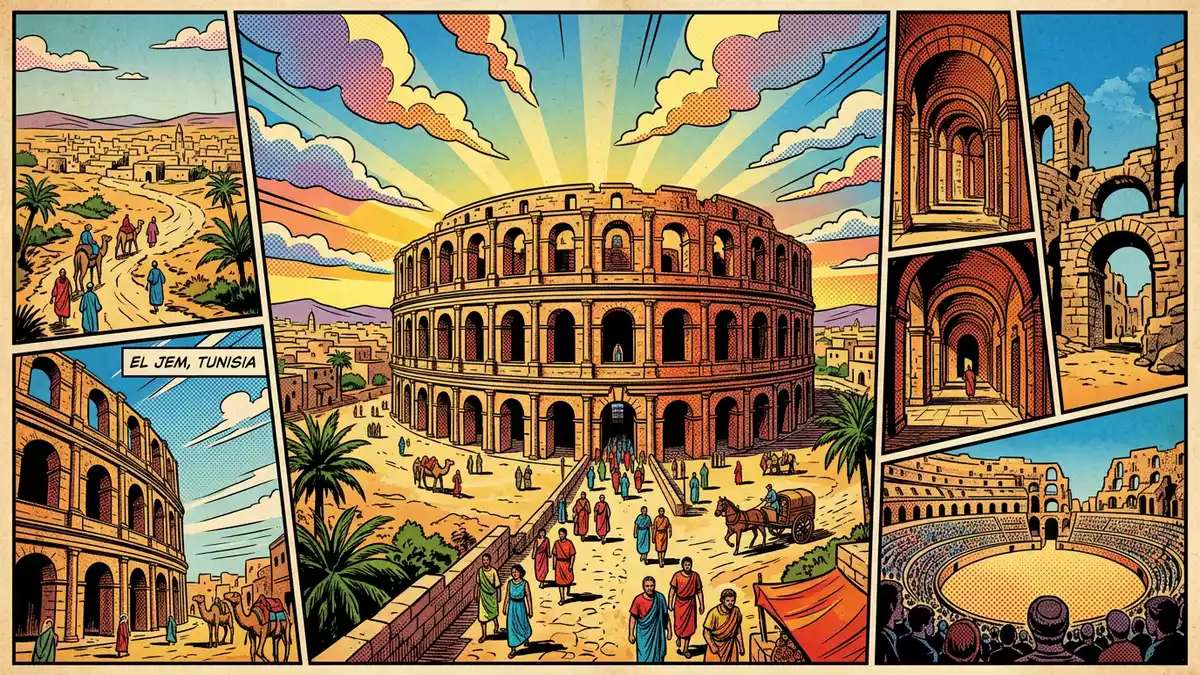
Amphitheatre of El Jem in central Tunisia is a vast Roman arena whose stone arcades dominate the small town of El Jem and the surrounding plain. Completed in the third century AD, this oval amphitheatre was built for mass spectacles in the ancient city of Thysdrus, a prosperous centre in the Roman province of Africa.Third-century monument Inscribed on the World Heritage List in 1979, it stands as one of North Africa’s most imposing surviving Roman structures.World Heritage inscription
An oval colosseum on open ground
The Amphitheatre of El Jem is an oval structure built entirely from large stone blocks, standing free on flat ground rather than against a hillside.Free-standing stone amphitheatre Its long axis measures about 148 m (486 ft) and the shorter axis about 122 m (400 ft), giving the arena a footprint comparable to the major amphitheatres of the Roman world.Overall dimensions Rising to around 30 m (98 ft), the outer facade is organised in three tiers of arcades carried on Corinthian and composite columns, stacking rhythmic arches in horizontal bands around the ellipse.Three levels of arcades
The seating bowl inside was designed to accommodate a crowd counted in tens of thousands, far exceeding the ancient town’s population.Spectator capacity Spectators would have looked down onto a central arena roughly 64 m (210 ft) by 39 m (128 ft), ringed by walls separating the action from the lowest rows of seats.Arena size From outside, the amphitheatre’s massive volume rises above nearby streets and houses, making its ring of arches a constant backdrop to daily life in El Jem.
Thysdrus and Roman Africa
In antiquity, El Jem was known as Thysdrus, a town enriched by agriculture and trade in the hinterland of Roman Africa.Ancient name Thysdrus The amphitheatre is traditionally dated to around 238 AD, placing it in the later phase of large-scale arena construction in the empire.Dated to the 230s AD Its scale and refinement reflect both the wealth of the region and its integration into imperial architectural culture centred on Rome.Imperial Roman context
The building is associated with the African proconsul Gordian, an elite landowner whose name appears in accounts of the amphitheatre’s construction.Attribution to Gordian Within Roman Africa, El Jem’s amphitheatre ranks among the largest arenas, standing alongside the complexes at Carthage and other regional centres while approaching the scale of the Colosseum in Rome.Ranking among major amphitheatres The World Heritage listing highlights the monument as an outstanding example of Roman architecture for spectator events in Africa, connecting the present-day town with its imperial past.UNESCO criteria
Exploring the stone corridors and tiers
The Amphitheatre of El Jem preserves a substantial portion of its outer walls and internal circulation, allowing visitors to move through stone corridors, staircases and viewing platforms that follow the original Roman layout.Surviving structure and tiers Passages beneath and behind the seating bowl reveal the network of arches that support the high outer shell, while the arena level gives clear views of the encircling terraces.
Over the centuries, parts of the structure have been lost, yet large stretches of facade and interior still stand, giving a strong sense of the amphitheatre’s original form.Extent of preservation From the upper tiers, the view extends across the roofs of El Jem and the surrounding countryside, underlining how the monument’s stone ring continues to frame the town. Cultural events use the arena and selected seating areas, maintaining a link between contemporary gatherings and the ancient purpose of the building.Use for cultural events
Visiting Amphitheatre of El Jem: what travellers from Western Europe should know
- The amphitheatre stands in the town of El Jem in central Tunisia, south of Sousse, and is reached by road and by railway services that connect with coastal cities.Location in central Tunisia
- Exploring the monument involves walking across uneven stone surfaces, climbing staircases within the stands and moving through vaulted corridors beneath the seating levels.Access to tiers and corridors
- The official language is Arabic and the currency is the Tunisian dinar.
- Entry requirements depend on your nationality; UK travellers can check the FCDO travel advice at gov.uk/foreign-travel-advice, Irish travellers the Department of Foreign Affairs at ireland.ie.
Searching for Amphitheatre of El Jem on social platforms
These links open searches for Amphitheatre of El Jem on each platform.
Frequently asked questions about Amphitheatre of El Jem
Where is Amphitheatre of El Jem located?
The amphitheatre stands in the town of El Jem in central Tunisia, on a plain that formed part of the Roman province of Africa.
What can visitors expect on a visit?
Visitors encounter extensive stone arcades, interior corridors, staircases and viewing terraces that follow the original Roman arrangement of the arena and seating bowl.
What makes Amphitheatre of El Jem distinctive?
Its third-century date, free-standing construction on flat ground, large oval plan and World Heritage status mark it out among Roman amphitheatres in North Africa.


