
Amfiteatre de Tarragona and the Roman arena above the Mediterranean
Published on 09/19/2026 at 11:22 | Editorial responsibility: Rafael Müller, Editor-in-Chief AD HOC NEWS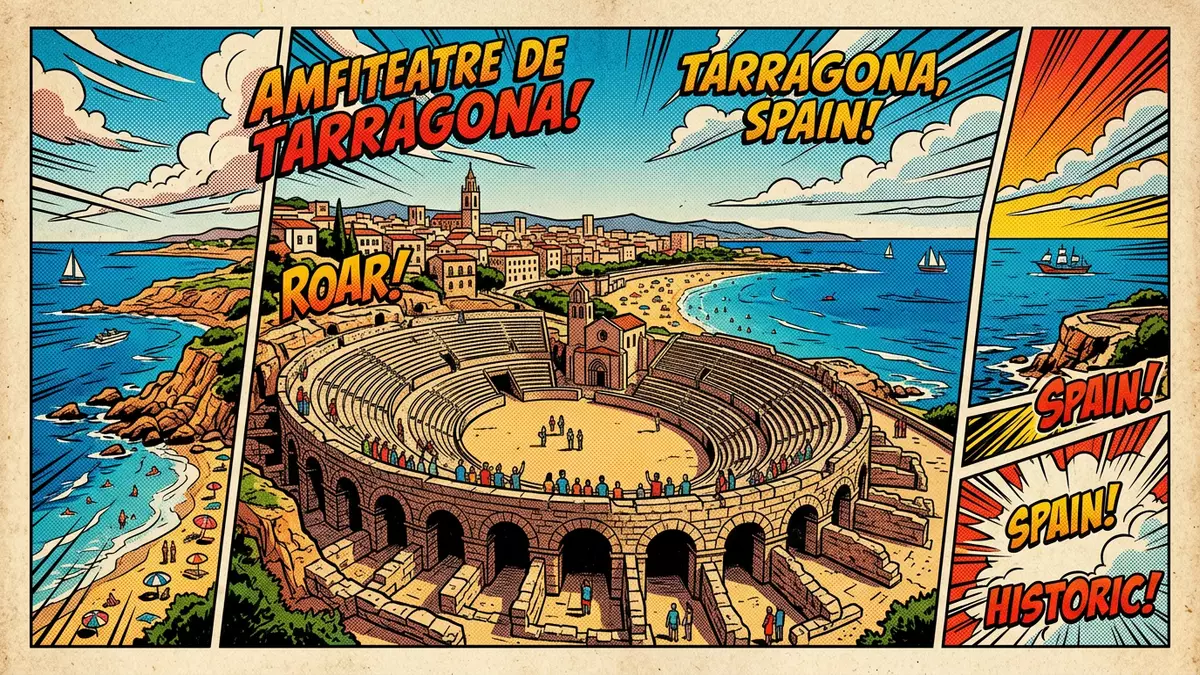
Amfiteatre de Tarragona is the Roman amphitheatre of ancient Tarraco, cut into the slope above the Mediterranean in the city of Tarragona in Spain. Built in the second century AD, it formed part of the Roman provincial capital of Hispania Tarraconensis, where crowds gathered for spectacles in a stone arena facing the sea.
A Roman arena carved into the seaside slope
The amphitheatre occupies a terrace between the former Roman city and the shoreline, with its arena aligned towards the Mediterranean so that events unfolded against a coastal backdrop. In Roman terms it belonged to the city of Tarraco, a colonia that served as the administrative centre of the province known as Hispania Citerior or Hispania Tarraconensis.Roman Amphitheatre of Tarraco From the outset it was a venue for gladiatorial combat, staged animal hunts and public executions, an arena where imperial entertainments were given permanent form in stone.Tarraco’s amphitheatre was built
The building follows the standard Roman amphitheatre plan, with an oval arena ringed by ascending tiers of seating that rise from the podium. Part of the cavea, the stepped seating, is hewn directly into the rock of the hillside, while other sectors rest on constructed substructures, a combination that ties the monument into the landscape. The arena itself retains traces of the subterranean service spaces that once lay beneath its surface, reminders of the machinery and labour behind each spectacle.
From Flavian construction to Christian memory
Archaeological and epigraphic evidence places the construction of Amfiteatre de Tarragona in the second half of the first century and the early second century AD, within the period of the Flavian dynasty and its successors.dinastia Flàvia Later, in 221 AD, the podium was crowned by a long dedicatory inscription during the reign of Emperor Elagabalus, recording alterations made to the structure.alterations in 221 AD The amphitheatre remained in use for public spectacles into the imperial period before losing its original function when Christianity became the dominant religion of the Empire.
On 21 January 259, Amfiteatre de Tarragona was the setting for the martyrdom of Bishop Fructuosus of Tarraco and his deacons Augurius and Eulogius, who were burned in the arena during the persecutions under Emperor Valerian.martyrdom of Fructuosus In the sixth century a basilica dedicated to these martyrs was constructed on the arena floor, and its remains, together with those of a later Romanesque church of Santa Maria del Miracle from the twelfth century, can still be traced within the contours of the amphitheatre.Visigothic basilica and Romanesque church The result is a layered site in which Roman masonry, early Christian foundations and mediaeval walls intersect within a single enclosed space.
Scale, form and the wider ensemble of Tarraco
Measurements recorded for Amfiteatre de Tarragona underline its role as a major entertainment venue in the provincial capital. Sources give overall dimensions of around 130 m by 102 m, with a spectator capacity in the range of 14,000 to 15,000 people, placing it among the larger amphitheatres of Roman Hispania.dimensions and capacitycapacity of 14,000 spectators The arena itself, set out on a slightly elongated axis, echoes the proportions of other imperial amphitheatres while adapting to the coastal terrain into which it was cut.
Amfiteatre de Tarragona forms part of the Archaeological Ensemble of Tarraco, a group of Roman monuments in and around Tarragona that has been inscribed on UNESCO’s World Heritage List.Archaeological Ensemble of Tarraco Within this ensemble the amphitheatre stands alongside remains of the circus, the provincial and colonial fora, sections of the city walls and associated infrastructure, together illustrating the urban layout of a Roman provincial capital.UNESCO declared the archaeological ensemble From the seating of Amfiteatre de Tarragona the relationship between ancient stonework, the modern city and the sea can be read in a single sweep.
Visiting Amfiteatre de Tarragona: what travellers from Western Europe should know
- Amfiteatre de Tarragona stands in Tarragona on the Catalan coast of Spain, below the former Roman upper town and near Parc de l'Amfiteatre Romà and Platja del Miracle. It lies within walking distance of the historic centre and the Mediterranean shore.
- The monument occupies a sloping site cut partly into rock, with terraces and stairways connecting different levels around the arena floor and the remains of the basilica and later church.
- Amfiteatre de Tarragona forms part of the wider Roman heritage of Tarragona, alongside the circus, sections of the walls and the forum area, so the surrounding streets also carry numerous archaeological traces.
- The official language is Spanish and Catalan and the currency is the euro.
Searching for Amfiteatre de Tarragona on social platforms
These links open searches for Amfiteatre de Tarragona on each platform.
Frequently asked questions about Amfiteatre de Tarragona
Where is Amfiteatre de Tarragona located?
Amfiteatre de Tarragona stands in the coastal city of Tarragona in Catalonia, Spain, on a slope between the historic centre and the Mediterranean shore.
What can visitors expect when exploring the site?
Visitors encounter a Roman arena cut into the hillside, with surviving tiers of seating, the outline of the podium and remains of later Christian basilica and church structures within the same enclosure.
What makes Amfiteatre de Tarragona distinctive among Roman sites?
Its form combines a substantial amphitheatre beside the sea with visible layers of Roman, early Christian and mediaeval architecture, and it stands within a UNESCO-listed ensemble of monuments from the provincial capital of Tarraco.


