
Amfiteatre de Tarragona and its sea-facing Roman arena
Published on 09/17/2026 at 20:55 | Editorial responsibility: Rafael Müller, Editor-in-Chief AD HOC NEWS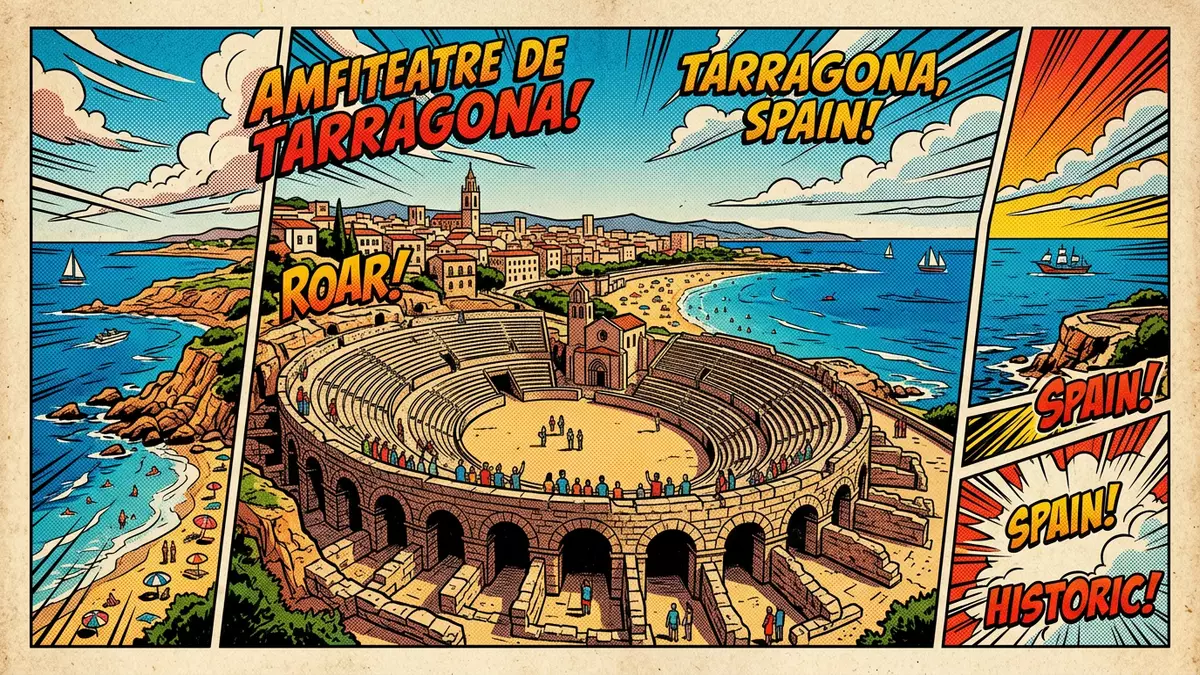
Amfiteatre de Tarragona is a Roman amphitheatre on the coastal side of Tarragona in Spain, where the stone outline of an ancient arena opens towards the Mediterranean Sea. Built in the second century AD in the former Roman colonia of Tarraco, it formed part of a wider ensemble of civic monuments that has been recognised as a World Heritage Site.
A Roman arena cut into the coastal slope
Amfiteatre de Tarragona occupies a terrace on the seaward slope below central Tarragona, in Catalonia, where the terrain falls towards the shoreline and the beach.Tarraco’s amphitheatre The structure stands outside the line of the ancient city walls, close to the course of the Via Augusta and near the point where goods and animals arriving by sea would have reached the Roman city.the amphitheatre near Via Augusta and the beach
The amphitheatre follows the elongated ground plan associated with large Roman arenas, its footprint measuring about 130 by 102 metres (427 ft by 335 ft), with the central area reserved for spectacles and executions.Tarragona Amphitheatre dimensions The northern part of the seating was cut directly into the rock of the slope, while sections of the southern stands were carried on a substructure of concrete vaults that extended towards the sea.northern stands carved into the rock
From Tarraco’s public spectacles to a World Heritage ruin
The amphitheatre belongs to the period when Tarraco served as the capital of the Roman province of Hispania Citerior, one of the major urban centres on the Iberian Peninsula.Tarraco as a provincial capital It was constructed in the second century AD, in the age of the Flavian dynasty and its successors, and inscriptions on the podium record alterations dated to 221 AD under the reign of the emperor Elagabalus.alterations in 221 AD
In Roman times the arena hosted gladiatorial combat, wild beast hunts and public executions, events that drew thousands of spectators to the stone tiers.gladiatorial combat and battles with wild animals Capacity estimates based on the surviving structure and its plan place the number of spectators at around 14,000, giving Amfiteatre de Tarragona a scale comparable with other provincial arenas of the Roman world.14,000 spectators The ruin forms part of the Archaeological Ensemble of Tarraco, inscribed on the UNESCO World Heritage List in 2000 together with the circus, forums, walls, aqueduct and other Roman remains in and around Tarragona.Archaeological Ensemble of Tarraco
Reading the amphitheatre in stone and sea
Standing inside Amfiteatre de Tarragona, the relationship between architecture and landscape is clear: sections of the northern cavea remain embedded in the slope, while the southern side opens towards the Mediterranean with the beach and water beyond.amphitheatre carved into the cliffs by the sea The arena keeps its elongated outline, framed by the podium and lower seating terraces, and the visitor walks across a floor where stone and sand once staged spectacles under Roman rule.
A modern viewpoint on the higher ground of Rambla Nova, including the Balcó del Mediterrani, offers an elevated view of the amphitheatre with the sea as a backdrop, making its position between city and water easy to grasp.views from Rambla Nova towards the amphitheatre Within the wider Roman route through Tarragona, the amphitheatre sits alongside the circus, provincial forum and other monuments, forming a continuous thread of stone that runs from the hilltop down to the coast.Roman route in Tarragona
Visiting Amfiteatre de Tarragona: what travellers from Western Europe should know
- Amfiteatre de Tarragona stands on the coastal slope below central Tarragona in Catalonia, Spain, close to Parc de l’Amfiteatre romà and the Mediterranean shoreline.
- The monument lies outside the line of the ancient city walls, beside the course of the historic Via Augusta and near the modern beach, with an approach that includes exposed stone terraces.
- Rambla Nova and the Balcó del Mediterrani on the higher ground above the coast provide elevated views over the amphitheatre and its setting between the city and the sea.
- The official language is Spanish and the currency is the euro.
Searching for Amfiteatre de Tarragona on social platforms
These links open searches for Amfiteatre de Tarragona on each platform.
Frequently asked questions about Amfiteatre de Tarragona
Where is Amfiteatre de Tarragona located?
Amfiteatre de Tarragona stands on the coastal slope of Tarragona in Catalonia, Spain, outside the line of the ancient city walls and close to the Mediterranean shoreline.
What should visitors expect on a visit?
Visitors encounter the stone outline of a Roman amphitheatre, with surviving tiers of seating, an open arena and views towards the beach and sea.
What makes Amfiteatre de Tarragona distinctive among Roman sites?
The amphitheatre combines a substantial second-century Roman arena with a setting directly by the Mediterranean and forms part of the UNESCO-listed Archaeological Ensemble of Tarraco.


