
Amfiteatre de Tarragona and its sea-facing Roman arena
Published on 09/15/2026 at 09:24 | Editorial responsibility: Rafael Müller, Editor-in-Chief AD HOC NEWS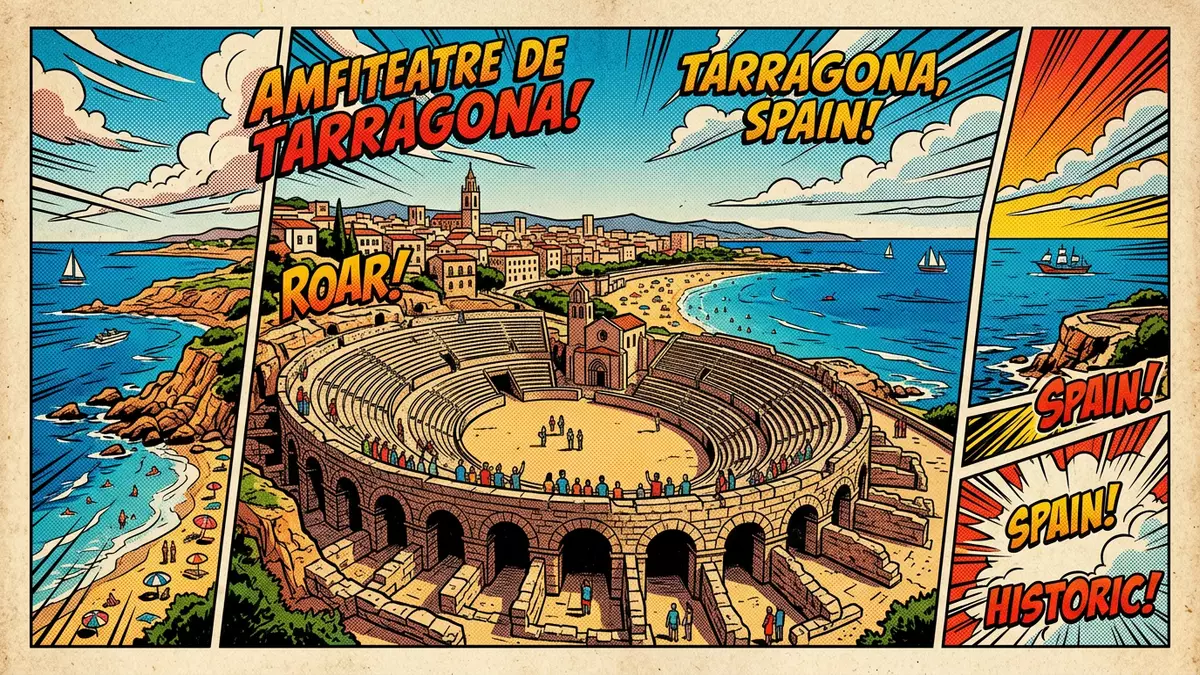
Amfiteatre de Tarragona is a Roman amphitheatre on the coastal slope of Tarragona in Spain, where the outline of a stone arena faces the Mediterranean Sea and recalls the city’s ancient role as Tarraco. Built in the second century AD in the Roman colonia of Tarraco, it belongs to a wider ensemble of Roman monuments in and around Tarragona that was inscribed as the Archaeological Ensemble of Tarraco on the UNESCO World Heritage List in 2000.
A Roman arena above the Mediterranean
Amfiteatre de Tarragona stands on a slope below central Tarragona, set between the modern city and the shoreline, so that its terraces descend towards an arena that lies close to the sea. The amphitheatre formed part of the Roman colonia of Tarraco, which served as the capital of the province of Hispania Tarraconensis and developed a complex of public monuments including a circus, theatre and forums alongside this arena.Roman Amphitheatre of Tarraco
The plan follows the elongated form associated with Roman amphitheatres, with an overall footprint measuring about 130 by 102 m (427 by 335 ft) according to excavated traces, and the seating arranged around a central arena set within a surrounding podium.overall footprint measuring roughly 130 by 102 metres The surviving terraces run along the northern and southern sides, where stepped stone tiers show how spectators were organised above the arena on multiple levels.
From Roman spectacles to a layered sacred site
The amphitheatre is traditionally dated to the second century AD, a period when arenas for gladiatorial combats, animal hunts and public executions were established in major cities of the Roman Empire.constructed in the second century In Tarraco it completed a trio of spectacle buildings with the circus and theatre, giving the provincial capital multiple venues for public events that reflected its status within Hispania Tarraconensis.completed a trio of spectacle buildings
Later, in the sixth century, the space gained a different character when a Visigothic basilica was built within the arena, followed by a Romanesque church that reused the same ground in the medieval period.Visigothic basilica in the 6th century Standing on the terraces today, the visitor sees not only the ring of stone seating around the central space but also the foundations of later ecclesiastical buildings that overlie parts of the arena, making Amfiteatre de Tarragona a layered site where a Roman place of spectacle and later Christian worship share the same ground.
Part of the Archaeological Ensemble of Tarraco
Amfiteatre de Tarragona forms one element within the Archaeological Ensemble of Tarraco, a serial World Heritage property that brings together the principal Roman remains of Tarragona and its surroundings. The inscription covers the ancient city and suburban monuments, including the walls, the provincial forum, the circus, the colonial forum and other structures that illustrate the layout and evolution of Tarraco as a provincial capital.Archaeological Ensemble of Tarraco
Within this ensemble, the amphitheatre occupies a seaward terrace below the modern Balcó del Mediterrani and near present-day parks that follow the coastal edge of the city.amfiteatre de Tarragona Its position close to the Mediterranean, outside the line of the Roman walls and near the route of the ancient Via Augusta, places it at the transition between urban fabric and shoreline, where the arena opens towards sea views that underline the amphitheatre’s coastal setting.
Visiting Amfiteatre de Tarragona: what travellers from Western Europe should know
- Amfiteatre de Tarragona stands on the coastal slope below central Tarragona in Catalonia, Spain, near Parc de l’Amfiteatre romà and within walking distance of the Balcó del Mediterrani.
- The monument occupies a terraced site on a hillside above the sea, with stone steps and sloping paths linking the different levels around the arena and the later church foundations.
- The surrounding area includes other Roman remains from the Archaeological Ensemble of Tarraco, so the amphitheatre can be combined with visits to the circus and forum districts in the same part of the city.
- The official language is Spanish and the currency is the euro.
Searching for Amfiteatre de Tarragona on social platforms
These links open searches for Amfiteatre de Tarragona on each platform.Frequently asked questions about Amfiteatre de Tarragona
Where is Amfiteatre de Tarragona located?
Amfiteatre de Tarragona is located on the coastal slope below central Tarragona in Catalonia, Spain, near Parc de l’Amfiteatre romà and close to the Mediterranean shoreline.
What can visitors expect when exploring the amphitheatre?
Visitors encounter stone terraces around a central arena, foundations of later churches within the amphitheatre floor and views towards the sea that reveal its coastal position.
What makes Amfiteatre de Tarragona distinctive among Roman sites?
The amphitheatre combines a second-century Roman arena, medieval ecclesiastical remains and a seaward setting within a UNESCO-recognised archaeological ensemble, giving it a rare mix of monument types on one coastal terrace.


