
Amer Fort, Jaipur’s sandstone palace above Maota Lake
Published on 09/03/2026 at 22:48 | Editorial responsibility: Rafael Müller, Editor-in-Chief AD HOC NEWS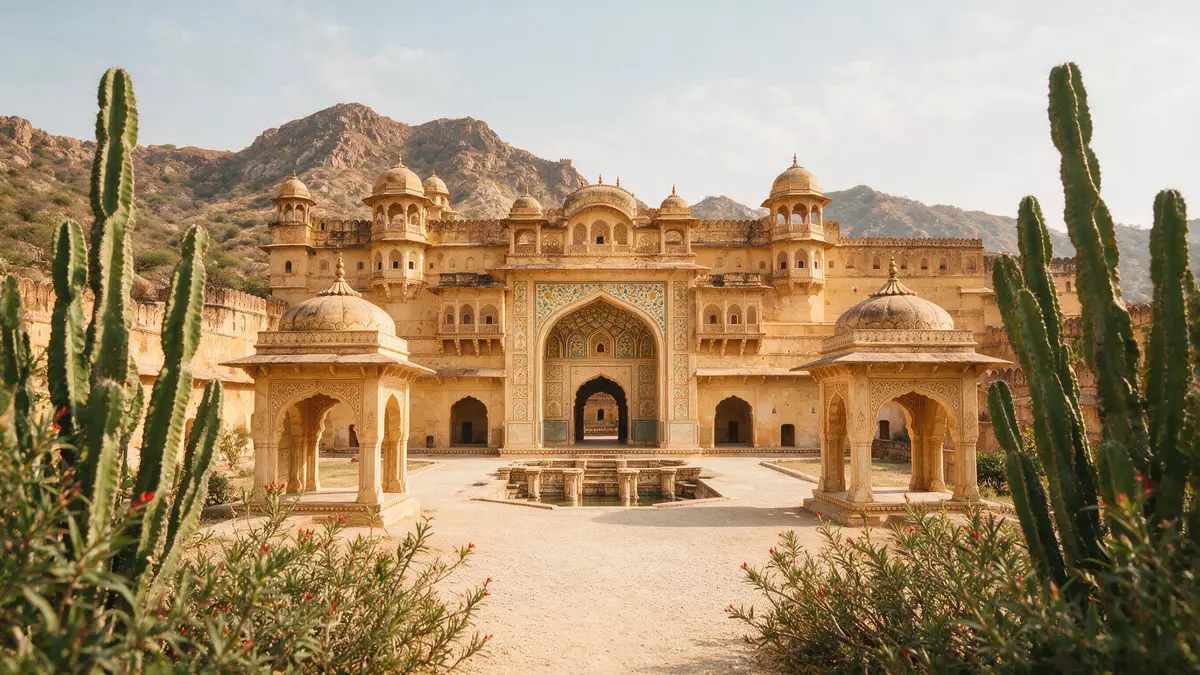
Amer Fort near Jaipur is a hilltop palace complex of pale sandstone and marble that once served as the seat of the Kachwaha Rajput rulers and still dominates the shore of Maota Lake.
A hill fort that became a palace city
Amer Fort stands on the rugged slopes of the Aravalli Hills above the historic town of Amer, with its walls and gateways climbing the ridge in terraces that look down towards Jaipur and the surrounding plains. The fort occupies a site that long served as a stronghold, but the palace complex known today took shape under the Kachwaha Rajputs, who made Amer their capital until the early eighteenth century when the court shifted to Jaipur.Amer was a political centre for centuries Construction phases associated with Raja Man Singh I in the late sixteenth century and his successors in the seventeenth century gave Amer Fort its core arrangement of courtyards, halls and royal apartments.Raja Man Singh I commissioned the fort in 1592
The complex belongs to the group of Hill Forts of Rajasthan recognised as a UNESCO World Heritage Site, a serial inscription that links Amer with other Rajput forts such as Chittorgarh, Kumbhalgarh, Ranthambore, Gagron and Jaisalmer.Hill Forts of Rajasthan were inscribed in 2013 The setting on a rocky hill above Maota Lake and the extended fortifications connecting Amer Fort to Jaigarh Fort on the crest form a continuous fortified landscape that once protected the Rajput capital and its courtly life.Amer Fort is linked to Jaigarh Fort above
Sandstone, marble and the blend of Rajput and Mughal styles
Amer Fort is constructed largely from pale yellow and pink sandstone with extensive use of white marble, giving the palace surfaces a warm, honey-coloured appearance that catches the light on the hill.The fort uses pale sandstone and white marble The architecture combines Rajput defensive forms such as ramparts and bastions with Mughal-influenced decorative schemes in its courts and audience halls, an Indo-Islamic synthesis that became characteristic of elite Rajput palaces in Rajasthan.Rajput and Islamic styles are integrated Within the main palace, richly carved columns, painted ceilings and lattice screens frame views between the courtyards and towards the lake below.
The best-known interiors belong to the Sheesh Mahal and the surrounding royal apartments, where mirror mosaics and coloured glass inlay transform the walls and vaults into reflective surfaces that scatter small points of light. These mirror-lined chambers sit within the Jai Mandir and related structures, parts of the palace that formed the private quarters of the Maharaja and his immediate household.Sheesh Mahal and Jai Mandir are major buildings Around them, the Diwan-i-Aam and Diwan-i-Khas furnish halls for public and private audiences, with arcades looking into one of the central courtyards and elevated platforms where rulers could receive envoys and petitioners.
Courtyards, gates and the route into the royal apartments
Amer Fort is organised around a sequence of courtyards that step up the hillside from the outer arrival space to the inner palace. Visitors first encounter Jaleb Chowk, the main forecourt inside the principal gate, which historically received armies returning from campaigns and large ceremonial processions.Jaleb Chowk forms the outer arrival court Above this level, stairways and ramps lead towards the second courtyard with its pillared halls, before narrower passages and more controlled gateways mark the transition into the residential zone.
Among the gates, Ganesh Pol stands out as the painted entrance leading into the third courtyard, which contains many of the royal apartments and their attendant service spaces.Ganesh Pol leads to the Maharajas’ palaces Elsewhere in the complex, Singha Pol and other named gateways regulate access between the courtyards and connect the palace to surrounding defensive works. Temples, including the Shila Devi shrine, sit within this sequence, reflecting the integration of royal worship spaces into the everyday functioning of the fort. Together, the courtyards, halls, temples and women’s apartments create a layered spatial system in which administrative, ceremonial and domestic life were arranged vertically on the hill.
Visiting Amer Fort: what travellers from Western Europe should know
- Amer Fort lies north-east of central Jaipur on the slopes of the Aravalli Hills, above the town of Amer and beside Maota Lake, and is reached by road from the city.
- The ascent from the base involves uneven stone surfaces and stairways between the courtyards, and the palace levels rise high above the lake, so substantial walking on inclined terrain is involved.
- The official language is Hindi and the currency is the Indian rupee.
- Entry requirements depend on your nationality; UK travellers can check the FCDO travel advice at gov.uk/foreign-travel-advice, Irish travellers the Department of Foreign Affairs at ireland.ie.
Searching for Amer Fort on social platforms
These links open searches for Amer Fort on each platform.
Frequently asked questions about Amer Fort
Where is Amer Fort and what is its setting?
Amer Fort stands above the town of Amer north-east of Jaipur, on a rocky hill of the Aravalli range overlooking Maota Lake and the surrounding countryside.
What should a visitor expect inside Amer Fort?
A visitor encounters successive courtyards, audience halls, temples and royal apartments, with sandstone and marble architecture leading towards the mirror-lined Sheesh Mahal and other decorated interiors.
What makes Amer Fort distinctive among Rajasthan’s forts?
Amer Fort combines its hilltop defensive setting and extended fortifications with richly decorated palace architecture and forms part of the Hill Forts of Rajasthan UNESCO World Heritage Site.


