Amer Fort, Jaipur’s sandstone hill palace
Published on 09/11/2026 at 11:01 | Editorial responsibility: Rafael Müller, Editor-in-Chief AD HOC NEWS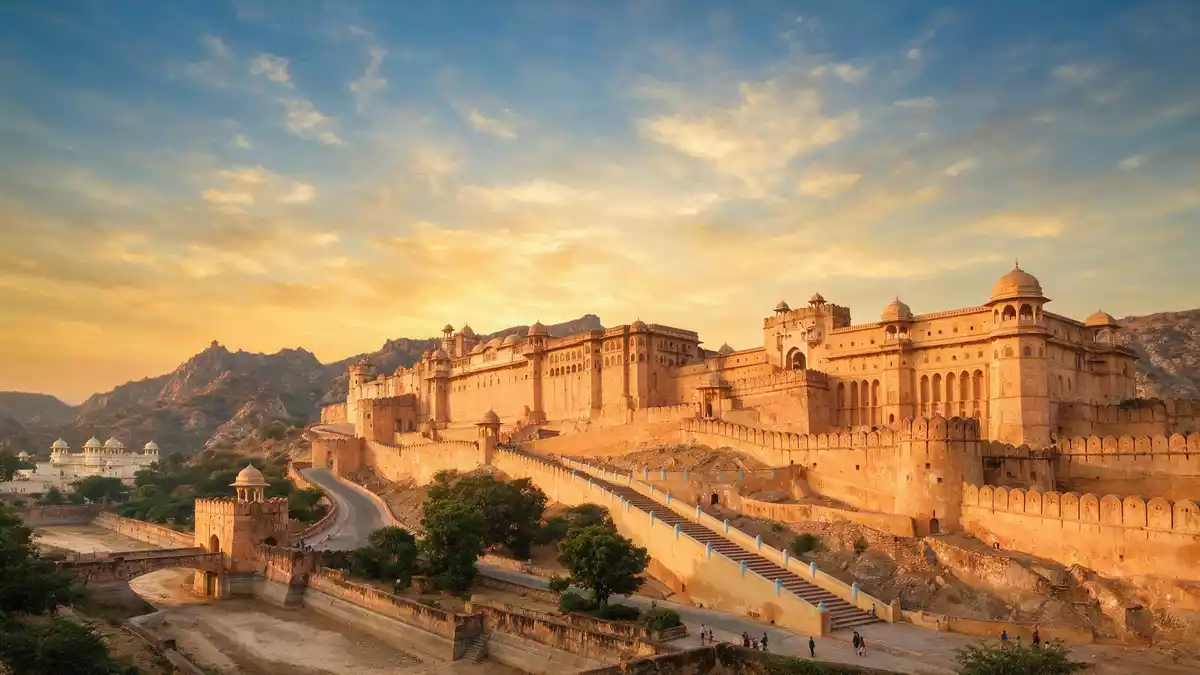
Amer Fort on the outskirts of Jaipur is a Rajput hill fortress that evolved into a palace complex of sandstone courts and halls overlooking Maota Lake and the Aravalli hills. Built for the Kachwaha Rajput rulers from the late sixteenth century onwards, it became their principal residence until the capital shifted to Jaipur in the early eighteenth century, giving the site a layered royal character that is still legible in its courtyards and gateways.principal residence until the capital shifted to Jaipur
Hilltop setting above Maota Lake
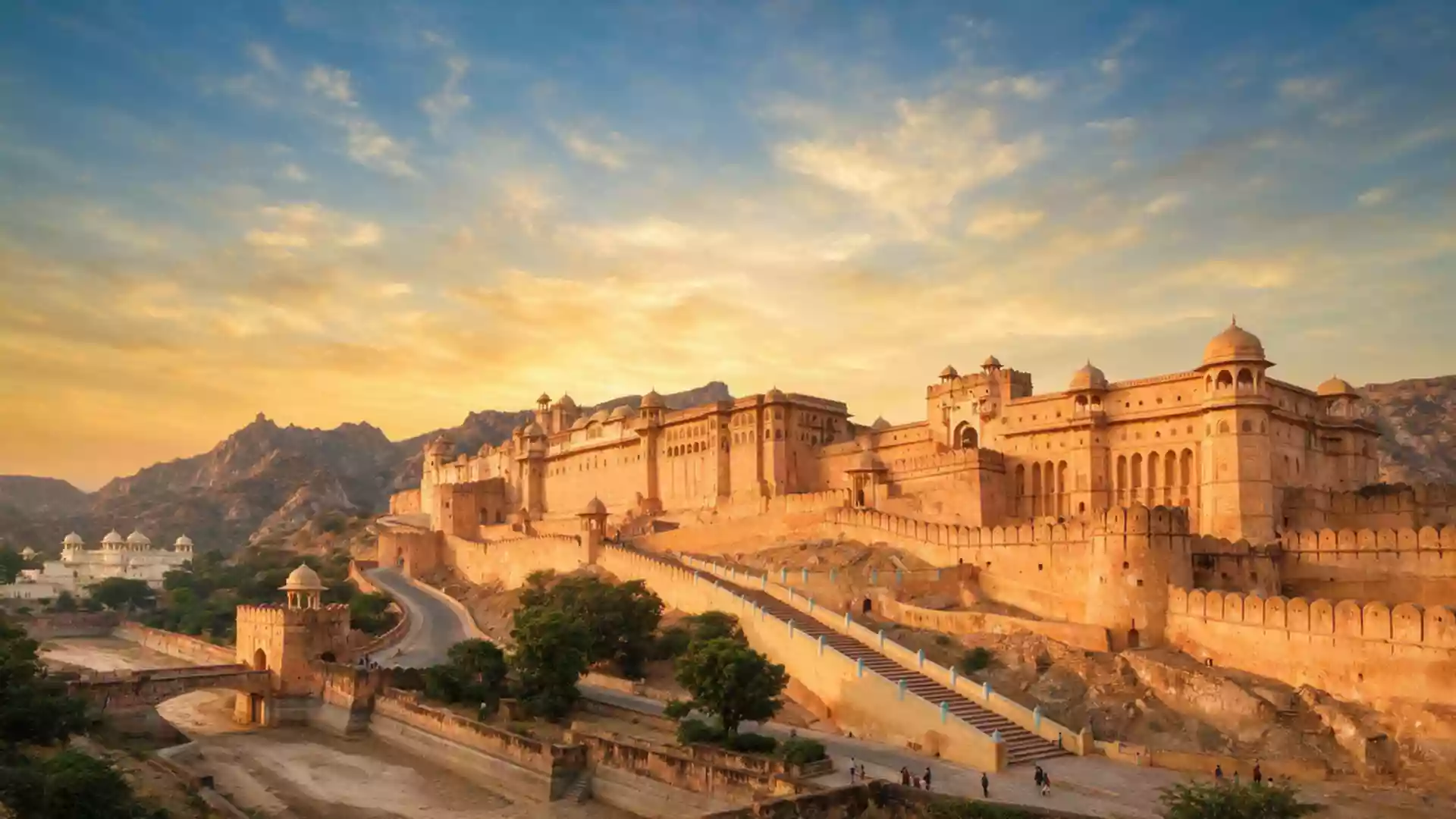
Amer Fort occupies a ridge of the Aravalli hills north of central Jaipur, its outer walls following the contours of the slope and enclosing a sequence of ascending terraces. From the lower approaches, the fort’s pale yellow and red sandstone mass rises above the waters of Maota Lake, with bastions and curtain walls stepping up towards the main gate and first courtyard.located 11 kilometers from Jaipur city center The hilltop setting places Amer within the wider ensemble of fortified ridges in Rajasthan, and a further stronghold, Jaigarh Fort, crowns the higher line of hills linked to Amer by protected passages.Jaigarh Fort above through secret passages
Approaching the fort, the relationship between architecture and terrain is immediate: long ramps and stairways climb from the lakeside towards the principal gate, and defensive walls run along the slopes in irregular lines. From the higher terraces, the views stretch across the countryside surrounding Jaipur, while the lake below reflects the bulk of the fort and the surrounding hills on still days.
Rajput and Mughal architecture in sandstone and marble
The palace complex at Amer Fort was begun in 1592 under Raja Man Singh I and expanded by later Kachwaha rulers, producing an interplay of Rajput and Mughal architectural forms over roughly two centuries.built in 1592 by Raja Man Singh Much of the visible fabric dates to the sixteenth and seventeenth centuries, when halls of audience, residential suites and garden courts were added for successive generations of the Amer rulers.most of what is visible today dates to the 16th and 17th centuries The fort’s construction in red and pale sandstone, combined with white marble in key interiors, gives its surfaces warm tonal contrasts that change with the light across the day.
Within the complex, architectural motifs drawn from Mughal palaces sit alongside Rajput forms: arcaded halls with carved columns open onto courtyards, while latticed screens and richly ornamented ceilings appear in the more private rooms.integration of Hindu and Islamic styles One of the most intricate spaces is the Sheesh Mahal, or Mirror Palace, where thousands of small mirror pieces and relief patterns cover the walls and ceilings, creating complex reflections when illuminated.Sheesh Mahal with thousands of mirror mosaics Elsewhere, garden courts with geometric layouts and water channels introduce greenery and shade into the otherwise fortified setting.
From royal capital to UNESCO hill fort
Amer served as the capital of the Kachwaha Rajputs for centuries before Jaipur was founded in 1727 under Sawai Jai Singh II, and Amer Fort functioned as both a stronghold and a royal residence during that period.Amer Fort served as the primary capital of the Kachwaha clan When the capital moved to the planned city of Jaipur in the eighteenth century, Amer’s political role diminished, but the palace complex retained its architectural significance and continued to be maintained and embellished.
In 2013 Amer Fort was inscribed as part of the “Hill Forts of Rajasthan” UNESCO World Heritage Site, a serial listing that covers six major fortified ensembles across the state.UNESCO World Heritage Site since 2013 The inscription highlights the fort’s value as an example of Rajput military architecture combined with courtly culture, with its sequence of ramparts, water management structures, temples and palatial buildings forming a coherent historic landscape.part of the Hill Forts of Rajasthan World Heritage site
Visiting Amer Fort: what travellers from Western Europe should know
- Amer Fort stands in the town of Amer, on hill slopes north of Jaipur in Rajasthan, reached from the city by road and approached from near Maota Lake.
- The ascent from the lower approaches to the main courtyard involves ramps and stairways on an incline, with further internal staircases linking the successive levels.
- The fort lies within the semi-arid landscape of the Aravalli hills, so exposed terraces and walls can feel dry under strong sun while garden courts offer more sheltered spaces.
- Amer is in India, where the official currency is the Indian rupee and the official national languages include Hindi alongside regional languages.
- Entry requirements depend on your nationality; UK travellers can check the FCDO travel advice at gov.uk/foreign-travel-advice, Irish travellers the Department of Foreign Affairs at ireland.ie.
Searching for Amer Fort on social platforms
These links open searches for Amer Fort on each platform.
Frequently asked questions about Amer Fort
Where is Amer Fort located?
Amer Fort stands in the town of Amer in Rajasthan, on hill slopes about 11 km north of Jaipur, overlooking Maota Lake and the Aravalli hills.
What can visitors expect during a visit to Amer Fort?
Visitors encounter a sequence of sandstone courtyards, halls and garden spaces linked by ramps and staircases, with views over the lake and surrounding hills.
What makes Amer Fort distinctive among Rajasthan’s forts?
Amer Fort is distinctive for its combination of Rajput defensive walls and palace architecture, its mirrored interiors and its role within the Hill Forts of Rajasthan UNESCO listing.