
Amer Fort, Jaipur’s hilltop palace of sandstone and marble
Published on 09/18/2026 at 22:21 | Editorial responsibility: Rafael Müller, Editor-in-Chief AD HOC NEWS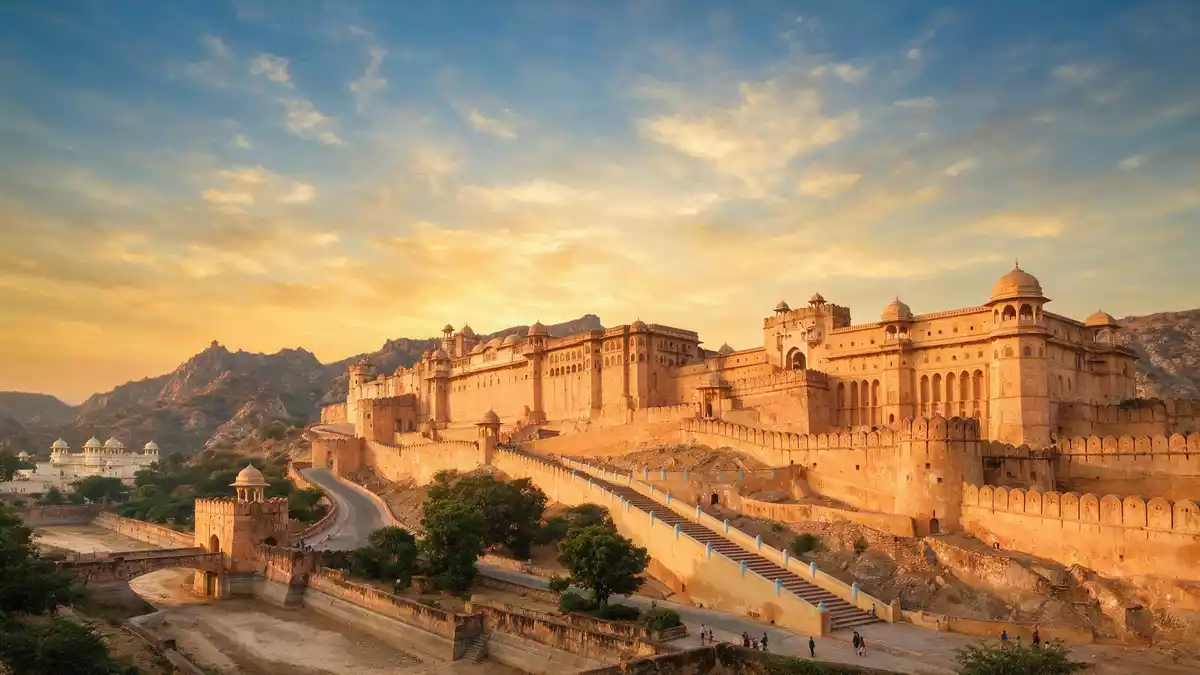
Amer Fort in Jaipur stands on a rocky spur of the Aravalli Hills above Maota Lake, a fortified palace complex built in the late sixteenth century for the Kachhwaha Rajput rulers of Amer. Raja Man Singh I began the major works around 1592, creating a residence whose sandstone and marble courts still show the fusion of Rajput and Mughal styles that defined his reign.
Rajput capital on the Aravalli Hills
Amer lies north-east of Jaipur, in a valley ringed by the Aravalli range, and the fort occupies a hillside position that looks down towards the water of Maota Lake and the settlement below.Amer was the regional capital before the foundation of Jaipur in 1727 shifted political power to a planned city on the plain.Amer Palace remained the royal residence until that transfer.
The fort belongs to the group of “Hill Forts of Rajasthan”, a UNESCO World Heritage inscription recognising a series of Rajput strongholds that combine defensive walls with palatial residences.Amer Fort is part of this hill-fort ensemble, and its ramparts and gateways climb with the contours of the ridge. Standing on the higher terraces, the visitor can see lines of fortification reaching along the hills towards other outworks.
From fortified gateway to mirrored halls
Construction in its present form began under Raja Man Singh I in 1592, and successive rulers such as Jai Singh I and Sawai Jai Singh II extended and refined the complex over roughly two centuries.The fort-palace developed over generations, with ascending courtyards leading from the defensive outer gateways to audience halls and private apartments.
The lower sections are approached through monumental portals leading into open courts where troops and officials would once have assembled, while higher levels contain more intimate spaces, including the famed Sheesh Mahal, whose mirrored surfaces reflect light from lamps and small openings in the stone. Red and pale-yellow sandstone, combined with white marble, give the walls and colonnades their characteristic colouring, and carved details range from floral reliefs to Mughal-style arches.The palace complex mixes sandstone and marble throughout its courtyards and halls.
Rajput–Mughal blend in stone and water
Amer Fort is a key example of Rajput architecture that absorbed Mughal influences during the period when Kachhwaha rulers such as Man Singh I served as generals at the Mughal court of Akbar.Amer Palace shows this Rajput–Mughal fusion in its layout and decorative programme, from pillared audience halls to gardens framed by arcades. Indo-Islamic motifs appear beside elements drawn from Hindu temple architecture, creating an interior world where painted ceilings, inlaid panels and latticed stone screens sit within a defensive shell.
The relationship between the fortress and Maota Lake is central to its setting: the water lies at the base of the hill, with terraced gardens and projecting bastions above, so the fort is reflected in the surface of the lake when conditions are clear.Amer Fort overlooks Maota Lake, and the steep approach from the lakeside reinforces the impression of a palace protected by elevation as much as by walls.
Visiting Amer Fort: what travellers from Western Europe should know
- Amer Fort stands in the suburb of Amer to the north-east of central Jaipur, on a hill above Maota Lake, reached by road from the city’s main districts.
- The fort’s upper levels are linked by stone stairways and slopes between courtyards, and exploring the towers and terraces involves climbing a series of steps on uneven historic surfaces.
- The surroundings include further hilltop fortifications and the Jaigarh Fort on a nearby ridge, which is visually connected to Amer Fort by long defensive walls along the Aravalli Hills.
- The official language is Hindi and the currency is the Indian rupee.
- Entry requirements depend on your nationality; UK travellers can check the FCDO travel advice at gov.uk/foreign-travel-advice, Irish travellers the Department of Foreign Affairs at ireland.ie.
Searching for Amer Fort on social platforms
These links open searches for Amer Fort on each platform.
Frequently asked questions about Amer Fort
Where is Amer Fort and what is its historical role?
Amer Fort stands above the town of Amer near Jaipur in Rajasthan, and it served as the main residence of the Kachhwaha Rajput rulers until the capital moved to Jaipur in 1727.
What can visitors expect inside Amer Fort?
Visitors encounter a sequence of courtyards, audience halls, temples and royal apartments, including the Sheesh Mahal, all built in sandstone and marble with detailed Rajput–Mughal decoration.
What makes Amer Fort distinctive among Rajasthan’s forts?
Amer Fort combines a hilltop defensive position overlooking Maota Lake with an elaborate palace interior, and forms part of the UNESCO-listed Hill Forts of Rajasthan ensemble.


