
Amer Fort, Jaipur’s hilltop palace of sandstone and marble
Published on 09/07/2026 at 17:48 | Editorial responsibility: Rafael Müller, Editor-in-Chief AD HOC NEWS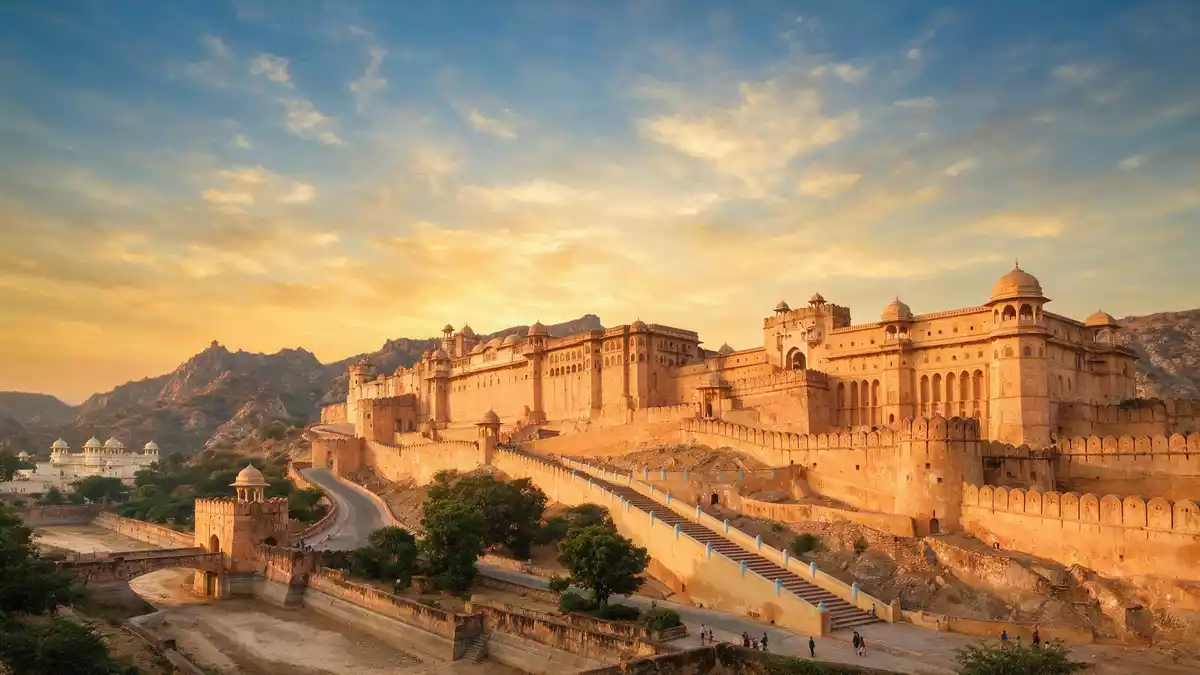
Amer Fort on the outskirts of Jaipur is a former Rajput capital where a hilltop palace of sandstone and marble steps down towards Maota Lake in layered courtyards. Built under Raja Man Singh I in the late sixteenth century and expanded by his successors, the complex blends Rajput and Mughal forms into a single fortified residence that now anchors the historic landscape north-east of the city.
A hill fort above Maota Lake
Amer Fort occupies a ridge in the Aravalli hills, with its walls and terraces running along the slope above the waters of Maota Lake. A sequence of defensive walls links the main palace to outlying structures, forming part of the ensemble recognised as the Hill Forts of Rajasthan on the UNESCO World Heritage List.Hill Forts of Rajasthan UNESCO World Heritage Site The access route rises from the lakeside up towards the fort, with gateways punctuating the climb and framing views back over the water.
The settlement at Amer long predates the palace visible today, and the fort became the seat of the Kachhwaha Rajput rulers when they made Amer their capital before founding Jaipur in the eighteenth century.Amer Palace royal residence Stone ramparts follow the contours of the hill, enclosing a complex that reads from a distance as a continuous mass of pale yellow and pink sandstone, broken by projecting bastions and stepped terraces.
Rajput and Mughal architecture in sandstone and marble
The present form of Amer Fort took shape under Raja Man Singh I, a powerful general in the army of Mughal emperor Akbar, beginning in 1592.built in 1592 by Raja Man Singh I Later rulers such as Jai Singh I and Sawai Jai Singh II added courtyards, halls and gateways, so that the fort now reflects nearly two centuries of Rajput and Mughal-influenced building campaigns.expanded by Jai Singh I and successors Red and pale sandstone combine with white marble in facades that alternate between solid walls and arcaded fronts, giving the palace a layered, almost terraced profile against the hillside.
Inside the outer defences, the palace is organised around courtyards such as Jaleb Chowk and more inward-facing spaces for ceremonial and residential life.Jaleb Chowk main courtyard Public audience halls known as the Diwan-e-Aam stand alongside more intimate areas like the Diwan-e-Khas, while the Sheesh Mahal or mirror palace concentrates glasswork and ornament into a compact, richly decorated chamber. Throughout the fort, arches, columns, latticed screens and frescoed surfaces illustrate the fusion of Hindu and Islamic-influenced design associated with Rajput and Mughal architecture.
From capital residence to heritage landmark
For centuries Amer Fort served as the principal residence and political centre of the Kachhwaha Rajput dynasty before the capital shifted to the planned city of Jaipur under Sawai Jai Singh II in 1727.Amer capital until Jaipur was founded The palace’s layered courtyards include spaces such as Sukh Niwas, associated with royal leisure, and gateways like Ganesh Pol, whose painted surfaces mark the threshold between more public and more private areas within the complex.Ganesh Pol and Sukh Niwas Temples stand within the fort, underscoring its role not only as a military stronghold but as a palace and ritual centre.
Recognition of Amer Fort within the UNESCO Hill Forts of Rajasthan inscription emphasises its significance as an example of Rajput military architecture combined with elaborate palace planning.Rajput and Mughal architectural blend Restoration work has stabilised many of the stone structures and decorative surfaces, allowing the sequence of courtyards, halls and terraces to be read as a continuous ensemble that reflects the ambitions of successive rulers between the sixteenth and eighteenth centuries.
Visiting Amer Fort: what travellers from Western Europe should know
- Amer Fort stands about north-east of central Jaipur, on a hill above Maota Lake, and is reached by road through the suburb of Amer.
- The approach from the base of the hill involves an ascent on foot or by vehicle over stone paths and ramps, with gateways and staircases inside the fort itself.
- The fort lies in a semi-arid landscape; in the hot season the stone terraces and courtyards can feel exposed, while the enclosed halls provide more sheltered spaces.
- The official language is Hindi and the currency is the Indian rupee.
- Entry requirements depend on your nationality; UK travellers can check the FCDO travel advice at gov.uk/foreign-travel-advice, Irish travellers the Department of Foreign Affairs at ireland.ie.
Searching for Amer Fort on social platforms
These links open searches for Amer Fort on each platform.
Frequently asked questions about Amer Fort
Where is Amer Fort located?
Amer Fort stands on a hill above Maota Lake in the settlement of Amer, north-east of central Jaipur in the Indian state of Rajasthan.
What should visitors expect inside Amer Fort?
Visitors encounter a sequence of courtyards, audience halls, temples and residential chambers built in sandstone and marble, many with intricate arches, frescoes, mirrorwork and latticed screens.
What makes Amer Fort distinctive among Rajasthan’s forts?
Amer Fort combines a hilltop defensive setting with an elaborately planned palace complex, blending Rajput and Mughal architectural elements and forming part of the Hill Forts of Rajasthan UNESCO World Heritage Site.


