Amer Fort above Maota Lake: Jaipur’s hilltop palace fortress
Published on 09/14/2026 at 16:35 | Editorial responsibility: Rafael Müller, Editor-in-Chief AD HOC NEWS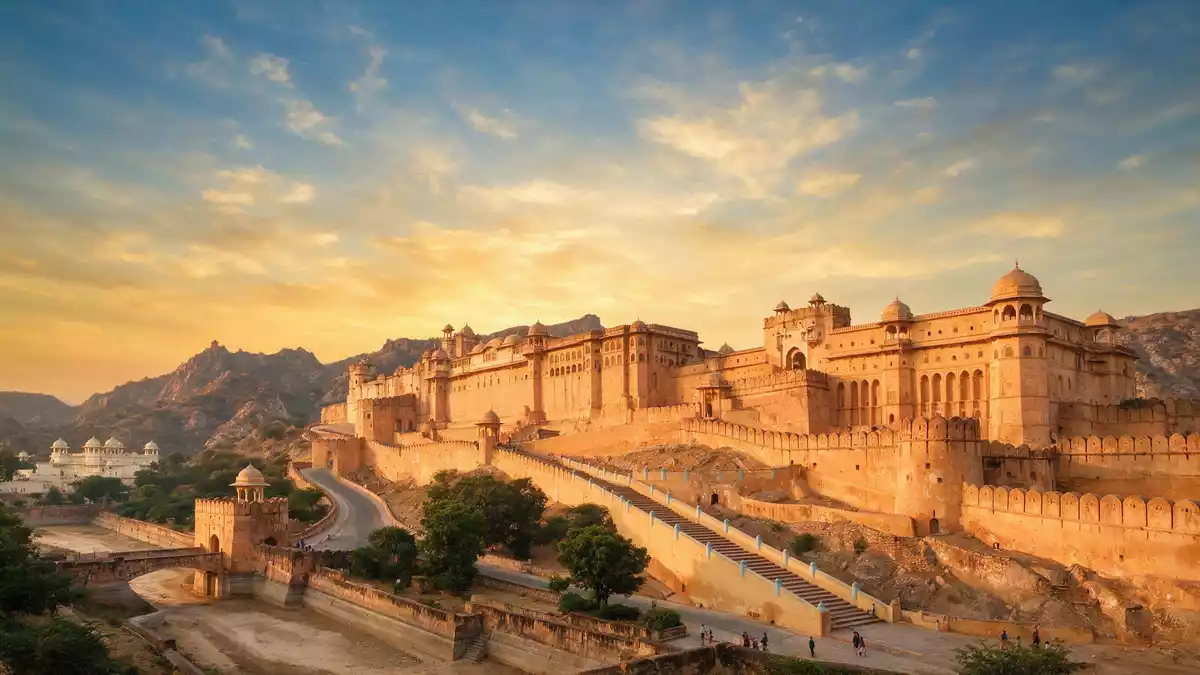
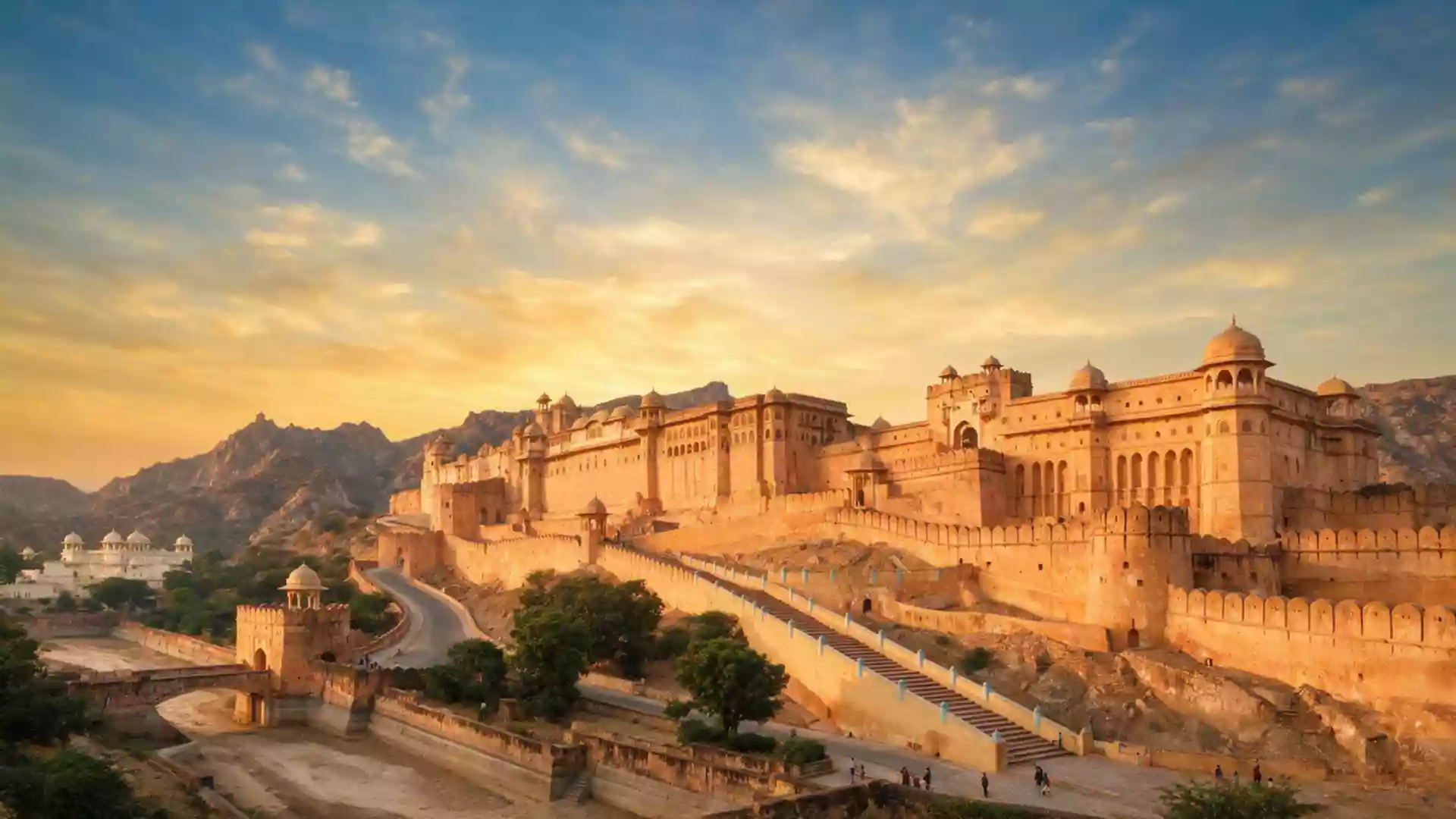
Amer Fort on the outskirts of Jaipur is a hilltop palace fortress that looks over Maota Lake and the old town of Amer, bringing Rajput military strength together with Mughal-influenced luxury in one sprawling complex. Built from the late sixteenth century onward under Kachwaha Rajput rulers, beginning with Raja Man Singh I, it became the principal seat of power before Sawai Jai Singh II founded Jaipur in 1727.
A hill fort that once ruled before Jaipur
Amer Fort occupies a ridge above the historic settlement of Amer, a town that served as the capital of the Kachwaha Rajput dynasty for centuries before the creation of Jaipur city in the eighteenth centurycapital of the state before Jaipur. The palace fortress forms part of a wider defensive landscape that includes Jaigarh Fort on the heights behind, linked to Amer by passages and walls in stone.
The fort that visitors recognise today began under Raja Man Singh I around 1592, a Kachwaha ruler who also served as a commander in the Mughal armybuilt in 1592 by Raja Man Singh I. Later generations, especially Mirza Raja Jai Singh I in the seventeenth century, enlarged and remodelled the palaces and courts so that the complex developed over the late sixteenth to early eighteenth centurieslate 16th–18th century. When Sawai Jai Singh II laid out planned Jaipur in 1727 and shifted the capital, Amer Fort ceased to be an administrative centre but retained its role as a ceremonial seat set high above the surrounding hills.
Rajput and Mughal architecture in sandstone and marble
Architecturally, Amer Fort is known for its fusion of Rajput and Mughal styles: robust ramparts and gateways frame courtyards lined with pillared halls, delicate jali screens and painted chambersRajput architecture with Mughal influence. The complex uses red and pale sandstone alongside white marble, giving facades a warm, variegated surface that catches the Rajasthani lightconstructed using red, cream, and white sandstone.
The palace is organised around a sequence of courts, each with its own role in the life of the Rajput courtfour main sections with courtyards. The first forecourt, Jaleb Chowk, functioned as a gathering space for troops and processions. Deeper inside, the Diwan-i-Aam, or Hall of Public Audience, stands on pillars with arches facing an inner courtyard, while more private apartments and gardens lie beyond. One of the most celebrated interiors is the Sheesh Mahal, the mirror palace where walls and vaults are covered with tiny mirror pieces and painted motifs, arranged to multiply and fragment light within a relatively compact chamberSheesh Mahal (Mirror Palace).
Maota Lake, gardens and the UNESCO hill forts
Below the fort, Maota Lake forms a broad basin at the foot of the hill and supplied water to the palace complex and its gardensMaota Lake as water source. From the ramparts and terraces, the view takes in the lake and its stepped edges, with geometric garden layouts on the islands, including the Kesar Kyari garden where planting beds form patterned shapes against the water surfaceKesar Kyari garden in Maota Lake. The structural relationship between lake, hill and fort makes Amer a clear example of a hill palace integrated with its landscape.
Amer Fort stands among six major hill forts of Rajasthan inscribed together on the UNESCO World Heritage List in 2013 as “Hill Forts of Rajasthan”Hill Forts of Rajasthan World Heritage Site. The series includes Chittorgarh, Kumbhalgarh, Ranthambore, Gagron and Jaisalmer in addition to Amersix hill forts including Amer Fort. In the UNESCO documentation, Amber Palace is highlighted as representative of a seventeenth-century phase in Rajput–Mughal court style, embodied in its buildings and gardens above Maota Lakekey phase in Rajput-Mughal court style.
Visiting Amer Fort: what travellers from Western Europe should know
- Amer Fort lies north-east of central Jaipur in Rajasthan, on a hill above the town of Amer and overlooking Maota Lake; it is reached by road from the city and stands close to the Jaipur–Delhi highway.
- The approach to the fort involves an ascent on foot or by vehicle up the hillside, with cobbled paths and ramped sections within the complex, and staircases connecting the courtyards and upper terraces.
- The surrounding area includes Jaigarh Fort higher on the ridge, visible from many points within Amer Fort, and views extend across the Aravalli hills and the plains around Jaipur.
- India’s official language at federal level is Hindi and the national currency is the Indian rupee.
- Entry requirements depend on your nationality; UK travellers can check the FCDO travel advice at gov.uk/foreign-travel-advice, Irish travellers the Department of Foreign Affairs at ireland.ie.
Searching for Amer Fort on social platforms
These links open searches for Amer Fort on each platform.
Frequently asked questions about Amer Fort
Where is Amer Fort and what kind of place is it?
Amer Fort is a hilltop palace fortress above the town of Amer north-east of Jaipur, in the Indian state of Rajasthan, overlooking Maota Lake.
What should a visitor expect on a visit to Amer Fort?
A visitor encounters stone ramparts, gateways, cobbled paths and staircases leading through successive courtyards, audience halls and richly decorated palace chambers with mirror work and painted surfaces.
What makes Amer Fort distinctive among Rajasthan’s forts?
Amer Fort stands out for the way its Rajput hill-fort setting combines with Mughal-influenced palace architecture, water-focused planning around Maota Lake and its recognised role in the UNESCO Hill Forts of Rajasthan series.