
Amboseli National Park and the elephants under Kilimanjaro
Published on 08/21/2026 at 20:03 | Editorial responsibility: Rafael Müller, Editor-in-Chief AD HOC NEWS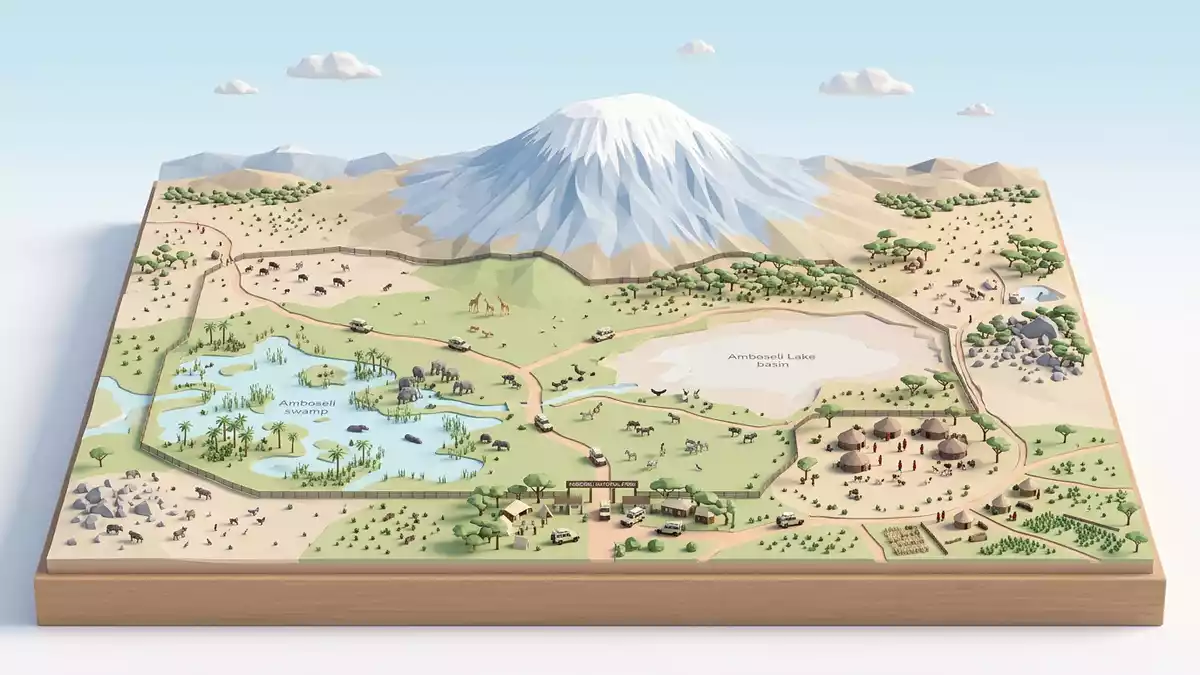
Amboseli National Park in southern Kenya is a landscape where free-roaming elephants, seasonal plains and the distant bulk of Mount Kilimanjaro share the same wide horizon. Established as a national park in 1974 and recognised as a UNESCO Man and the Biosphere Reserve in 1991, it condenses an unusually varied savannah ecosystem into a relatively compact protected area in Kajiado County.
An elephant landscape framed by Kilimanjaro
Amboseli National Park lies in Kenya’s Kajiado County, close to the border with Tanzania, immediately north-west of Mount Kilimanjaro, which rises over the plains as a constant backdrop when the air is clear.lies immediately north-west of Mount Kilimanjaro The protected core covers around 392 km² (151 sq mi) of semi-arid lowland, sitting roughly between 1,180 and 1,240 m (3,870–4,070 ft) above sea level, and forms the centre of a much larger wildlife ecosystem that extends across the Kenya–Tanzania frontier.392 km² semi-arid lowland
The park is known for its elephant herds, which move across open grassland, swamps and the dry lakebed of Lake Amboseli in search of water and grazing. The Amboseli Elephant Research Project, based within the ecosystem and running since 1972, has made these elephants among the most closely studied on the continent, turning the area into a long-term field laboratory for behaviour and conservation.Amboseli Elephant Research Project since 1972 Alongside elephants, visitors encounter lions, cheetahs, Maasai giraffes, buffalo and a wide range of antelope species moving between the different habitats that cluster around the central basin.variety of wildlife inhabits the park
From game reserve to biosphere reserve
Amboseli began the twentieth century as part of a wider Southern Game Reserve founded in 1906, reflecting early efforts to regulate hunting and protect wildlife in British East Africa.part of Southern Game Reserve founded in 1906 It was later formalised as the Maasai Amboseli Game Reserve in 1948, a designation that covered a much larger area than today’s park and acknowledged the presence of Maasai pastoral communities whose cattle graze the surrounding rangelands.established as a game reserve in 1948 In October 1973, a smaller portion centred on Lake Amboseli was set aside as a national park, and the gazettement took effect in 1974 under Kenya’s National Parks Trustees, giving the area a more tightly defined conservation status.gazetted as National Park in 1974
The park sits at the heart of the Amboseli Biosphere Reserve, one of Kenya’s sites under UNESCO’s Man and the Biosphere Programme, nominated in 1991.biosphere reserve nominated in 1991 The biosphere reserve concept reflects the mosaic of ecological zones in and around the national park: dry mountain forest on Kilimanjaro’s flanks, savannah rangelands, permanent wetlands fed by groundwater and the swamps that line the park’s interior. These overlapping zones support elephants, lions, giraffes and many other species, and they also leave room for Maasai pastoral activity in the wider buffer areas beyond the strictly protected core.core of an 8,000 km² ecosystem
Swamps, dry lakebed and open plains
At the centre of Amboseli National Park lies the usually dry basin of Lake Amboseli, floored with alkaline soils that turn to pale dust when the surface is exposed.centred on Lake Amboseli Around this basin, three main habitats dominate: open plains, thornbush country and acacia woodland, interspersed with swamps fed by underground water that has travelled down from Kilimanjaro’s higher slopes.open grassland, swamps and lakebed During dry spells, wildlife congregates around these permanent wetlands, where hippos wallow, buffalo and wildebeest graze, and waterbirds share the margins with wading elephants.
The wider park falls into several distinct wildlife habitats, including grassland savannah, swamps and marshes, woodlands and the lake basin itself, giving a visitor moving across the park the sense of travelling between linked but contrasting zones.distinct habitats: savannah, woodland, wetlands Birdlife is correspondingly rich, with several hundred species recorded, from flamingos and herons on the wetter margins to raptors, hornbills and weavers in drier areas.haven for bird enthusiasts Across these habitats, the open views to Kilimanjaro give the park its defining visual character: elephant families moving through reeds and grass with the mountain’s outline rising above them.
Visiting Amboseli National Park: what travellers from Western Europe should know
- Amboseli National Park lies in southern Kenya’s Kajiado County, close to the border with Tanzania and at the northern foot of Mount Kilimanjaro; access is by road from Nairobi and by light aircraft using the Kimana airstrip near the park.
The main approach routes converge on several park gates, including Iremito, Kimana and Meshanani, which mark entry points into the protected area. - The terrain inside the park is largely flat but open, with tracks crossing dry plains, skirting swamps and passing the alkaline basin of Lake Amboseli, so visitors spend long periods exposed to sun and dust.
Elevations around 1,200 m (about 4,000 ft) above sea level and occasional soft surfaces on the lakebed make sturdy footwear and sun protection important on any time spent outside vehicles. - Amboseli sits in a semi-arid region with two contrasting seasons, one characterised by rainfall that refreshes the wetlands and one drier period when vegetation thins and wildlife concentrates more strongly around permanent water.
These shifts between wet and dry phases shape the appearance of the plains and the density of animals close to the swamps. - The official language in Kenya is English and the currency is the Kenyan shilling.
- Entry requirements depend on your nationality; UK travellers can check the FCDO travel advice at gov.uk/foreign-travel-advice, Irish travellers the Department of Foreign Affairs at ireland.ie.
Searching for Amboseli National Park on social platforms
These links open searches for Amboseli National Park on each platform.
Frequently asked questions about Amboseli National Park
Where is Amboseli National Park?
Amboseli National Park is in southern Kenya’s Kajiado County, near the Kenya–Tanzania border, immediately north-west of Mount Kilimanjaro and centred on Lake Amboseli.
What should visitors expect on a visit to Amboseli?
Visitors encounter open plains, swamps and a dry lakebed supporting elephants, large mammals and abundant birdlife, all set against views towards Mount Kilimanjaro when conditions are clear.
What makes Amboseli National Park distinctive among Kenyan parks?
Amboseli combines long-studied elephant herds, groundwater-fed swamps and the silhouette of Africa’s highest mountain in a relatively compact protected area that forms the core of a wider transboundary ecosystem.


