
Amboseli National Park and its ring of water and dust
Published on 09/22/2026 at 01:24 | Editorial responsibility: Rafael Müller, Editor-in-Chief AD HOC NEWS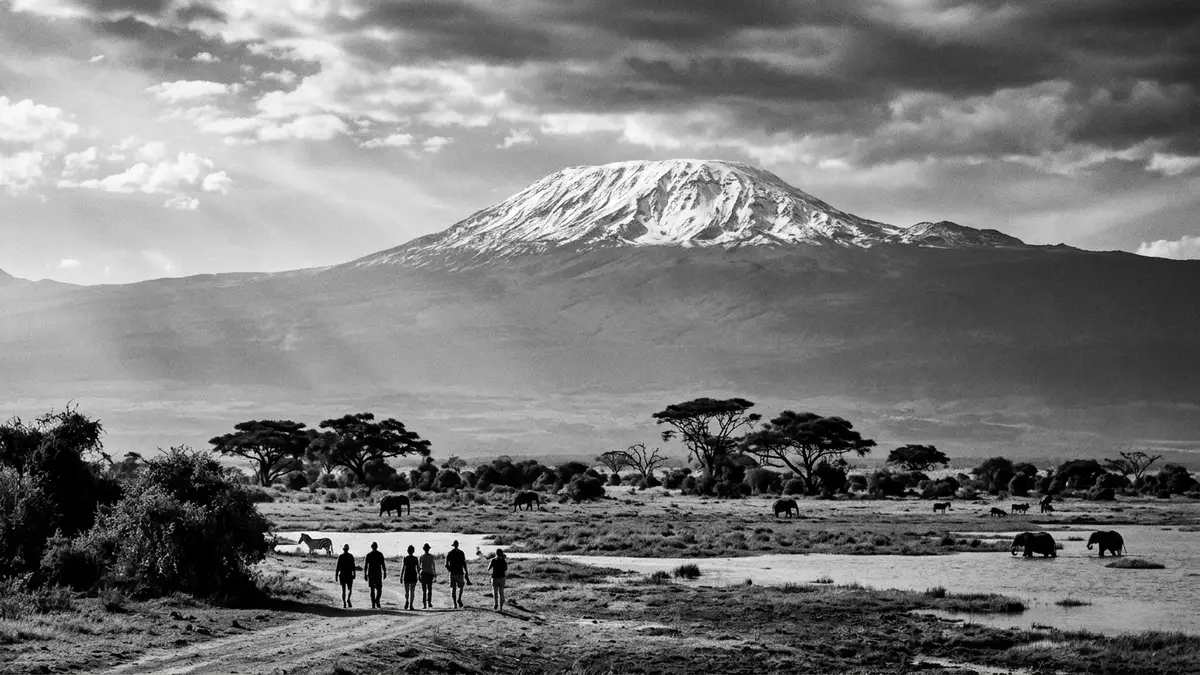
Amboseli National Park is a semi-arid basin in southern Kenya, near the Tanzania border, with Mount Kilimanjaro rising beyond it. Its most striking feature is the contrast between pale lakebed dust and green wetland ground.
Lakebed, swamps and savanna in one view
The park includes the dried-up bed of Lake Amboseli, wetlands with sulphur springs, savanna and woodlands. That mix gives the landscape a clear visual rhythm: open plains, water edges and scattered trees in close succession.
The park covers 39,206 ha and sits at the core of an 8,000 km2 ecosystem that reaches across the Kenya-Tanzania border. Kajiado County is the recorded region, and the park’s coordinates place it in the country’s south-western corner.
Kilimanjaro, elephants and long study
Amboseli is closely associated with Mount Kilimanjaro, which stands across the border in Tanzania and shapes the park’s skyline. Its open ground makes elephant herds easy to see against that mountain backdrop.
The Amboseli Elephant Research Project began in 1972, and the park has become a major place for long-term study of free-ranging elephants. That research history gives the park a strong identity beyond scenery alone.
A protected core inside a wider landscape
Amboseli was declared a UNESCO-Mab Biosphere Reserve in 1991, and it later appeared on Kenya’s World Heritage Tentative List in 2023. Those designations reflect a landscape that combines wildlife habitat, pastoral land use and cross-border ecological connections.
The park is part of a wider system that also includes group ranches and dispersal areas. In Amboseli, the boundary matters, but the surrounding basin matters too.
Visiting Amboseli National Park: what travellers from Western Europe should know
- The park lies in Kajiado County in southern Kenya, near the Tanzania border. It is reached by road from the Nairobi side and by air through the park airstrip.
- The ground is open and exposed, with flat plains, swamp edges and dusty lakebed surfaces. Kilimanjaro sits beyond the park rather than inside it.
- Amboseli spans a dry basin with permanent wetland pockets. That contrast shapes the landscape and the wildlife concentrations seen there.
- The official language is English and the currency is the Kenyan shilling.
Searching for Amboseli National Park on social platforms
These links open searches for Amboseli National Park on each platform.
Frequently asked questions about Amboseli National Park
Where is Amboseli National Park?
It lies in Kajiado County in southern Kenya, close to the Tanzania border. Mount Kilimanjaro rises across that border and forms the park’s best-known distant landmark.
What should a visit feel like?
Expect an open, largely flat landscape with swamps, woodland patches and broad dust plains. The park reads as a landscape of water and dry ground rather than dense cover.
What makes Amboseli National Park distinctive?
Its defining combination is the elephant landscape, the wetland core and the Kilimanjaro skyline. The park’s long elephant research history adds another layer to that identity.


