
Altstadt Bern, a medieval city on a loop of the Aare
Published on 08/27/2026 at 06:56 | Editorial responsibility: Rafael Müller, Editor-in-Chief AD HOC NEWS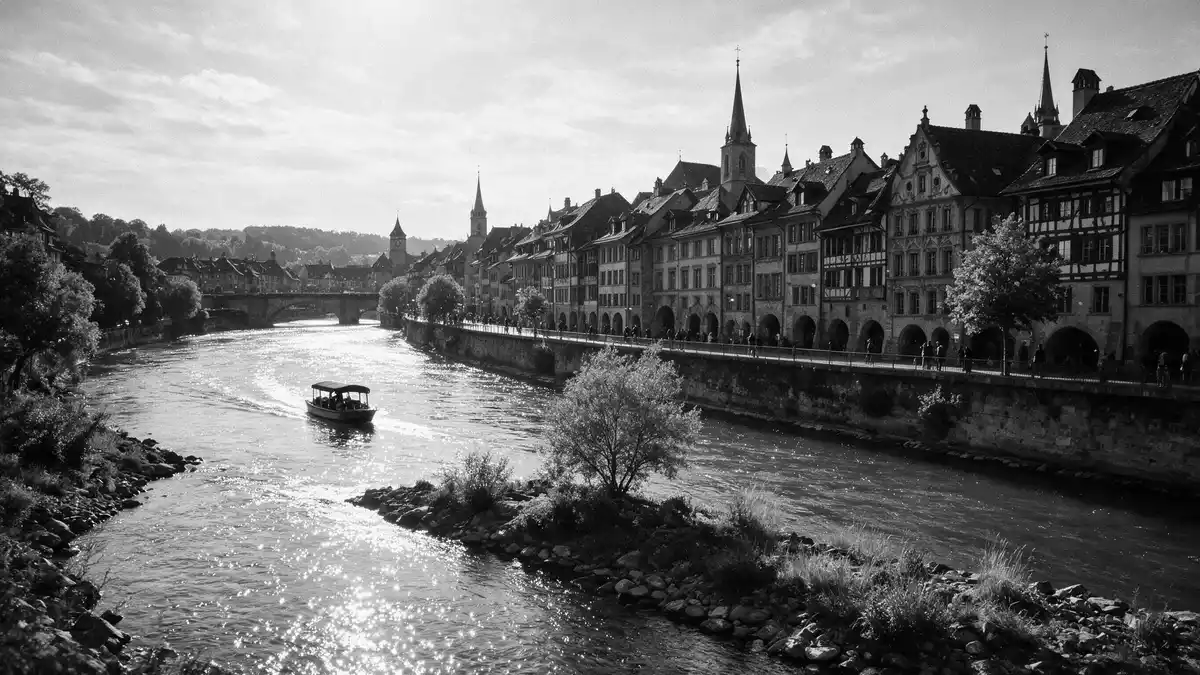
Altstadt Bern is the medieval core of Bern, laid out on a narrow hill encircled on three sides by the River Aare, with streets and façades that still follow their original plan from the twelfth century.Founded in the 12th century on a hill site surrounded by the Aare River gives the old town its distinctive peninsula form.
Sandstone streets on a medieval ridge
The defining experience of Altstadt Bern is the walk along its long east–west spine, where cobbled streets run atop the sandstone ridge and arcades frame almost every shopfront.Six kilometres of covered arcades line these streets, creating one of the longest continuous shopping promenades sheltered from the weather in Europe.Impressive sandstone buildings, clock towers, churches and arcades give the Altstadt a consistent material palette in warm grey and beige stone.
Founded in 1191 by Berthold V of Zähringen, the old town grew in stages but kept a compact street layout between the twelfth and fifteenth centuries, and later restorations in the eighteenth century retained that underlying plan.The old city was founded in 1191 by Berthold V of Zähringer on a peninsula on a loop within the River Aare established Bern as a planned city rather than a place that grew haphazardly from a market village.Its compact layout has remained essentially unchanged since its construction during the twelfth to the fifteenth century is still evident in the straight runs of Marktgasse, Kramgasse and Gerechtigkeitsgasse.
Fountains, towers and the UNESCO World Heritage label
Altstadt Bern’s streets are punctuated by an extraordinary collection of early-modern fountains, many dating from the sixteenth century and topped with colourful allegorical figures that mark junctions and squares.Buildings in the Old City include 15th?century arcades and 16th?century fountains contribute to the sense of a townscape where decorative stonework is part of everyday infrastructure rather than confined to monuments.
The old town’s skyline is dominated by Bern Minster, a late Gothic cathedral whose tower rises to about 100 m (328 ft) and looks out across the whole loop of the Aare.The city's Cathedral is 100 metres tall makes this tower one of the most prominent vertical accents in a city otherwise defined by four? and five?storey sandstone façades.Der Zeitglockenturm, der Zytglogge, hat seit der Stadtgründung einen hohen Stellenwert marks the transition between the lower and upper parts of the Altstadt and remains a clock tower with an ornate astronomical dial and mechanical figures.
Altstadt Bern has been recognised as a UNESCO World Heritage Cultural Site since 1983, a status that underscores how intact its medieval core is despite later adaptations for government, commerce and transport.Bern’s Old City has been a UNESCO World Heritage site since 1983 situates it among a small number of Swiss sites on the World Heritage List.Altstadt (Old City) is the medieval centre of Bern, the capital of Switzerland, and a UNESCO World Heritage Site emphasises that the federal, cantonal and municipal seats of government sit within this historic core rather than in a separate modern district.
Layers within the lower and upper Altstadt
Altstadt Bern is often described in two sectors that share the same ridge yet differ in how they are protected: the lower Altstadt stretches from the riverside Matte neighbourhood up to the Zytglogge, while the upper Altstadt continues from that clock tower towards Bollwerk–Hirschengraben.The lower part of the Old City comprises the area from the Matte neighbourhood to the Zytglogge; the upper part lies between the Zytglogge and Bollwerk?Hirschengraben reflects distinct conservation rules, with the lower section protected as a whole and the upper treated building by building.
Walking these streets reveals how the medieval plan accommodates tram tracks, shops and government buildings without losing its underlying structure of long terraces broken by transverse lanes that drop towards the river.Alleys and six kilometres of arcades form one of the longest covered shopping promenades of Europe show how the arcades integrate commercial life into the historic façades.
Visiting Altstadt Bern: what travellers from Western Europe should know
- Altstadt Bern occupies the old city peninsula of Bern in Switzerland, enclosed by a sweeping loop of the River Aare and reached easily on foot from Bern’s main railway station.
- The terrain rises from riverside neighbourhoods up to the ridge streets, with cobbled surfaces, stepped lanes and some narrow passageways between sandstone buildings.
- The old town streets carry tram lines and road traffic, but much of the central area is structured around pedestrian routes beneath the arcades.
- The official language is German and the currency is the Swiss franc.
Searching for Altstadt Bern on social platforms
These links open searches for Altstadt Bern on each platform.Frequently asked questions about Altstadt Bern
Where is Altstadt Bern located?
Altstadt Bern forms the historic centre of Bern, on a hill almost entirely surrounded by the River Aare in western Switzerland.
What should visitors expect on a visit to Altstadt Bern?
Visitors encounter long arcaded streets, sandstone façades, historic fountains, towers such as the Zytglogge, and views down to the river from terraces and lanes.
What makes Altstadt Bern distinctive among European old towns?
Its medieval street plan has remained largely intact, with extensive covered arcades and a World Heritage designation that protects both lower and upper sections of the old town.


