
Alishan Senlin Tie Lu climbs through Taiwan’s mountain forests
Published on 09/22/2026 at 13:18 | Editorial responsibility: Rafael Müller, Editor-in-Chief AD HOC NEWS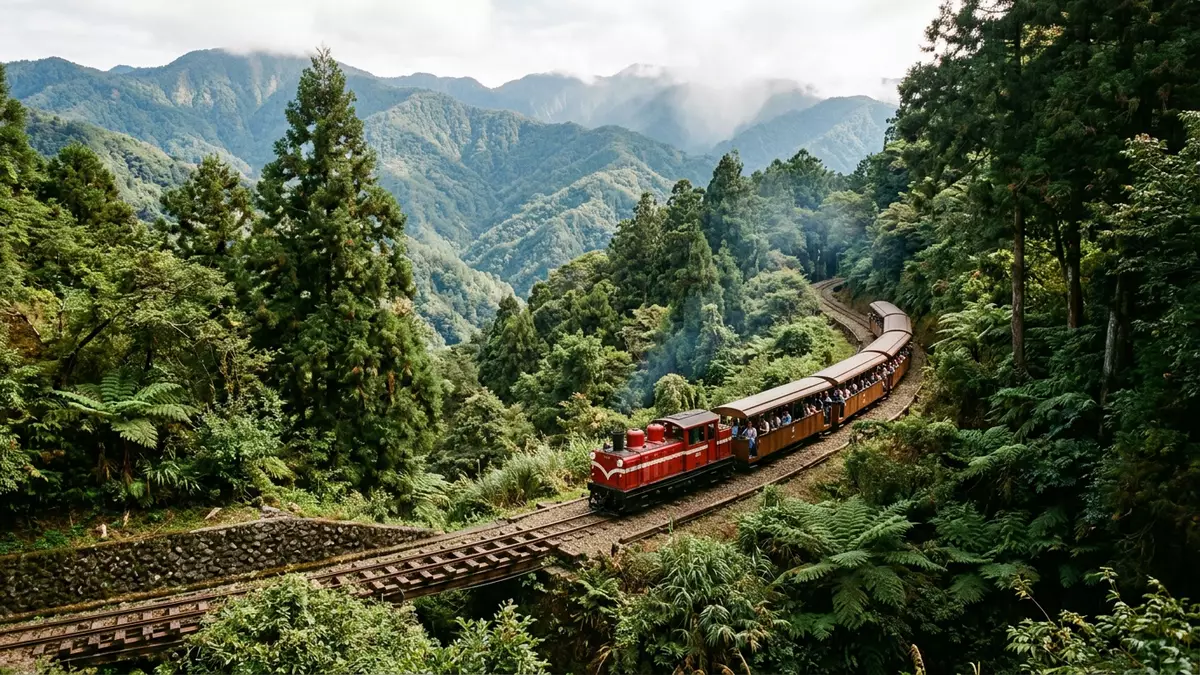
Alishan Senlin Tie Lu is a narrow-gauge mountain railway rising from Chiayi into Taiwan’s Alishan Range. Its route combines tropical, subtropical and temperate forest zones with spirals, horseshoe curves, U-turns and zigzags.
Construction began in 1906, and the first section entered service in 1912. The railway’s changing use, distinctive locomotives and steep mountain route connect Chiayi’s industrial history with the forests above it.
Alishan Senlin Tie Lu and the climb from Chiayi
The railway extends for about 71.34 km through Chiayi City, Chiayi County and Nantou County. Its main route begins in Chiayi and reaches the Alishan mountain region through settlements and stations including Beimen, Zhuqi, Fenqihu, Erwanping, Shenmu and Zhaoping. the railway’s 71.34 km route is part of a wider cultural landscape covering railway infrastructure, mountain forests and settlements.
The line uses a 762 mm gauge and climbs from the lowlands towards elevations above 2,000 metres. Its route belongs to the Alishan Range, within the wider Yushan Range, where sandstone and siltstone formations shape cliffs, slopes and waterfalls.
At lower elevations, the railway passes through vegetation associated with tropical forests. Higher sections include camphor, Japanese oak, Taiwania fir and Japanese red cedar. The upper mountain environment contains cypress, Taiwania fir, Chinese hemlock and Chinese white pine.
Spirals, switchbacks and Shay locomotives
The railway’s most recognisable features are visible in its track geometry. Horseshoe curves turn through 180 degrees, while spiral sections wind around the mountain before returning towards the next part of the ascent.
Between Pingzhena and Zhaoping, sections of track use zigzags. The train reverses direction on alternating stretches, creating a gradual climb across steep terrain. These alignments form part of the railway’s engineering identity rather than decorative additions.
Shay steam locomotives were used on the original railway. Their geared transmission and upright cylinders suited the steep gradients and uneven mountain route. Several historic locomotives connected with the line have been preserved and restored.
The railway’s combination of narrow gauge, non-rack operation and mountain engineering gives it a clear place in the history of industrial railways. Its technology belongs to the period when forestry railways carried timber from remote mountain areas to processing towns.
From timber railway to cultural landscape
Japanese authorities developed the railway during the period of Japanese rule in Taiwan. Construction started in 1906, and the first section between Chiayi and Erwanping began operating in 1912. The line reached Zhaoping by 1914.
Its early work centred on timber transport from the Alishan forests. Logs moved downhill towards Chiayi, where forestry, sawmilling, commerce and related trades shaped the city’s development. The Chiayi Sawmill, completed in 1914, became part of that industrial landscape.
Forestry policy and road transport changed the railway’s role during the twentieth century. Passenger travel became increasingly important, while the line’s historic railway structures, stations, locomotives and surrounding settlements acquired cultural significance.
In 2019, the railway and associated forestry heritage received national-level cultural landscape status in Taiwan. It also appears on Taiwan’s tentative list for possible UNESCO World Heritage consideration. the 1912 railway opening and its extension to Zhaoping in 1914 mark the key stages of its original development.
The cultural landscape includes more than a train journey. Chiayi’s railway buildings, former industrial areas, mountain stations, forests and historic transport routes form connected parts of the same story.
Visiting Alishan Senlin Tie Lu: what travellers from Western Europe should know
- Alishan Senlin Tie Lu begins in Chiayi City, where Chiayi Station connects with Taiwan’s main railway network. The route continues through Chiayi County towards Alishan.
- The railway climbs through changing elevations and forest zones. Spirals, 180-degree horseshoe curves and reversing zigzags are permanent features of the route.
- Chiayi lies near the western lowlands, while Alishan’s mountain stations stand above 2,000 metres. The journey therefore crosses markedly different landscapes.
- The official language is Mandarin Chinese and the currency is the New Taiwan dollar.
- Entry requirements depend on your nationality; UK travellers can check the FCDO travel advice at gov.uk/foreign-travel-advice, Irish travellers the Department of Foreign Affairs at ireland.ie.
Searching for Alishan Senlin Tie Lu on social platforms
These links open searches for Alishan Senlin Tie Lu on each platform.
Frequently asked questions about Alishan Senlin Tie Lu
Where is Alishan Senlin Tie Lu?
The railway begins in Chiayi City in western Taiwan and continues through Chiayi County towards the Alishan Range. Its route also extends into Nantou County.
What can travellers expect from the railway?
The railway passes through changing forest zones and uses spirals, horseshoe curves, U-turns and reversing zigzags. Historic stations and mountain settlements form part of the wider route.
What makes Alishan Senlin Tie Lu distinctive?
Its identity comes from the combination of a 762 mm narrow gauge, steep mountain gradients, forest-railway history and preserved Shay locomotive technology.


