
Alishan Senlin Tie Lu and the mountain railway to the clouds
Published on 08/22/2026 at 08:24 | Editorial responsibility: Rafael Müller, Editor-in-Chief AD HOC NEWS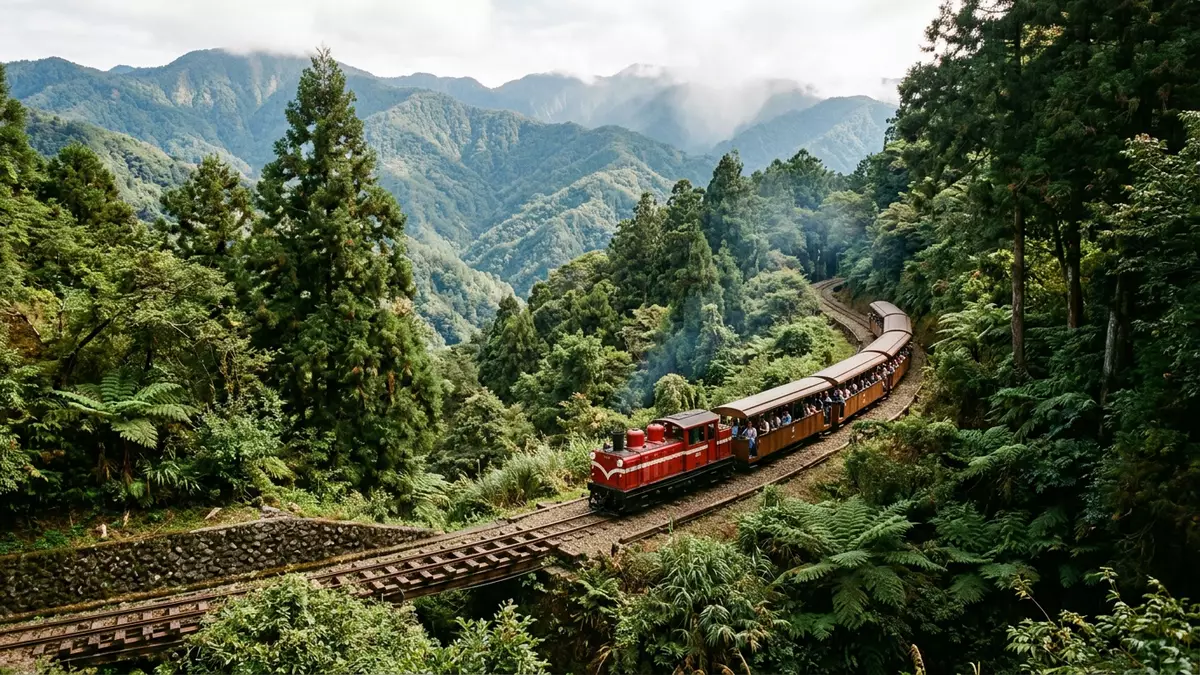
Alishan Senlin Tie Lu is the Mandarin name of the Alishan Forest Railway, a narrow-gauge mountain line that winds from Chiayi into the high forests of central Taiwan. Opened in the early twentieth century and later adapted from logging to passenger use, it links the lowland city at around 30 m (98 ft) above sea level with stations in the Alishan highlands above 2,000 m (6,562 ft), making the railway itself the way many travellers experience the region’s striking change in altitude, climate and landscape.from Chiayi to Alishan
A century-old climb from Chiayi into the Alishan highlands
The Alishan Senlin Tie Lu main line begins at Chiayi Station, where it connects with the Western Line of Taiwan Railways Administration, and heads south-east towards the mountains.Chiayi Station Construction of the railway began under Japanese colonial administration in the first decade of the twentieth century, with the initial section between Chiayi and Erwanping opening in 1912 and the extension into the Alishan area completed in 1914.operations in 1912 and 1914 The line was originally laid as an industrial railway for timber extraction, reflecting the importance of the Alishan forests in that period.
The main line runs on a narrow gauge of 762 mm and climbs from around 30 m (98 ft) above sea level near Chiayi to roughly 2,216 m (7,270 ft) at Alishan Station within the Alishan National Forest Recreation Area.from 30 m to 2,216 m Over this ascent the railway covers approximately 71 km (44 mi) of track on the main line, passing through dozens of tunnels and bridges and crossing different climate zones from subtropical lowlands to temperate montane forest.length and elevation gain
Engineering on a steep, forested mountain line
Alishan Senlin Tie Lu follows a route that combines relatively flat foothills with steep mountain slopes, requiring a series of curves, gradients and switchbacks to gain height. The line negotiates a maximum gradient of around 6.25% and uses tight turning radii to thread its way among ridges and valleys, a layout that creates extended sections of slow climbing through forest.gradient and radius The narrow-gauge track and relatively small rolling stock suit the sharp curves and varied alignment.
Along the way the railway crosses a substantial number of tunnels and bridges, reflecting the broken terrain between Chiayi and Alishan. Figures published for the main line give 47 tunnels and 72 bridges on the historical alignment between Chiayi and Alishan, illustrating the density of engineering structures behind what appears, from inside the carriage, as a continuous run through trees and cuttings.tunnels and bridges Certain sections, such as the corkscrew around Mt Duli, are noted for the way the track loops to gain altitude in a confined space, a pattern that becomes visible when tracing the line on a map.
From logging railway to heritage travel route
When Alishan Senlin Tie Lu opened in the early twentieth century it served primarily as a logging line, moving timber from the Alishan forests down to Chiayi for further transport and processing.logging operations As logging declined and conservation focus increased, its function shifted towards passenger services, carrying visitors into the Alishan National Forest Recreation Area to experience high-altitude woodland, sunrise viewpoints and forest trails, while the railway itself became part of the attraction.National Forest Recreation Area
Over time the system has come to be recognised as a cultural landscape and heritage railway, with the Alishan Forest Railway and its surrounding environment formally listed as a cultural landscape within Taiwan’s heritage framework.cultural landscape designation Branch lines from Alishan Station lead to places such as Zhushan, extending the reach of the trains further into the mountain area and connecting with trails and viewpoints, while the main line retains its role as the core link from Chiayi up into the recreation zone.Zhushan and Mianyue lines
Visiting Alishan Senlin Tie Lu: what travellers from Western Europe should know
- Alishan Senlin Tie Lu’s main line begins at Chiayi Station in Chiayi City, connecting with conventional Taiwan Railways services before continuing towards Beimen, Fenqihu and the high stations in the Alishan National Forest Recreation Area.
- The railway climbs from low elevation at Chiayi to over 2,000 m (6,562 ft) in the Alishan area, so a journey involves extended periods on a mountain line with gradients, curves, tunnels and bridges rather than short urban sections.
- The official language is Mandarin Chinese and the currency is the New Taiwan dollar.
- Entry requirements depend on your nationality; UK travellers can check the FCDO travel advice at gov.uk/foreign-travel-advice, Irish travellers the Department of Foreign Affairs at ireland.ie.
Searching for Alishan Senlin Tie Lu on social platforms
These links open searches for Alishan Senlin Tie Lu on each platform.
Frequently asked questions about Alishan Senlin Tie Lu
Where is Alishan Senlin Tie Lu located?
Alishan Senlin Tie Lu is the Alishan Forest Railway in Chiayi County, Taiwan, with its main line starting at Chiayi Station and running into the Alishan National Forest Recreation Area.
What can travellers expect on a journey along the line?
A journey on Alishan Senlin Tie Lu involves travelling by narrow-gauge train from lowland city streets into high mountain forest, passing tunnels, bridges and changing vegetation zones as altitude increases.
What makes Alishan Senlin Tie Lu distinctive among railway journeys?
The line combines early twentieth-century engineering, a climb of over 2,000 m (6,562 ft) from Chiayi to the Alishan area and recognition as a cultural landscape, turning an historic logging railway into a notable mountain route.


