
Alhambra, the hilltop palatine city of Granada
Published on 09/17/2026 at 19:15 | Editorial responsibility: Rafael Müller, Editor-in-Chief AD HOC NEWS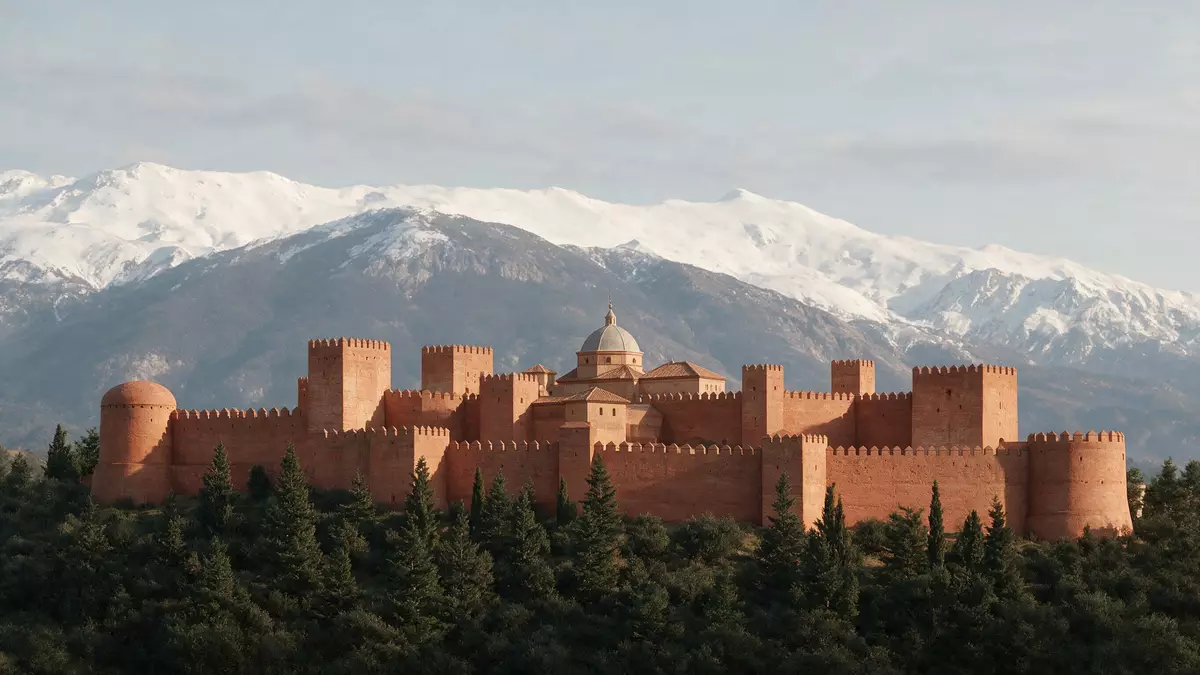
Alhambra rises above Granada as a self-contained palatine city, where Nasrid palaces, fortress walls and later Renaissance additions share a single hilltop overlooking southern Spain. Built on Sabika hill during the thirteenth and fourteenth centuries as the royal seat of the Emirate of Granada, it later became a Christian court after 1492 and is now recognised as a World Heritage complex of exceptional Nasrid architecture.
A Nasrid palace city on Sabika hill
Alhambra occupies Sabika hill on the south-eastern edge of Granada, forming a distinct elevated terrace separated from the lower city by steep slopes and defensive walls.Sabika hill above Granada From this position, the palaces and towers look across the plain and towards the Sierra Nevada, while within the walls the complex functions as an enclosed urban landscape. The name Alhambra derives from the Arabic Qal’at al-Hamra, “the red fort”, a reference to the reddish tone of its walls built with local materials rich in iron oxide.red fort in Arabic
The palace city took shape under the Nasrid dynasty, the last Muslim rulers of the Iberian Peninsula, whose emir Muhammad I ibn Nasr began construction around 1238.Muhammad I in the thirteenth century Successive Nasrid rulers extended the complex through the fourteenth century, establishing a royal residence, administrative quarters and ceremonial halls within the fortified precinct.Nasrid campaigns over two centuries The result is a layered ensemble in which military architecture, refined domestic spaces and enclosed gardens occupy different terraces of the same hill.
Fortress walls, palaces and Nasrid decoration
Alhambra is organised around distinct zones: the Alcazaba as the main fortress, the cluster of Nasrid palaces, and the former medina with remains of houses and service buildings.fortress, palatial zone and medina The Alcazaba forms the western stronghold, with massive towers such as the Watch Tower and the Keep rising above the walls, recalling its original role as a military outpost guarding Granada.Watch Tower and Keep East of the fortress, a sequence of palaces built for the Nasrid emirs creates a more delicate architectural world of courtyards, halls and chambers arranged around water and planting.
Within these palaces, Nasrid art appears in carved stucco, geometric tilework and elaborately patterned surfaces that frame doorways, arches and wall panels.Nasrid ornament in palaces Key fourteenth-century structures such as the Comares Palace and the Palace of the Lions are associated with rulers including Yusuf I and Muhammad V, whose building campaigns defined much of the architecture visitors see.Comares and Lions palaces In these spaces, slender columns surround courtyards, arcades open towards pools, and inscriptions run along walls and cornices, integrating text, geometry and light as central elements of the design.
Christian interventions and World Heritage status
After 1492, when the Catholic Monarchs of Castile and Aragon took Granada, Alhambra became a Christian royal residence, and parts of the complex were altered or rebuilt.Christian court after 1492 In the sixteenth century Charles V ordered a Renaissance palace to be constructed within the precinct, designed by Pedro Machuca and set beside the Nasrid palaces as a statement of imperial architecture.palace of Charles V These interventions add stone façades, classical orders and a distinct courtyard plan to the hilltop, contrasting directly with the earlier Islamic forms while sharing the same fortified setting.
Alhambra, together with the Generalife gardens and the historic Albayzín district, is inscribed on the UNESCO World Heritage List, first recognised in 1984 and later extended.World Heritage inscription in 1984 The designation reflects its status as a rare surviving palatine city from the Islamic period and an outstanding example of Nasrid art in architecture and decoration.Nasrid style and influence The complex’s continuous occupation and accumulated layers of Islamic and Christian construction make it a key site for understanding the cultural history of Granada and of Spain.
Visiting Alhambra: what travellers from Western Europe should know
- Alhambra stands on Sabika hill south-east of Granada’s historic centre and is reached along roads that climb from the lower city, with access points near the fortress and palaces.
- Moving through the complex involves walking over stone paving and climbing stairways between terraces, including steps within towers and palace areas.
- The Generalife gardens lie to the east of the main fortress and palace zone, connected by pathways that cross the ravine between the two hill slopes.
- Granada lies in Spain; the official language is Spanish and the currency is the euro.
- Entry requirements depend on your nationality; UK travellers can check the FCDO travel advice at gov.uk/foreign-travel-advice, Irish travellers the Department of Foreign Affairs at ireland.ie.
Searching for Alhambra on social platforms
These links open searches for Alhambra on each platform.
Frequently asked questions about Alhambra
Where is Alhambra and what kind of place is it?
Alhambra is a palace-and-fortress complex on Sabika hill in Granada, southern Spain, forming a walled palatine city above the modern town.
What should visitors expect when exploring Alhambra?
Visitors move between fortress towers, Nasrid palaces and garden terraces, with stone stairways linking courtyards, halls and viewpoints across the hilltop.
What makes Alhambra distinctive among historic sites?
Alhambra combines a well-preserved Nasrid royal city with later Renaissance interventions, all recognised as a World Heritage ensemble of exceptional Islamic-period architecture.


