
Alhambra in Granada: a palatial city of stone, water and light
Published on 08/28/2026 at 19:55 | Editorial responsibility: Rafael Müller, Editor-in-Chief AD HOC NEWS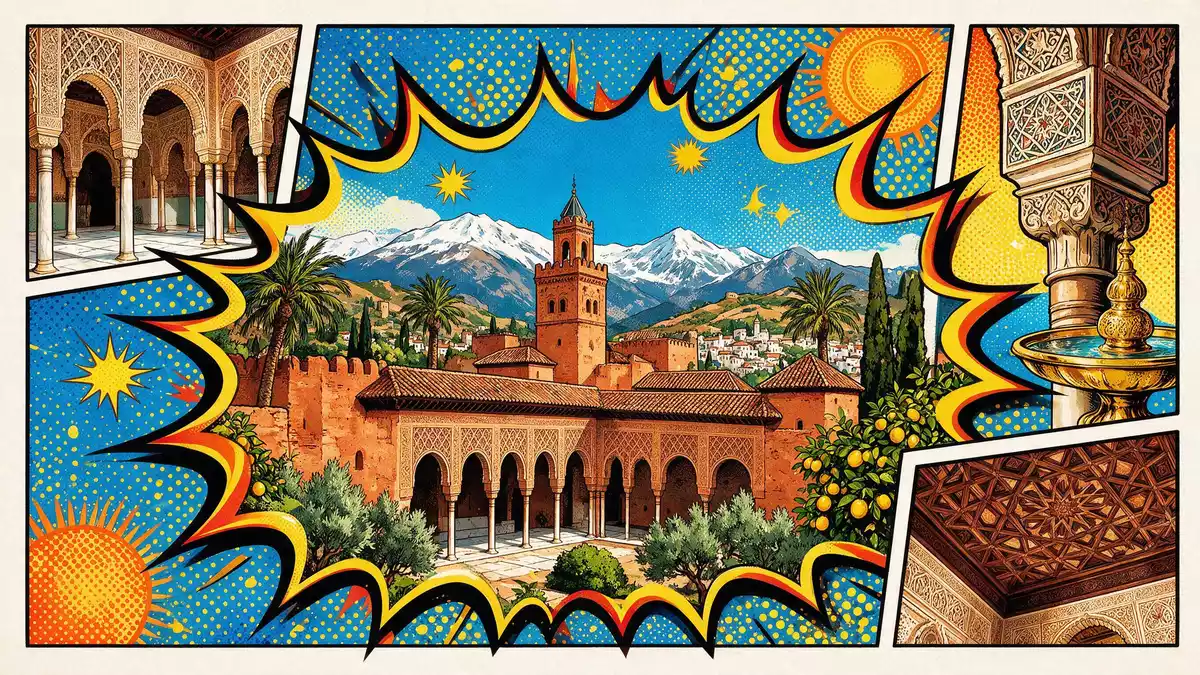
Alhambra in Granada is a fortified palatial city on a hill above the Darro valley, where Nasrid palaces, towers and gardens form a self-contained world of stone, water and light. Built chiefly in the thirteenth and fourteenth centuries under the Nasrid dynasty and later reshaped by Christian rulers, it concentrates several centuries of Iberian history into one enclosed complex.
The hilltop palatial city above Granada
Alhambra occupies Sabika hill, a long spur overlooking Granada and the wider Vega plain, with the snow-covered Sierra Nevada rising further to the south-east. From the plateau the complex looks down over the white houses of the former Muslim quarter of Albayzín on the facing hill and across the clustered streets of the lower city, underlining its role as both fortress and courtly residence.Sabika hill above Granada The setting makes clear why Alhambra developed not as a single palace but as a small, walled city, with distinct zones for defence, ceremony and daily life.
The oldest core is the Alcazaba, a compact fortress whose towers dominate the western end of the hill, marking the military heart of the Nasrid stronghold.Alcazaba fortress section Behind it, the plateau carries a palatial zone and an area that once held the administrative quarter sometimes described as a medina. Together they give Alhambra the character of a palatine city rather than a single residence, an arrangement that is rare among surviving Islamic sites in Europe.palatine city of the Islamic period
Nasrid palaces and their intricate interiors
The most celebrated spaces within Alhambra are the Nasrid palaces built for the emirs of Granada from the late thirteenth century onwards, especially under Muhammad I ibn al-Ahmar and his successors.Muhammad I and the Nasrid dynasty These palaces cluster around a sequence of courtyards, where slender columns carry arcades and carved stucco surfaces catch the sharp Andalusian light. The architecture belongs to the final flowering of Andalusi Islamic art, with thin walls, timber roofs and decoration that tends towards the dematerialisation of surfaces.
Inside, floors and lower wall zones are lined with glazed ceramic tiles in complex geometric patterns, while upper walls and vaults carry dense calligraphic and vegetal reliefs associated with Nasrid design.Nasrid architecture and decoration Light enters through latticed openings and doorways, picking out details in honeycomb vaults and wooden ceilings. In courtyards, pools of still water mirror arcades and sky, and channels bring water to basins and planting beds, reinforcing the sense of the palaces as a carefully ordered environment where architecture, inscription and water form a continuous surface.
Renaissance interventions and surrounding gardens
Alhambra’s fabric records the arrival of new powers as clearly as it preserves Nasrid work. After the conquest of Granada in 1492 the complex became a Christian royal residence, and in the sixteenth century Charles V ordered a new palace in the Renaissance style within the enclosure.Charles V and the Renaissance palace His palace, attributed to architect Pedro Machuca and begun in 1526, stands as a square, heavy stone volume set beside the lighter Nasrid structures, with an internal circular courtyard and classical detailing that mark a sharp change from the earlier architecture.
Beyond the main walls to the east lie the gardens and terraces of Generalife, once a rural residence of the Nasrid emirs and now a linked part of the wider World Heritage ensemble.Generalife as rural residence Here stepped plots, channels and planted borders extend across the slope, with views back towards Alhambra’s towers and the Albayzín district on the opposite hill. Together the fortress, palaces and gardens illustrate how Islamic and later Christian rulers shaped the hilltop as both defended site and place of pleasure, and how the ensemble has been conserved and recognised, including its inscription on the UNESCO World Heritage List in 1984.World Heritage inscription in 1984
Visiting Alhambra: what travellers from Western Europe should know
- Alhambra stands on Sabika hill on the south-west side of Granada, above the Darro valley, and is reached from the city by roads climbing through wooded slopes.
- The complex covers a broad plateau with cobbled paths, stepped ramps and interior staircases; exploring the towers and some viewpoints involves climbing narrow flights with many steps.
- The surrounding area includes the Albayzín district on the facing hill and the Generalife gardens to the east, both within view from several terraces of Alhambra.
- The official language is Spanish and the currency is the euro.
Searching for Alhambra on social platforms
These links open searches for Alhambra on each platform.
Frequently asked questions about Alhambra
Where is Alhambra and what kind of place is it?
Alhambra is a walled palatial city and fortress on Sabika hill above Granada in southern Spain, combining defensive towers, royal palaces and gardens.
What can visitors expect on a visit to Alhambra?
Visitors encounter fortified walls and towers, sequences of Nasrid palaces with carved interiors, the Renaissance palace of Charles V and the linked terraced gardens of Generalife.
What makes Alhambra distinctive among historic sites?
Alhambra preserves an extensive medieval Islamic palatine city with richly decorated Nasrid palaces, later Renaissance additions and gardens on one hilltop, a combination rare in Europe.


