
Alhambra in Granada, a palace city on Sabika hill
Published on 08/24/2026 at 19:27 | Editorial responsibility: Rafael Müller, Editor-in-Chief AD HOC NEWS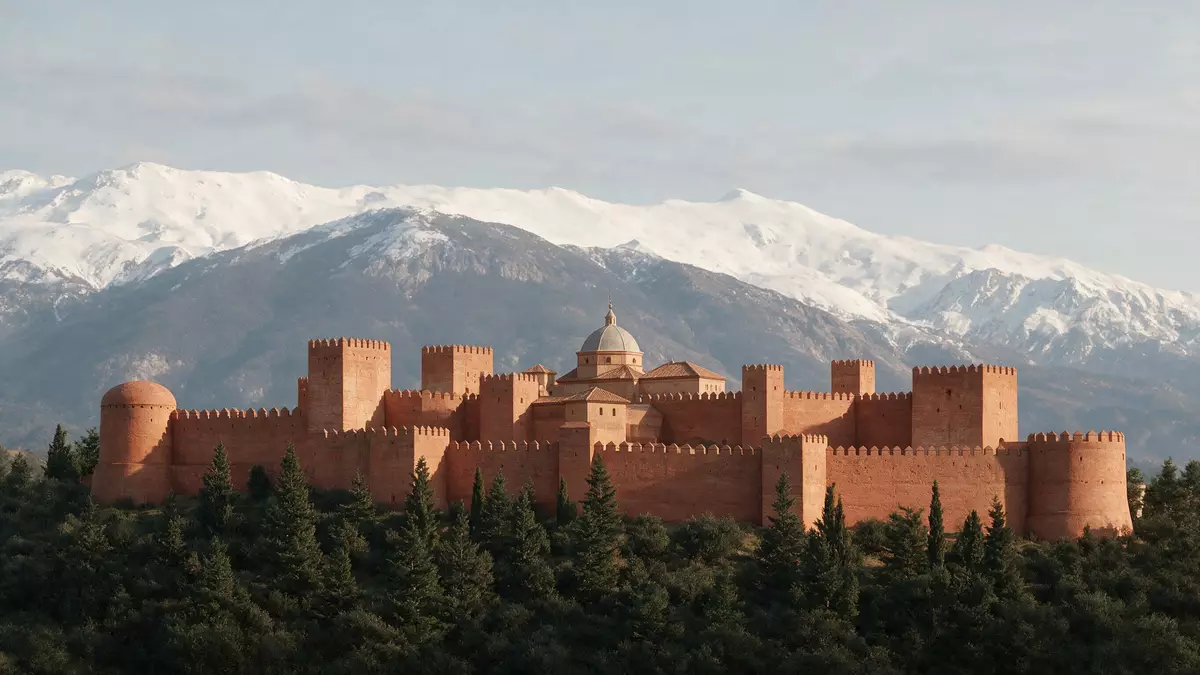
Alhambra rises above Granada as a hilltop complex of palaces, fortifications and gardens. Its most famous layers belong to the Nasrid dynasty, and the site is part of the UNESCO-listed property shared with the Generalife and Albayzín.
Sabika hill and the Nasrid citadel
The complex stands on Sabika hill, above the modern lower town and beside the Darro valley. That position gives Alhambra a clear outline, with walls, towers and palatial buildings stepping across the ridge.Sabika hill appears throughout the site as both setting and form.
The oldest defensive core is the Alcazaba, and the palatial heart is the Nasrid palace area. The broader complex belongs to the final centuries of Muslim rule in Granada, when the Na?rid court made the hill its residence.built chiefly between 1238 and 1358 Nasrid dynasty
Renaissance stone inside a medieval complex
One of Alhambra’s clearest contrasts is the Palace of Charles V, a Renaissance building inside the older complex. It is a square block with a circular courtyard, and it introduces a different architectural language without leaving the hilltop setting.Palace of Charles V
The palace sits alongside the Nasrid remains rather than replacing them completely, so the visitor reads the site as a sequence of periods. Charles V’s building belongs to the sixteenth century, while the surrounding walls and palaces belong to the medieval Islamic city that gave Alhambra its identity.sixteenth century Islamic architecture
Gardens, water and the wider ensemble
East of the fortress area lies the Generalife, with gardens and former palace spaces. Together with the Alcazaba and the Nasrid palaces, it makes Alhambra more than a single monument: it is a composed landscape of courtly, military and ornamental parts.Generalife World Heritage
Water is one of the recurring elements across the whole ensemble, from channels and pools to planted courtyards and terraces. The result is a site that combines enclosure and openness, stone and vegetation, defence and residence, in a way that can be read across the hill.
Visiting Alhambra: what travellers from Western Europe should know
- Alhambra lies on the Sabika hill in Granada, and the approach runs uphill from the city below. The complex is reached on foot, by local bus and by taxi.
- The ground rises in terraces and the site includes stairways, ramps and uneven surfaces. Comfortable shoes matter more than a straight route through the complex.
- The official language is Spanish and the currency is the euro.
- Parts of the visit sit in open air, while other parts pass through enclosed palatial rooms and courtyards. The experience changes from one section to another because the complex combines different kinds of spaces.
Searching for Alhambra on social platforms
These links open searches for Alhambra on each platform.
Frequently asked questions about Alhambra
Where is Alhambra?
Alhambra stands in Granada, Spain, on Sabika hill above the city. It forms part of the wider heritage landscape shared with the Generalife and Albayzín.
What does a visit show?
A visit brings together fortress walls, Nasrid palaces, gardens and the Palace of Charles V. The site reads as a sequence of military, residential and ornamental spaces.
What makes Alhambra distinctive?
The strong contrast between medieval Islamic architecture and the later Renaissance palace gives the hill its character. Stone, gardens and water features are all part of the same ensemble.


