
Alhambra in Granada: a palace city of Nasrid art
Published on 09/15/2026 at 22:32 | Editorial responsibility: Rafael Müller, Editor-in-Chief AD HOC NEWS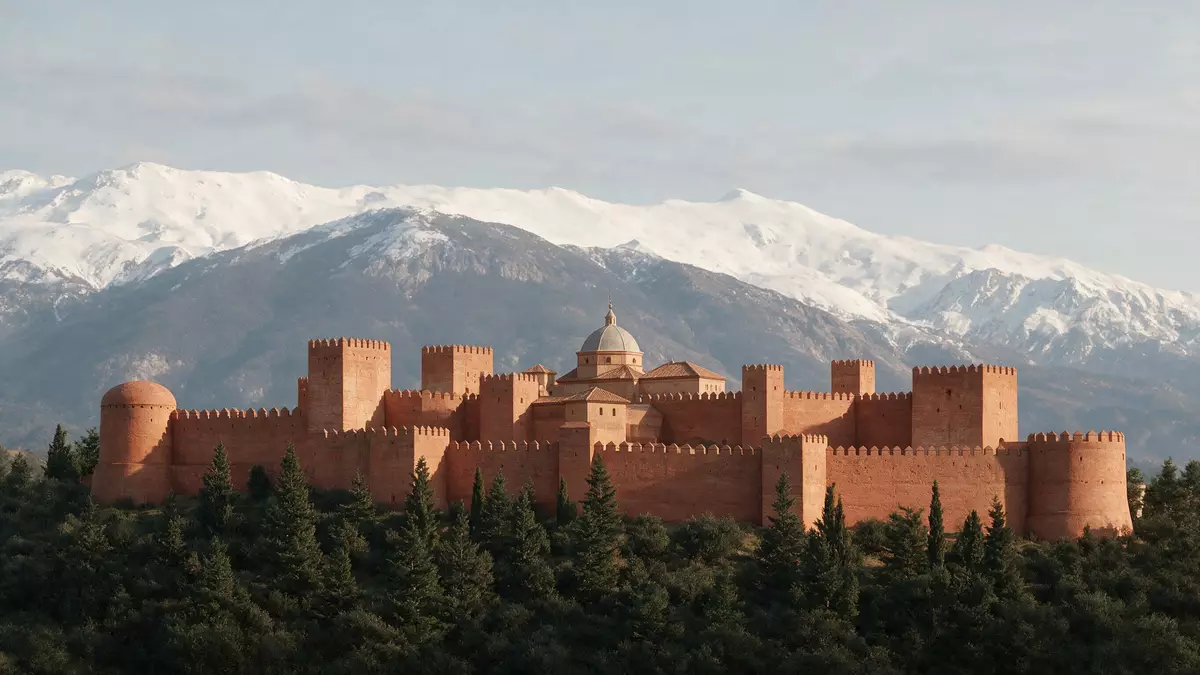
Alhambra rises on a hill above Granada, a palatine city of palaces, ramparts and gardens shaped under the Nasrid dynasty in the thirteenth and fourteenth centuries. Its sequence of courtyards, halls and fortified walls forms a rare surviving ensemble of medieval Islamic architecture in western Europe, later joined by Renaissance additions such as the Palace of Charles V.
A hilltop palatine city overlooking Granada
The complex occupies a long terrace on the south-eastern edge of Granada, separated from the historic Albayzín quarter by the valley of the Darro river.two adjacent hills Enclosing walls with towers define a compact city within a city, with gates leading towards the historic centre and the surrounding countryside.walls and towers enclose this city
At the western end stands the Alcazaba, the citadel section whose massive towers look out over the modern streets of Granada.constructed on a plateau Further east lie residential and ceremonial areas, including the Nasrid Palaces and the Generalife gardens, linked by pathways through woodland and open spaces along the ridge.complex of buildings and gardens
Nasrid Palaces: courtyards, carved stucco and water
The heart of Alhambra is the group known as the Nasrid Palaces, begun in the early fourteenth century as the habitual residence of the kings of Granada.construction began at the beginning of the 14th century Three principal palace areas survive: the Mexuar, used for justice and state affairs; the Comares Palace, associated with Yusuf I; and the Palace of the Lions, reshaped under Mohammed V.three independent areas in the Nasrid Palaces
The Comares Palace centres on the Court of the Myrtles, with a long reflective pool edged by planting and arcaded galleries leading towards the high Comares Tower and the Hall of Ambassadors.Patio de los Arrayanes and Comares Tower The neighbouring Palace of the Lions arranges its famous central courtyard around a fountain supported by carved stone lions, from which water channels run between slender columns to surrounding halls such as the Hall of the Two Sisters and the Hall of the Abencerrajes.Courtyard of the Lions and surrounding halls
Layers of history and UNESCO recognition
The name Alhambra derives from Arabic terms linked to “the red” and “the red fortress”, reflecting the colour of its outer walls.name signifying “the red” Construction is linked to Muhammad ibn al-Ahmar, founder of the Nasrid dynasty, in the thirteenth century, with major palace work continuing under his successors in the fourteenth century.seat of the Nasrid dynasty in the thirteenth century
After the capitulation of Granada in 1492 the complex became a royal residence for the Catholic monarchs, and in 1527 construction began on the square-plan Renaissance Palace of Charles V within the precinct.palace for Holy Roman Emperor Charles V in 1527 Alhambra, Generalife and Albayzín together form a UNESCO World Heritage Site, recognised as an outstanding example of Nasrid art and the only preserved palatine city of the Islamic period in Spain.Alhambra, Generalife and Albayzín, Granada
Visiting Alhambra: what travellers from Western Europe should know
- Alhambra stands above Granada in Andalusia, reached from the city by road and paths that climb through woodland towards the monumental complex.
- Within the site, approaches to viewpoints and towers include stepped routes and some narrow staircases inside historic structures.
- The Darro river valley and the Albayzín district lie close by, so views from the Alcazaba and palace terraces take in both the old quarter and the surrounding hills.
- Spanish is the official language and the currency is the euro.
Searching for Alhambra on social platforms
These links open searches for Alhambra on each platform.
Frequently asked questions about Alhambra
Where is Alhambra and what kind of place is it?
Alhambra is a palace and fortress complex on a hill above Granada in southern Spain, combining citadel structures with royal palaces and gardens.
What should visitors expect on a visit to Alhambra?
Visitors encounter enclosed courtyards, richly decorated halls, towers with broad views and landscaped gardens, linked by paths and stairways across the hilltop site.
What makes Alhambra distinctive among historic sites?
Alhambra is distinctive for its extensive Nasrid palaces with carved stucco, tilework and water features, combined with later Renaissance elements and wide views over Granada.


