
Alhambra and the Nasrid palaces above Granada
Published on 09/14/2026 at 21:34 | Editorial responsibility: Rafael Müller, Editor-in-Chief AD HOC NEWS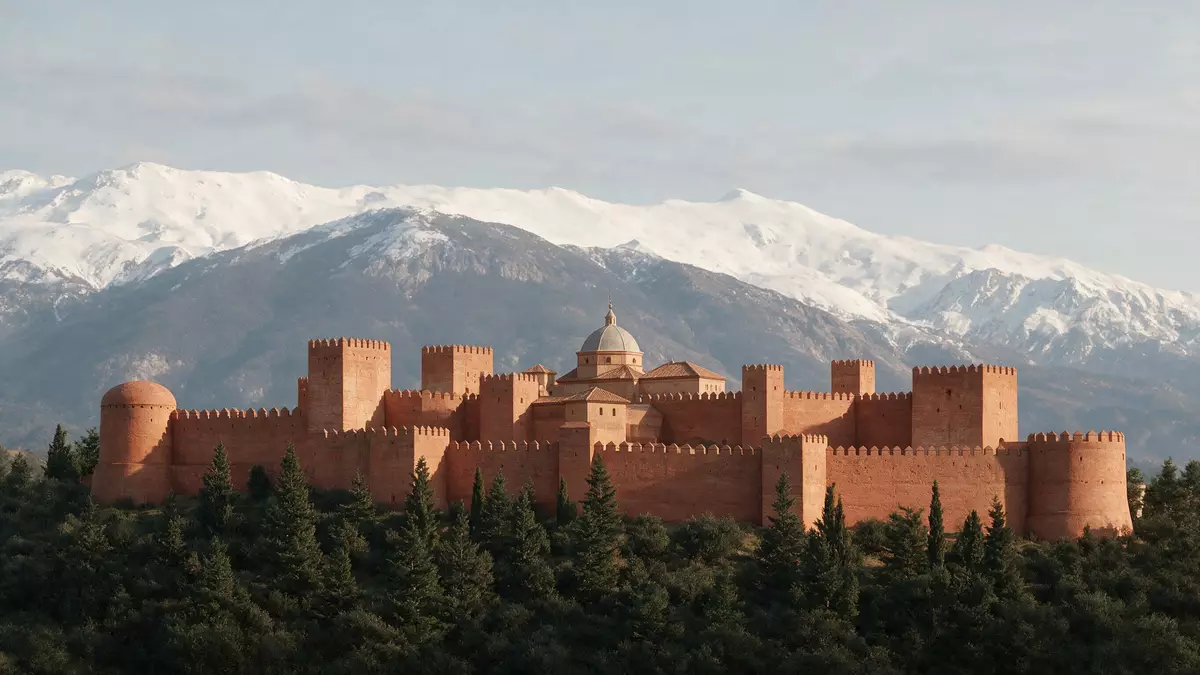
Rising over Granada on the Sabika hill, Alhambra is a walled palace and fortress complex where Nasrid palaces, later Renaissance additions and irrigated gardens form a layered record of Spain’s shifting cultures.palace and fortress complex
Alhambra on the Sabika hill above Granada
Alhambra occupies a ridge just west of central Granada, standing on the Sabika hill with views over the Vega plain and the white houses of the Albaicín district across the Darro valley.on top of the hill al-Sabika Defensive walls and towers encircle the complex in an irregular outline, giving it the character of a self-contained citadel rather than a single palace.surrounded by defensive walls
Within these walls, the terrain steps down in terraces and platforms, with the fortified Alcazaba at one end and palatial and garden zones extending along the ridge. From many viewpoints, the snow-capped Sierra Nevada mountains form a distant backdrop, underscoring how the complex sits between urban Granada and the wider Andalusian landscape.flat-topped ridge on the Sabika hill
Nasrid palaces and Islamic architecture in stone and stucco
The heart of Alhambra is the sequence of Nasrid palaces built in the thirteenth and fourteenth centuries for the emirs of the Emirate of Granada, whose court represented the last major Muslim kingdom in Iberia.built primarily by the Nasrid emirs Courtyards, reception halls and private apartments are arranged around water channels and reflective pools, with arcades framing views between rooms and gardens. Surfaces are covered in carved arabesques, kufic and cursive inscriptions, muqarnas vaulting and glazed tile, creating an interior world where architecture and ornament are inseparable.intricate Islamic architecture
Among the Nasrid palaces, the Comares Palace centres on the Court of the Myrtles, a long pool edged by hedges and pavements that doubles the adjacent tower in reflection, while the Palace of the Lions is organised around a courtyard with a marble fountain carried by sculpted animals.Court of the Myrtles Administrative chambers such as the Mexuar sit beside richly decorated residential spaces, reflecting how government and domestic life once intertwined in this palatine city.
Layers of power: from Nasrid emirate to Spanish monarchy and UNESCO heritage
Construction of Alhambra as a substantial palace and fortress complex began in the mid-thirteenth century under the Nasrid dynasty, building on earlier fortifications and establishing the seat of the Emirate of Granada.mid-thirteenth century In 1492, the Catholic Monarchs captured Granada, ending Muslim rule in the region; parts of Alhambra were then adapted as a royal residence, including the insertion of Renaissance architecture such as the Palace of Charles V with its circular courtyard.Palace of Charles V
Alhambra, the Generalife and the Albayzín together form a World Heritage ensemble recognised for its outstanding testimony to Andalusian and Moorish culture.World Heritage List in 1984 The Alhambra and Generalife were officially inscribed on the UNESCO World Heritage List in 1984, with the Albayzín district added as an extension in 1994, and the Spanish state had already declared the complex a national artistic monument in the nineteenth century.declared national-artistic monuments
Visiting Alhambra: what travellers from Western Europe should know
- Alhambra stands on the Sabika hill immediately west of central Granada, above the left bank of the Darro river and opposite the Albaicín neighbourhood, and is reached by city streets that climb towards its fortified gates.
- Within the complex, visiting the Alcazaba and towers involves staircases, and the Nasrid palaces include narrow passages and changes of level, while the gardens around Generalife extend along terraces on a hillside.
- The surrounding landscape combines the urban fabric of Granada with views towards the Vega plain and, in clear conditions, the higher slopes of the Sierra Nevada, giving a sense of altitude without alpine exposure.
- Spain’s official language is Spanish and the national currency is the euro, and signage on site generally foregrounds Spanish while indicating key areas with international visitors in mind.
Searching for Alhambra on social platforms
These links open searches for Alhambra on each platform.Frequently asked questions about Alhambra
Where is Alhambra and what kind of place is it?
Alhambra is a palace and fortress complex on the Sabika hill in Granada, southern Spain, forming a walled ensemble of fortifications, palaces and gardens.
What can visitors expect during a visit to Alhambra?
Visitors walk through courtyards, towers and halls with intricate Islamic decoration, see Renaissance additions such as the Palace of Charles V, and explore irrigated gardens around Generalife.
What makes Alhambra distinctive among historic sites?
Alhambra is distinctive for combining Nasrid palaces, a fortified citadel and a royal Renaissance residence on one hilltop, and for its recognition as a UNESCO World Heritage site.


