
Alhambra, a hilltop palatial city above Granada
Published on 08/20/2026 at 17:57 | Editorial responsibility: Rafael Müller, Editor-in-Chief AD HOC NEWS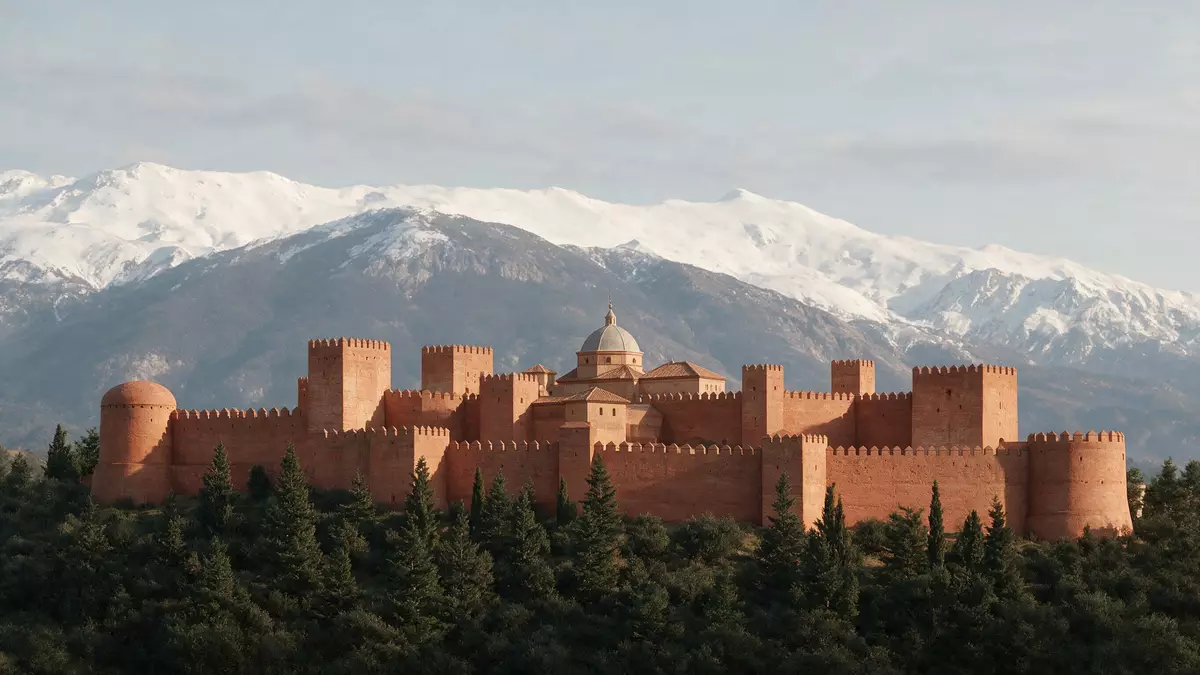
Alhambra rises on a hill above Granada in southern Spain, a fortified palatial city where Nasrid-period courtyards stand alongside Renaissance interventions by later Spanish monarchs. Built chiefly in the thirteenth and fourteenth centuries for the Nasrid dynasty and transformed after the conquest of Granada in 1492, it concentrates centuries of architecture in one enclosed complex.
A Nasrid palatial city on Sabika hill
Alhambra occupies Sabika hill, a long ridge that overlooks the historic centre of Granada and the surrounding plain. The complex developed from an earlier fortress into a palatial city with defensive walls and towers enclosing residences, administrative spaces and gardens.The historical introduction describes how the castle was drawn into the city’s ramparts and took on a military role.
Construction of the Nasrid palaces began under Mohammed ben Al?Hamar, also known as Muhammad I, in 1238, when he established his royal residence here and initiated the site’s most prosperous phase.Encyclopaedia references place the main building period between 1238 and the mid?fourteenth century, continued by his successors. Within the enclosure, the Alcazaba forms the compact fortress at the western end, while the palatial area stretches eastwards towards the Generalife gardens outside the main walls.
Courtly spaces: Nasrid palaces and water
Inside the palatial sector, a sequence of courtyards links the main Nasrid palaces, each arranged around a central space edged by arcades and rooms. The Comares Palace centres on a broad courtyard with a long reflective pool aligned with the tower that dominates the complex, while the Palace of the Lions arranges slender columns around an inner courtyard marked by a fountain carried by sculpted lions.Descriptions of the Nasrid palaces highlight the way water and architecture are combined in these spaces.
The interiors of these palaces carry some of the most elaborate Islamic decoration in Spain, with carved stucco, tilework and inscriptions covering walls and arches.The official history notes that the Nasrid rulers created a palatine city with distinct zones for residence and ceremony. Beyond the palaces, the Generalife on the neighbouring slope served as a rural retreat for the emirs, with terraced gardens and irrigated channels laid out above the river valley.UNESCO material describes the Generalife gardens as part of the wider ensemble including the residential Albayzín district.
From Islamic court to Christian monument
In 1492, the Catholic Monarchs Ferdinand of Aragon and Isabella of Castile took Granada, ending Nasrid rule and bringing Alhambra under the Spanish Crown.Historical summaries record that they used the palatial complex as a royal residence in the months after the conquest. During the sixteenth century, Charles V ordered the construction of a new palace within the enclosure, introducing Renaissance forms into the centre of the Nasrid city.
The Palace of Charles V, begun in 1526 to designs attributed to Pedro Machuca, sets a square exterior around a circular inner courtyard, creating a striking contrast with the surrounding Islamic architecture.Accounts of Charles V’s works explain that parts of earlier structures were demolished to clear space for this building. After periods of neglect and damage in the eighteenth and early nineteenth centuries, including losses during the French occupation and an earthquake, restoration programmes in the nineteenth century stabilised the complex and brought renewed attention to its conservation.World Monuments Fund documentation emphasises Alhambra’s importance as a surviving expression of Islamic rule in Iberia and the long history of repair.
Visiting Alhambra: what travellers from Western Europe should know
- Alhambra stands on Sabika hill immediately above Granada’s historic centre in Andalusia, Spain, and is reached by roads that climb from the city towards the main entrance.
- The complex covers a sizeable hilltop area, with enclosed courtyards, gardens and a fortress; visiting involves walking on stone surfaces and ascending internal staircases inside towers and palaces.
- The Generalife gardens extend onto terraces east of the main fortress, connected by paths and stairways that traverse changes in level between the palatial city and the rural retreat.
- The official language is Spanish and the currency is the euro.
Searching for Alhambra on social platforms
These links open searches for Alhambra on each platform.
Frequently asked questions about Alhambra
Where is Alhambra and what kind of place is it?
Alhambra is a fortified palatial complex on Sabika hill above Granada in Andalusia, Spain, combining a medieval fortress with palaces and gardens.
What should visitors expect during a visit?
Visitors move through enclosed courtyards, decorated palace interiors, towers and terraced gardens, with routes that involve walking over uneven stone surfaces and climbing staircases.
What makes Alhambra distinctive among Spanish sites?
Alhambra is a rare surviving palatial city from the Islamic period in Spain, where Nasrid architecture and decoration coexist with later Renaissance additions within one walled hilltop ensemble.


