
Alcazar de Segovia, a stone fortress above Segovia’s rivers
Published on 09/17/2026 at 21:53 | Editorial responsibility: Rafael Müller, Editor-in-Chief AD HOC NEWS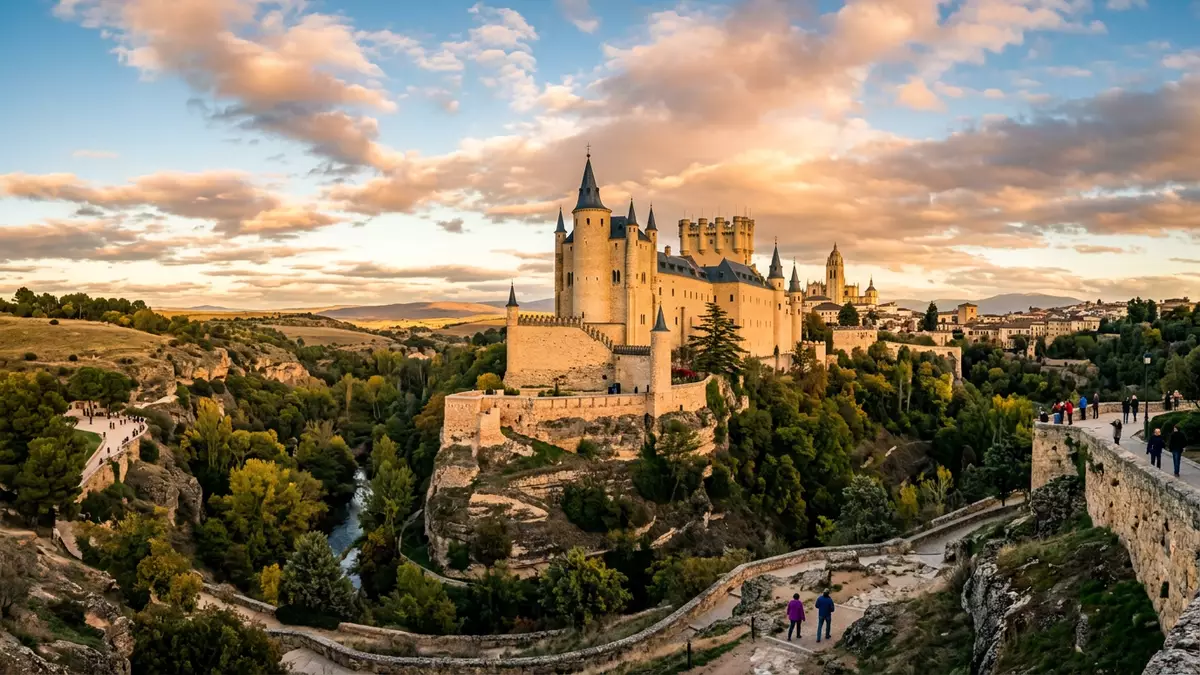
Alcazar de Segovia is a medieval stone fortress and former royal palace on the edge of Segovia in Spain, standing high above two river valleys at the tip of a rocky spur. Its profile of turrets, slate-roofed towers and defensive walls belongs to the twelfth century and later, yet the castle’s rooms still carry the memory of royal ceremony and military training side by side.
A cliff-edge castle shaped by centuries of power
The Alcazar occupies a promontory at the confluence of the Eresma and Clamores rivers, a position that combines steep natural slopes with built stone defences along the upper edge.rocky promontory at the confluence The castle’s recorded history reaches back to the early twelfth century, when a fortress on this site began to take the stone form that visitors recognise.twelfth century Later medieval rulers of Castile continued to reshape and enlarge the complex, adding halls, towers and defensive walls around the core.
Through the late Middle Ages, Alcazar de Segovia developed into a principal royal residence of the Crown of Castile, hosting court life in its great halls while retaining its character as a fortress with ramparts and a keep.fortified royal palace Monarchs including Alfonso VIII and later John II used the castle as a base of authority, and the site is closely associated with Isabella of Castile, who was proclaimed queen here in the fifteenth century.Isabella of Castile After the royal court moved away, the building’s strong construction and enclosed yards lent themselves to military uses, and it served successively as a state prison and as an artillery college before its post-war restoration.
Architecture between fairy-tale silhouette and working fortress
Seen from the surrounding countryside, Alcazar de Segovia presents a compact mass of masonry rising directly from the rock, with a cluster of towers and turrets clad in dark slate roofs above pale walls.stone fortress and slate-roofed towers The layout of towers, curtain walls and main rooms largely dates from the twelfth to fourteenth centuries, giving the castle a mix of Romanesque foundations and later Gothic upper structures.Romanesque ground floor preserved At one end, the outline of the walls tapers towards a pointed tip above the rivers, a form often likened to the prow of a ship.
Inside, the great halls combine stone walls with elaborate painted ceilings and decorative programmes reflecting different phases of Castilian rule, including Mudéjar and Gothic elements.Christian, Mudéjar and Gothic phases One of the most prominent exterior features is the tall tower known as the Tower of John II, built in the fifteenth century and rising above the lower sections of the fortress with a ring of smaller turrets around its upper levels.Tower of John II The combination of defensive stonework, refined interiors and elevated position above the rivers gives the building a character that feels at once like a working stronghold and like the archetype of a storybook castle.
From royal residence to museum and military archives
Alcazar de Segovia has passed through several distinct uses over its long life, all within the same stone envelope. After centuries as a royal palace and fortress, the building took on new functions in the eighteenth century, when it became the site of the Royal College of Artillery and linked its halls to the training of military officers.Royal College of Artillery A major fire in the nineteenth century damaged roofs and interiors, prompting restoration campaigns that reshaped some spaces while keeping the overall outline of the castle recognisable.
In the twentieth century the fortress became a public monument. Since the mid-twentieth century it has housed museum spaces and military archives, allowing visitors to walk through rooms connected both to medieval royalty and to later Spanish military history.museum and military archives Exhibits and restored interiors highlight the building’s roles as royal residence, artillery school and war college, and the sequence of halls, courtyards and towers makes those successive identities visible in stone.
Visiting Alcazar de Segovia: what travellers from Western Europe should know
- Alcazar de Segovia stands at the western edge of Segovia’s historic centre, on a rocky spur between the rivers Eresma and Clamores, reached on foot along streets that descend towards the cliff.
- The castle’s interior includes staircases and level changes, and the ascent in the Tower of John II runs up a narrow spiral staircase with numerous steps between the lower courtyard and the upper viewing platform.
- Segovia lies in Castile and León in central Spain, and the official language is Spanish and the currency is the euro.
- Within sight of Alcazar de Segovia are the valley of the Eresma, stretches of Segovia’s defensive walls and, further across the old town, the Gothic cathedral rising on its own hilltop.
Searching for Alcazar de Segovia on social platforms
These links open searches for Alcazar de Segovia on each platform.
Frequently asked questions about Alcazar de Segovia
Where is Alcazar de Segovia and what surrounds it?
Alcazar de Segovia stands on a rocky spur at the western edge of Segovia in Castile and León in Spain, above the valleys of the Eresma and Clamores rivers.
What can visitors expect inside the fortress?
Visitors move through fortified courtyards, stone halls with decorated ceilings, and towers such as the Tower of John II, with museum displays and military archives housed in restored rooms.
What makes Alcazar de Segovia distinctive among Spanish castles?
The combination of its cliff-edge position above two rivers, its ship-like outline of walls and towers, and its double life as royal palace and military college gives the castle a distinctive character.


