
Alcazaba de Malaga, a hilltop citadel above the Roman theatre
Published on 08/26/2026 at 08:22 | Editorial responsibility: Rafael Müller, Editor-in-Chief AD HOC NEWS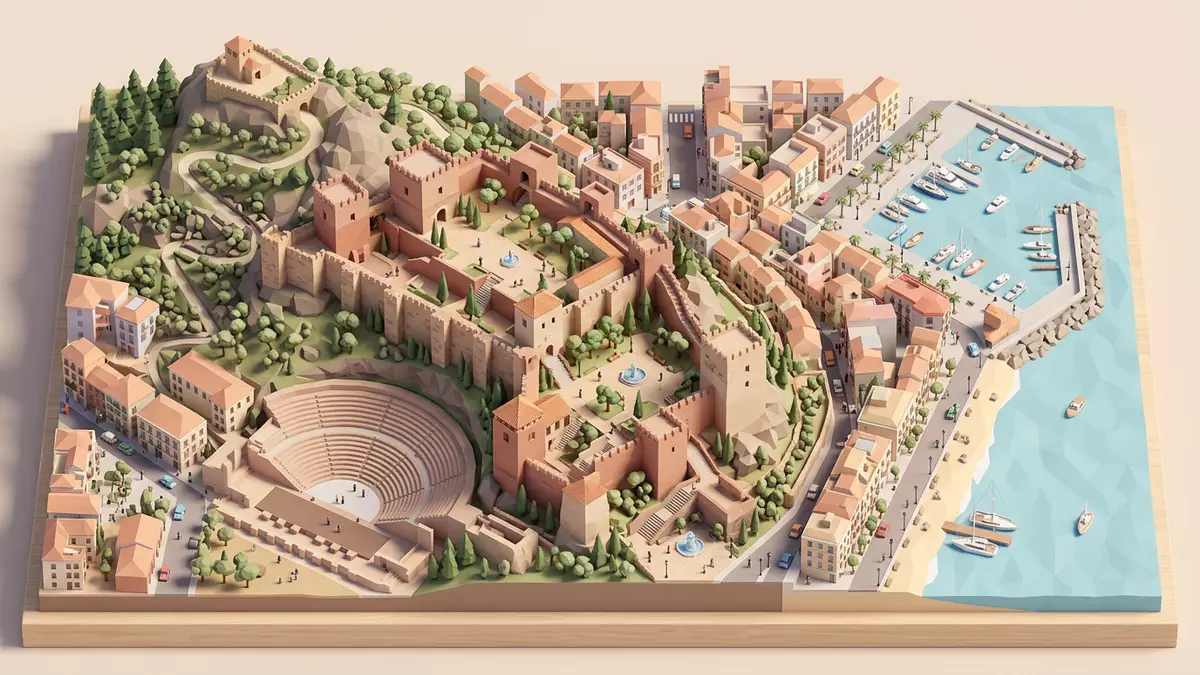
Alcazaba de Malaga rises above the centre of Malaga as a layered Moorish citadel, its walls climbing the hillside directly behind the Roman theatre. Built as a fortified complex between 1057 and 1063 under the Berber king Badis ben Habus during the era of the Taifa kingdoms, it later gained Nasrid palaces in the fourteenth century, turning the stronghold into a palace-fortress of Al-Andalus.
Fortress walls on the hill of Malaga
The Alcazaba occupies a strategic spur above the harbour, its fabric wrapping around the contours of the hill. The complex is enclosed by successive lines of fortification, with towers projecting from thick masonry walls that define a self-contained citadel. From the lower entrances beside the Roman theatre, the defences rise in stages towards the summit of the hill.The current complex was begun in the 11th century and reworked up to the fourteenth century, giving the hillside an architectural record of several centuries of Islamic rule in Malaga.
The first clearly documented phase belongs to the early eleventh century, when the Hammudid dynasty transformed an earlier fortification into a new seat of power. Historians attribute the main construction campaign to Badis ben Habus of the Zirid or Berber Taifa of Granada between 1057 and 1063, creating a prototype of Taifa-period military architecture with layered gates and a network of towers.The Alcazaba was built between 1057 and 1063 by order of Badis and served as both a defensive work and a seat of government above the port.
From Roman stones to Nasrid palaces
Beneath the Alcazaba, the Roman theatre anchors Malaga’s classical past, and the relationship between the two structures is unusually close. Stone from the theatre was reused in the construction and embellishment of the citadel’s walls and gateways, so that Roman columns and capitals appear throughout the Islamic fortifications as structural and decorative elements.Columns and other materials were taken from the nearby Roman theatre, binding the Alcazaba physically to the older monument just below.
Inside the outer walls, the complex is divided into successive enclosures that lead towards the Nasrid palace sector. Under the Nasrid dynasty of Granada, which incorporated Malaga in 1279 under Muhammad II, the inner palatial quarters were rebuilt and refined, giving the Alcazaba interiors comparable in style to those at the Alhambra.Under the Nasrid ruler Yusuf I in the 14th century, the inner palaces were refurbished with courtyards, pools and ornament that reflect Granadan traditions, although on a smaller scale than their counterpart in Granada.
A citadel layered with history
Across four centuries of Islamic rule, power over Malaga and its citadel shifted between several dynasties, including the Almoravids from 1092, the Almohads from 1146 and the Nasrids from 1279, each leaving traces in the fortifications and layout.The Alcazaba was taken by the Almoravids in 1092 and by the Almohads in 1146, and its role as an administrative and residential centre continued until the Christian conquest in 1487, when the forces of Isabella I of Castile and Ferdinand II of Aragon captured Malaga after a prolonged siege.
Later centuries brought both damage and restoration. Earthquakes and artillery in the seventeenth century and the early nineteenth century affected the fabric, and parts of the interior became a place of improvised housing and other uses. In the twentieth century, conservation campaigns reshaped the ruins into a monument with restored walls, courtyards and pathways, and the Alcazaba gained formal recognition as a historic monument and an Asset of Cultural Interest in Spain, preserving its mixture of military and palatial architecture for visitors and residents of Malaga alike.It was declared Historical Heritage of Spain and is now an Asset of Cultural Interest.
Visiting Alcazaba de Malaga: what travellers from Western Europe should know
- Alcazaba de Malaga stands on a hillside above the Roman theatre in central Malaga, a short ascent from the streets that lead inland from the harbour and the cathedral.
- The approach inside the fortifications follows sloping paths and stairways, with stone surfaces and some narrow turns between walls and towers.
- The citadel faces the Mediterranean, so exposed terraces and ramparts can be bright and unshaded in strong sunlight.
- The official language is Spanish and the currency is the euro.
Searching for Alcazaba de Malaga on social platforms
These links open searches for Alcazaba de Malaga on each platform.
Frequently asked questions about Alcazaba de Malaga
Where is Alcazaba de Malaga located?
Alcazaba de Malaga stands on a hillside in central Malaga, on Spain’s southern Mediterranean coast, directly above the city’s Roman theatre.
What can visitors expect inside the Alcazaba?
Visitors move through successive enclosures of walls and towers, passing courtyards, gardens and Nasrid palace rooms that recall the architecture of the Alhambra in Granada, though on a smaller scale.
What makes Alcazaba de Malaga distinctive among Spanish citadels?
Its combination of eleventh-century fortifications, Nasrid palaces and close physical relationship with the Roman theatre below gives Alcazaba de Malaga a dense layering of Roman and Islamic history on one compact hillside.


