
Al-Masjid an-Nabawi in Medina as a layered sanctuary of courtyards and domes
Published on 09/15/2026 at 16:31 | Editorial responsibility: Rafael Müller, Editor-in-Chief AD HOC NEWS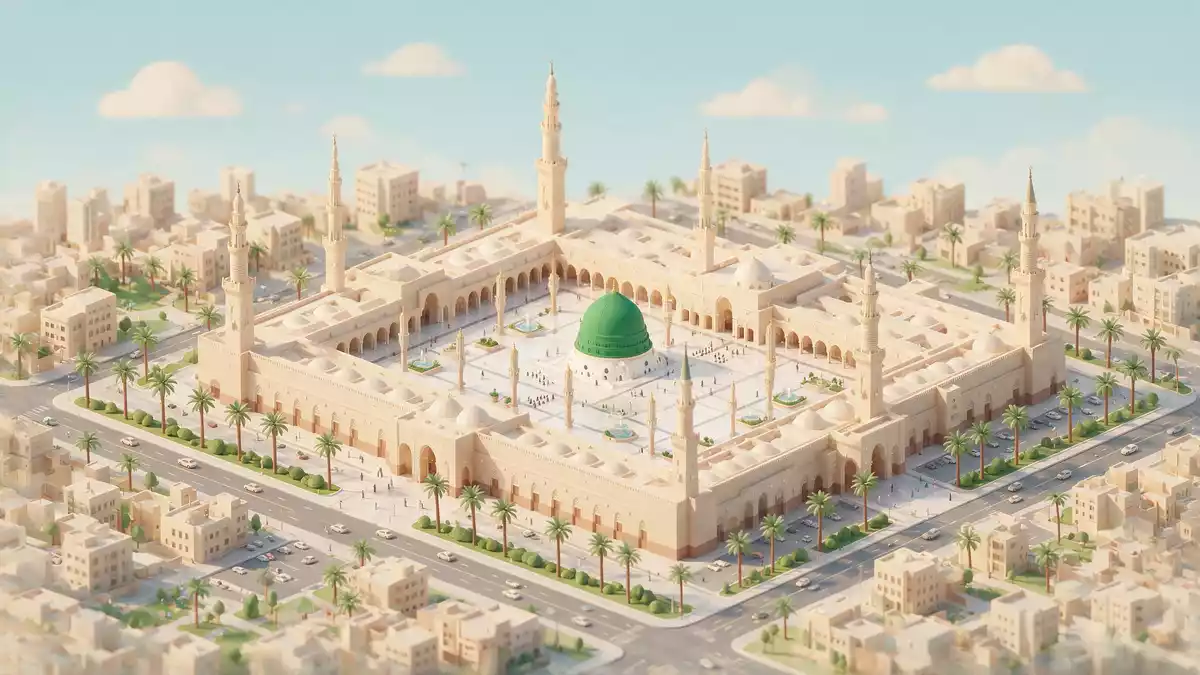
Al-Masjid an-Nabawi in Medina, often known in English as the Prophet’s Mosque, began in 622 CE as a modest courtyard built by the Prophet Muhammad and has grown into a vast sanctuary of domes, colonnades and marble surfaces around his resting place.
From a palm-trunk courtyard to a major mosque
Al-Masjid an-Nabawi stands in Medina in the Hejaz region of Saudi Arabia and traces its origin to the year 622 CE, when the Prophet Muhammad settled in the city after the Hijra from Mecca and established a mosque beside his dwelling.the year 622 CE The first building on the site took the form of a simple rectangular enclosure with mud-brick walls, palm-trunk supports and a roof of palm branches above an open courtyard.mud-brick walls and palm-trunk supports
This early mosque served at once as a place of prayer, a meeting hall and a centre of teaching and governance for the emerging Muslim community in Medina.place of worship, community centre and teaching space After the death of Muhammad, the complex was enlarged and parts of the original fabric were replaced with stone walls and more durable columns, while keeping the broad idea of a courtyard mosque that opens directly to the streets of Medina.early expansions with stone construction
Architectural layers across Islamic history
Across fourteen centuries, ruling dynasties extended and reworked Al-Masjid an-Nabawi, leaving visible layers of Islamic architecture in stone, plaster and marble. Rashidun and Umayyad caliphs enlarged the enclosure and introduced stone columns, timber roofs and new entrances, transforming the simple courtyard into a more formal hypostyle layout while preserving its role as a congregational mosque.Rashidun and Umayyad enlargements
Later, Mamluk and Ottoman patrons added decorative programmes such as carved stone, glazed mosaics and inscribed panels, and rebuilt parts of the structure, including the dome above the burial chamber of Muhammad.Mamluk and Ottoman interventions The present green colour of this dome dates to 1837 during the reign of Ottoman sultan Mahmud II, whose era fixed the visual impression that many travellers recognise in depictions of the Prophet’s Mosque.green dome painted in 1837
A vast sanctuary of courtyards, domes and arcades
The modern complex of Al-Masjid an-Nabawi covers a large area of central Medina, with prayer halls and open courtyards organised on a continuous floor of stone and marble. Within this expanse, rows of tall columns carry pointed arches, and domes rise above the roofscape, their surfaces marked by geometric and calligraphic ornament characteristic of Islamic architecture.Islamic architectural style
Inside the complex, the burial chamber of Muhammad, Abu Bakr and Umar is enclosed within a section of the mosque known as the Prophet’s chamber, over which the Green Dome stands as one of the most recognisable elements of Medina’s skyline.burial chamber within the mosque Around this core, later Saudi-era expansions introduced reinforced concrete wings, additional minarets and extensive shaded areas over the courtyards, giving the sanctuary its present scale while preserving sightlines towards the older structures.Saudi-period expansions with reinforced concrete wings
Visiting Al-Masjid an-Nabawi: what travellers from Western Europe should know
- Al-Masjid an-Nabawi stands in the historic centre of Medina in the Hejaz region of Saudi Arabia and is reached by road from Prince Mohammad bin Abdulaziz International Airport and other parts of the city.
- Within the mosque complex, moving between prayer halls and courtyards involves walking across extensive polished stone and marble floors and using stairways and ramps around the colonnades.
- The surrounding district is a built-up urban area with streets and accommodation blocks clustered around the sanctuary, and views framed by the mosque’s minarets rising above the city.
- The official language is Arabic and the currency is the Saudi riyal.
- Entry requirements depend on your nationality; UK travellers can check the FCDO travel advice at gov.uk/foreign-travel-advice, Irish travellers the Department of Foreign Affairs at ireland.ie.
Searching for Al-Masjid an-Nabawi on social platforms
These links open searches for Al-Masjid an-Nabawi on each platform.
Frequently asked questions about Al-Masjid an-Nabawi
Where is Al-Masjid an-Nabawi?
Al-Masjid an-Nabawi stands in the city of Medina in the Hejaz region of Saudi Arabia, forming a large mosque complex embedded in the urban centre.
What should visitors expect inside the complex?
Visitors encounter extensive prayer halls and courtyards paved in stone and marble, rows of columns with arches, and views towards domes and minarets above the roofscape.
What makes Al-Masjid an-Nabawi distinctive among mosques?
It combines its origin as a courtyard mosque built by the Prophet Muhammad in 622 CE with its role as his burial place under the Green Dome and the layered architecture of successive Islamic periods.


