
Al-Masjid an-Nabawi in Medina: a vast sanctuary of courtyards and domes
Published on 08/29/2026 at 12:09 | Editorial responsibility: Rafael Müller, Editor-in-Chief AD HOC NEWS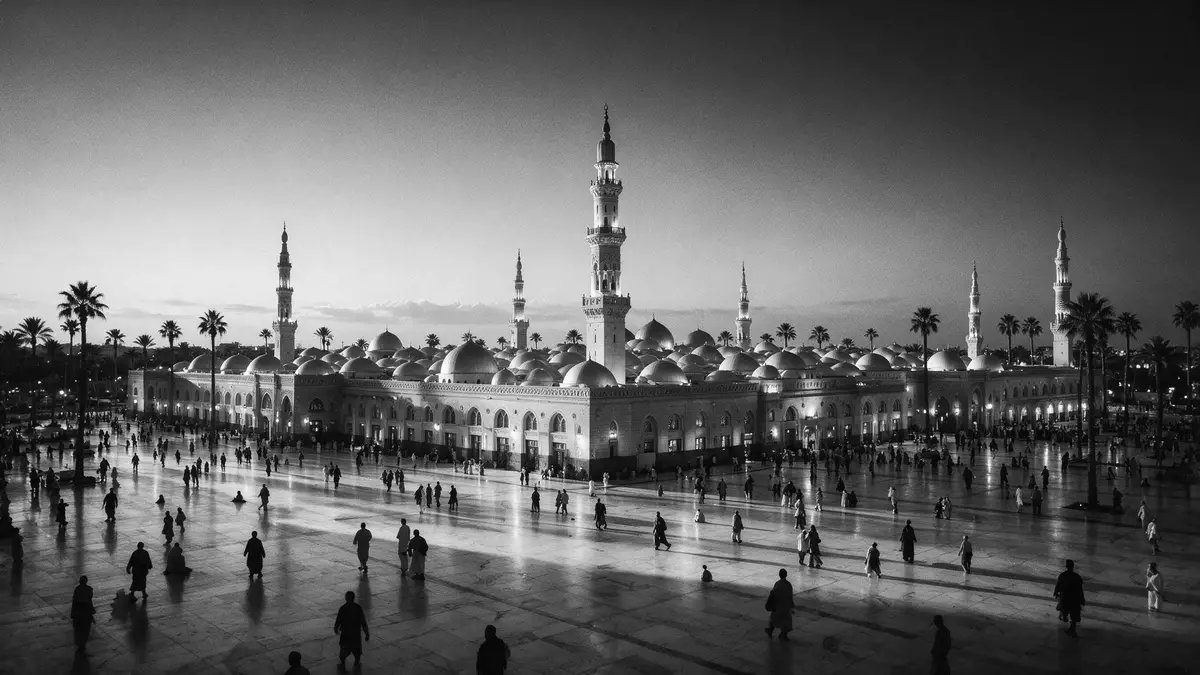
Al-Masjid an-Nabawi in Medina, often known in English as the Prophet’s Mosque, is a vast sanctuary built around the resting place of the Prophet Muhammad and shaped over more than fourteen centuries of Islamic history.the Prophet’s Mosque
A mosque founded in the earliest days of Islam
Al-Masjid an-Nabawi stands in Medina in the Hejaz region of Saudi Arabia and traces its origin to the year 622 CE, when the Prophet Muhammad settled in the city after the Hijra from Mecca.history of Masjid Nabawi The earliest mosque on this site was a simple courtyard structure of mud brick, with palm-trunk supports and a roof of palm leaves that reflected the materials and resources of an oasis town on the Arabian plateau.mud-brick courtyard
From the outset, Al-Masjid an-Nabawi served multiple roles as a place of prayer, teaching and community life, with spaces opening directly onto the surrounding streets of Medina and the Prophet’s house lying alongside the original courtyard.original courtyard Over the following generations the early caliphs enlarged the enclosure and replaced palm trunks with more durable stone and plaster, embedding the first layers of masonry that still underpin the mosque’s later expansions.stone and plaster arcade
Layers of architecture around the Prophet’s resting place
Walking through Al-Masjid an-Nabawi today, the most striking impression is of a complex built in successive architectural layers, with Ottoman, Mamluk and Saudi-period elements sharing a continuous floor of marble.osmanische, mamlukische und zeitgenössische The mosque’s prayer halls and courtyards are framed by arcades of tall columns carrying pointed arches, above which rise domes clad in stone and decorated with geometric and calligraphic patterns characteristic of Islamic architecture.
At the heart of the complex lies the area known as the Rawdah, where the Prophet Muhammad is buried, enclosed within a distinctive section of the mosque that also incorporates the graves of the first two Rashidun caliphs, Abu Bakr and Umar.resting place of Muhammad Above this cluster of tombs, the Green Dome rises from the eastern side of the mosque, a landmark cupola that has become one of the most recognisable silhouettes in Medina’s skyline.Green Dome Around it, successive Saudi expansions have extended the prayer halls and courts, adding ranks of minarets and broad plazas paved for worshippers.
Courtyards, colonnades and shade in a vast complex
The scale of Al-Masjid an-Nabawi is defined by its courtyards and colonnades, which spread across a large rectangle of stone paving and shelter worshippers under arcaded roofs and movable shade structures.retractable umbrellas Long lines of columns run in parallel across the interior, forming bays that lead towards the mihrab and minbar, while outside the covered halls open onto spacious courts that can be used as prayer areas.
The complex is ringed by multiple minarets that rise above the surrounding streets of Medina, their shafts articulated with balconies and mouldings before culminating in slender crowning elements.Minarette Within the enclosure, decorative details such as carved stone panels, inscriptions and patterned flooring mark transitions between older Ottoman zones, Mamluk additions and the more recent Saudi works, making the mosque a living record of changing styles within a single sacred precinct.continuous narrative
Visiting Al-Masjid an-Nabawi: what travellers from Western Europe should know
- Al-Masjid an-Nabawi occupies a central position in Medina’s haram district, with streets and walkways radiating from its perimeter and hotel blocks clustered around its outer plazas.
- The mosque complex consists of extensive paved courtyards and long interior colonnades, so a visit involves walking across large stone surfaces and moving between covered halls and open courts.
- The official language is Arabic and the currency is the Saudi riyal.
- Entry requirements depend on your nationality; UK travellers can check the FCDO travel advice at gov.uk/foreign-travel-advice, Irish travellers the Department of Foreign Affairs at ireland.ie.
Searching for Al-Masjid an-Nabawi on social platforms
These links open searches for Al-Masjid an-Nabawi on each platform.
Frequently asked questions about Al-Masjid an-Nabawi
Where is Al-Masjid an-Nabawi located?
Al-Masjid an-Nabawi is located in Medina, in the Hejaz region of Saudi Arabia, within the city’s haram district.
What should visitors expect inside the mosque complex?
Visitors encounter large prayer halls with rows of columns, marble-paved courtyards and shaded colonnades surrounding the area of the Prophet’s tomb.
What makes Al-Masjid an-Nabawi distinctive among mosques?
Al-Masjid an-Nabawi is distinctive as the mosque founded by the Prophet Muhammad and as the site of his resting place, enclosed beneath the Green Dome within a layered historic complex.


