
Al-Masjid an-Nabawi and the layered history of Medina
Published on 09/23/2026 at 18:54 | Editorial responsibility: Rafael Müller, Editor-in-Chief AD HOC NEWS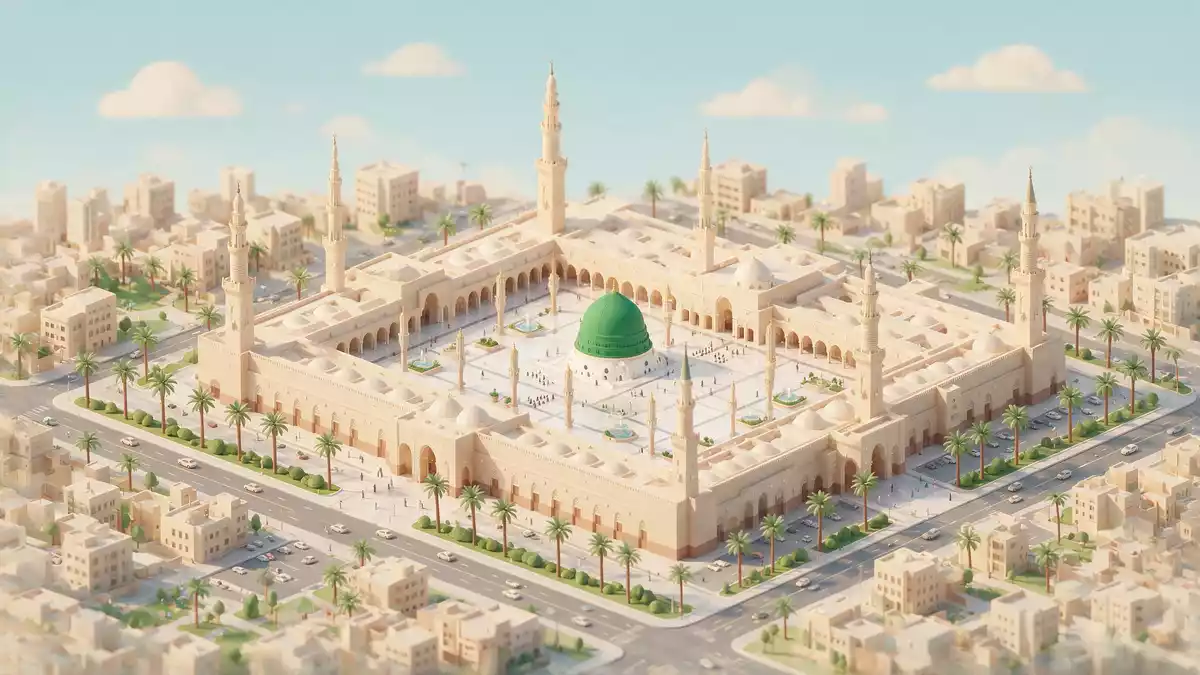
Al-Masjid an-Nabawi is a mosque in Medina whose visible form brings together an early Islamic foundation and centuries of expansion. Established by the Prophet Muhammad in 622 CE, it remains closely connected with the history of the Muslim community and the city around it.
Al-Masjid an-Nabawi began as a communal mosque
The first mosque on the site dates from the arrival of Muhammad and his followers in Yathrib, the settlement later known as Medina. Its early construction used palm trunks, mud walls and an open courtyard, creating a simple enclosure for prayer and communal life.
The mosque’s foundation belongs to the first year after the Hijra, the migration from Mecca to Medina. The original building was not an isolated monument. It was part of the religious, social and political centre of the early Muslim community, with prayer, teaching and public affairs connected to the same place.
From early enclosure to imperial architecture
Al-Masjid an-Nabawi changed substantially through successive expansions. The Umayyad caliph al-Walid I enlarged the mosque in the early eighth century, introducing a more monumental architectural language with stone construction, covered prayer areas and decorative work. the early mosque belongs to the architectural history of Yathrib and Medina.
Later dynasties repaired, rebuilt and extended the complex. Fire, structural damage and changing patterns of pilgrimage formed part of its long history, while Ottoman work added another layer to the building’s appearance. The mosque therefore presents Islamic architecture as a sequence of adaptations rather than a single period frozen in stone.
Domes, courtyards and the Green Dome
The contemporary complex is recognised by its broad marble courtyards, covered prayer spaces, many minarets and a large array of domes. Retractable umbrellas extend across open areas, while the Green Dome marks the chamber associated with the burial place of Muhammad.
The mosque also contains the burial places of Abu Bakr and Umar, the first two caliphs after Muhammad. This relationship between architecture and memory gives Al-Masjid an-Nabawi a distinctive place in Islamic history. the Green Dome is one visible feature within a much larger sacred complex.
The mosque’s scale reflects its role as a place of worship for pilgrims and residents. Its halls, courtyards, gates and shaded areas form an extensive urban religious landscape in central Medina. White marble, coloured stone, carved details and ornamental surfaces appear alongside contemporary engineering and services.
Visiting Al-Masjid an-Nabawi: what travellers from Western Europe should know
- Al-Masjid an-Nabawi stands in central Medina, in the Al-Haram district. Medina’s airport provides the principal air connection, while roads link the city with Mecca and other parts of Saudi Arabia.
- The complex contains broad paved courtyards, covered prayer halls, steps and large pedestrian approaches. Modest clothing and respectful conduct are part of the setting.
- The official language is Arabic and the currency is the Saudi riyal.
- Entry requirements depend on your nationality; UK travellers can check the FCDO travel advice at gov.uk/foreign-travel-advice, Irish travellers the Department of Foreign Affairs at ireland.ie.
Searching for Al-Masjid an-Nabawi on social platforms
These links open searches for Al-Masjid an-Nabawi on each platform.Frequently asked questions about Al-Masjid an-Nabawi
Where is Al-Masjid an-Nabawi?
Al-Masjid an-Nabawi is in Medina, Saudi Arabia. It occupies a central position within the historic city.
What can visitors expect to see?
The complex includes courtyards, covered prayer halls, marble surfaces, domes, minarets and retractable umbrellas. The Green Dome marks the burial chamber associated with Muhammad.
What makes the mosque distinctive?
Its identity joins a foundation established in 622 CE with repeated expansions across Islamic history. The mosque remains both an architectural complex and a major place of prayer and pilgrimage.


