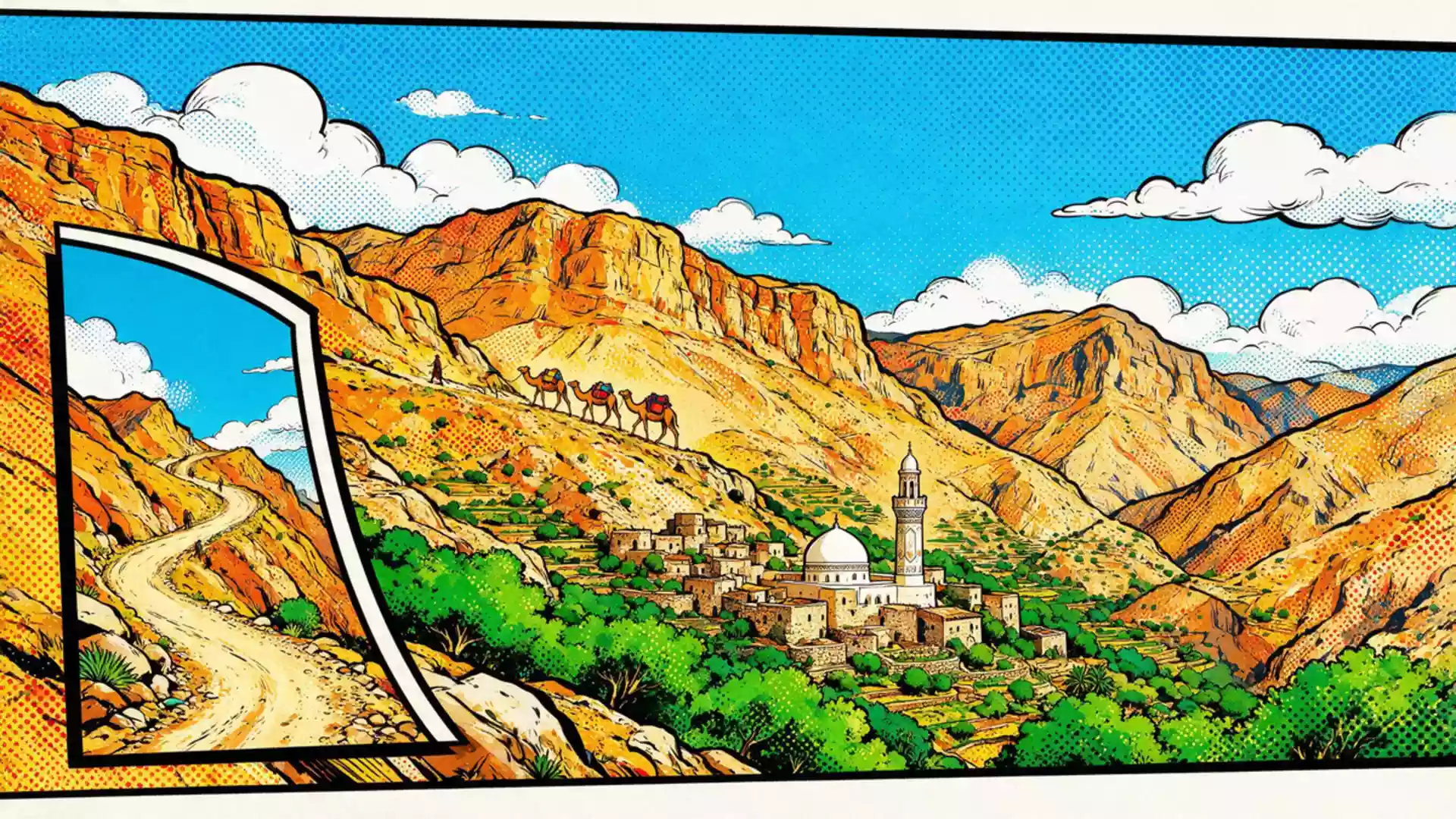
Al Jabal al Akhdar, the limestone highlands above Nizwa
Published on 09/01/2026 at 13:51 | Editorial responsibility: Rafael Müller, Editor-in-Chief AD HOC NEWS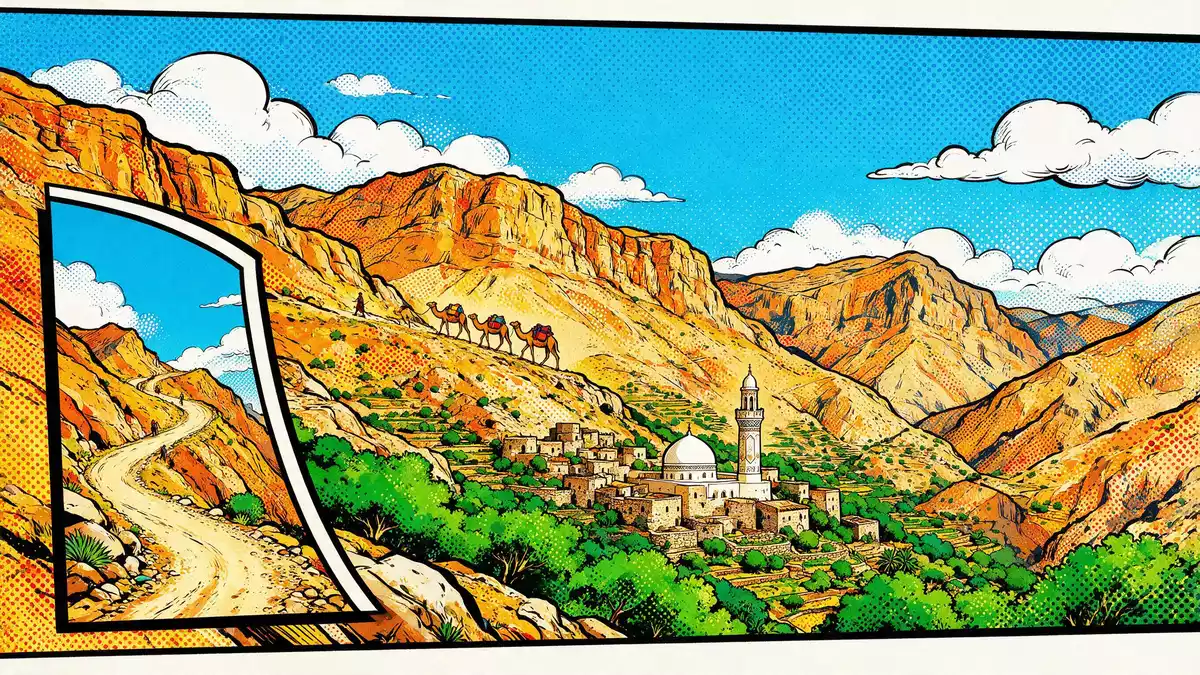
Al Jabal al Akhdar, “the Green Mountain”, is a high limestone massif north of Nizwa in Oman, forming part of the Western Hajar Mountains and rising to elevations of well over 2,000 m (6,562 ft). The Arabic name ???????? ?????????? refers to both the broader mountain range and, more specifically, the upland around the Saiq plateau in Ad Dakhiliyah Governorate.
A tabular mass in the Western Hajar
Seen from the surrounding lowlands, Al Jabal al Akhdar appears as a huge tabular mass of uplifted and greatly hardened limestone dominating the northern Oman mountains, with the wider range reaching up towards the twin peaks of Jabal Shams at about 2,980 m (9,777 ft).A huge tabular mass of uplifted limestone The mountain lies at the heart of Al Hajar, where steep rocky slopes and exposed pavements fall away into deep gorges on the southern side.
Geologically, Al Jabal al Akhdar is one of several large culminations of Permian to Cretaceous shelf carbonate rocks along the Oman Mountain range, formed as a very large-scale anticline whose strata dip away from a broad central high.A large-scale anticline with a Saiq plateau The rocks include dark grey crystalline limestones and dolomitic limestones with abundant marine fossils, along with older slates, mudstones and meta-volcanic units that reflect a complex tectonic history along the former Tethyan margin.Carbonate rocks of the Hajar Super Group
The Saiq plateau and terraced agriculture
Within the massif, the Saiq plateau forms a broad, relatively flat highland framed by craggy summits to the north and the deep incision of Wadi al Ayn to the south.The Saiq plateau framed by craggy summits For centuries, settlements have occupied pockets and terraces along its edges, where shallow soils and access to groundwater allowed cultivation despite the rocky surroundings.
The plateau and adjoining slopes are known for perennial crops grown on terraced fields, including pomegranates, walnuts and other temperate fruit trees that benefit from the altitude and cooler conditions at these elevations.Perennial crops cultivated on terraces In places, narrow runnels and small depressions in the limestone collect sediment, supporting shrubs and ground plants and contributing to the patchwork of cultivated and semi-natural vegetation across the upland.
Protected landscapes and steep geology
Al Jabal al Akhdar lies within the Wilayat of Nizwa in Ad Dakhiliyah Governorate, and part of its highland is designated as the Al Jabal al Akhdar Natural Landscapes Reserve, created in 2011 and covering an area of 122 km², much of it above 2,000 m (6,562 ft).Al Jabal al Akhdar Natural Landscapes Reserve The reserve reflects the ecological value of the high plateau and its steep slopes, where rainfall at these altitudes supports springs and distinctive biodiversity within the wider arid environment.
Across the massif, the terrain is very rocky and stony, with steep slopes, exposed pavements and limited soil cover, creating karstic topography where fractures and solution features influence how groundwater moves and emerges.Very rocky and stony mountain terrain Deep gorges dissect the southern side, and large boulders, stones and gravel mark runnels that carry episodic flows down towards the lower valleys, contrasting with the more gently inclined surfaces of the central plateau.
Visiting Al Jabal al Akhdar: what travellers from Western Europe should know
- Al Jabal al Akhdar rises north of Nizwa in the Western Hajar Mountains of Oman, reached by mountain roads that climb from lowland towns such as Birkat al Mawz towards the Saiq plateau.
- The terrain on the massif is steep and rocky, with high-altitude plateaus cut by deep gorges; paths and village approaches often involve substantial gradients and uneven ground.
- In winter, snow can fall on the higher parts of Al Jabal al Akhdar, and temperatures at altitude are markedly lower than in the surrounding plains.
- The official language is Arabic and the currency is the Omani rial.
- Entry requirements depend on your nationality; UK travellers can check the FCDO travel advice at gov.uk/foreign-travel-advice, Irish travellers the Department of Foreign Affairs at ireland.ie.
Searching for Al Jabal al Akhdar on social platforms
These links open searches for Al Jabal al Akhdar on each platform.
Frequently asked questions about Al Jabal al Akhdar
Where is Al Jabal al Akhdar in relation to Nizwa?
Al Jabal al Akhdar forms part of the Western Hajar Mountains in Ad Dakhiliyah Governorate and lies north of Nizwa within the Wilayat of Nizwa.
What kind of landscape should visitors expect on Al Jabal al Akhdar?
The massif combines high plateaus such as the Saiq plateau with steep limestone slopes, deep gorges, rocky pavements and terraced agricultural pockets.
What makes Al Jabal al Akhdar distinctive among Oman’s mountains?
Its combination of a broad limestone anticline, high-altitude plateau agriculture and a designated natural landscapes reserve gives Al Jabal al Akhdar a particular geological and ecological character.