
Al Fateh Grand Mosque and its vast domed prayer hall in Manama
Published on 09/07/2026 at 10:25 | Editorial responsibility: Rafael Müller, Editor-in-Chief AD HOC NEWS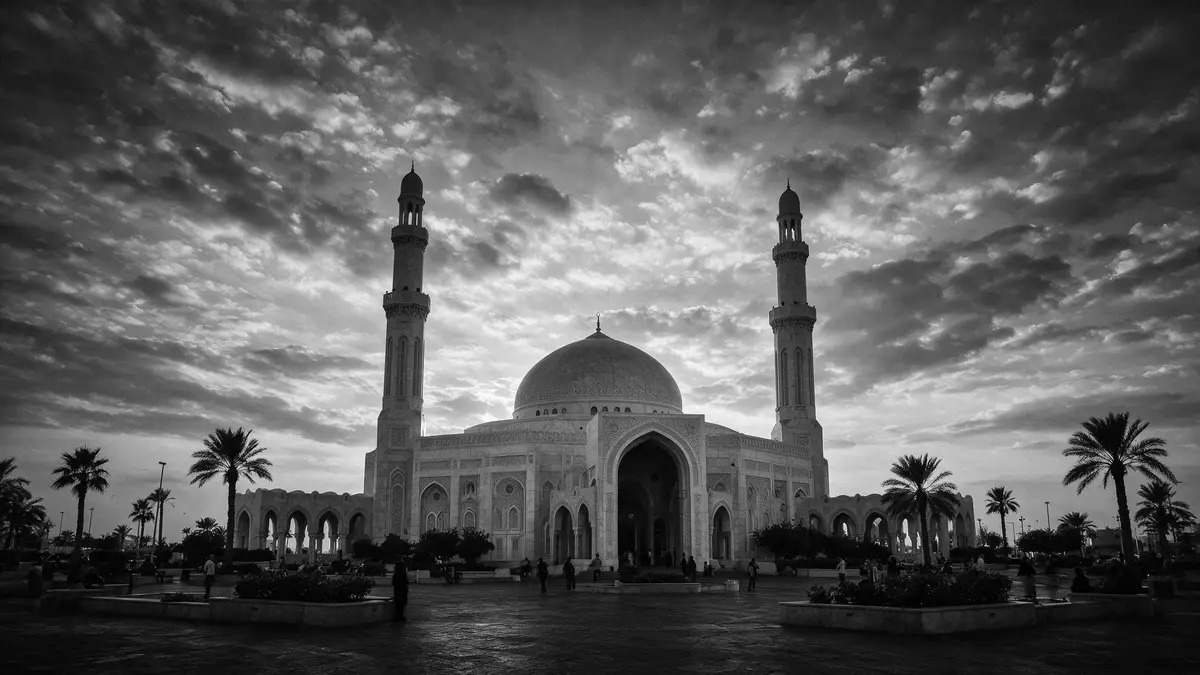
Al Fateh Grand Mosque in Manama is Bahrain’s principal place of worship and a landmark Islamic centre, known for its vast domed prayer hall and expansive marble interior. Completed in 1988 under the patronage of Sheikh Isa bin Salman Al Khalifa and named for Ahmed Al Fateh, it ties contemporary religious life to the islands’ eighteenth?century political origins.
A mosque built on a grand scale
Al Fateh Grand Mosque occupies around 6,500 m² (about 70,000 sq ft) in the Juffair district of Manama, forming a large rectangle of prayer halls and ancillary spaces set back from Awal Avenue and the Al Fateh Highway.The mosque occupies an area of 6,500 square meters The building is aligned towards the qibla with a principal façade and entrance sequence that lead into the main hall, which is designed to hold up to 7,000 worshippers on congregational occasions.accommodating 7,000 worshipers
The prayer hall is covered by a dominant central dome flanked by secondary domes and framed by two minarets, giving the complex a balanced, symmetrical outline against the low?rise skyline of Juffair.The mosque features two minarets and four domes The main dome is constructed from fibreglass and reaches a diameter of about 24 m (79 ft), a scale that makes it one of the largest fibreglass domes used in a mosque structure.world's largest fiberglass dome This combination of modern materials with traditional mosques’ volumetric forms is characteristic of the late twentieth?century period in which the complex was conceived.
Materials, craftsmanship and calligraphy
The surfaces of Al Fateh Grand Mosque are articulated through a palette of imported and regional materials that give the interior its distinctive character. The main floors are laid with Italian marble, creating broad expanses of pale stone underfoot that reflect light from chandeliers and wall fittings.flooring is Italian marble The principal doors and much of the timber work are made from teak sourced from India, adding a deep brown contrast to the lighter stone.doors were made of teak from India Above, the main chandelier is an imported Austrian piece, suspended from the central dome and surrounded by smaller fittings along the arcades.
Across the interior, Kufic calligraphy runs along cornices, walls and domes, spelling out Qur’anic verses in angular script that anchors the monumental architecture in the textual tradition of Islam.There is Kufic calligraphy throughout the mosque The overall layout follows established mosque typologies, with separate prayer halls for men and women, a mihrab set into the qibla wall, and subsidiary spaces dedicated to ablutions and circulation.separate prayer halls for men and women Together, these elements form a coherent example of Islamic architecture that combines large spans, repeated arches and domes with inscriptions and crafted surfaces.
An Islamic centre and national library
Al Fateh Grand Mosque forms part of a wider Islamic centre whose functions extend beyond the core religious ones. The complex incorporates departments for Qur’anic studies, an Islamic institute and programmes for the memorisation of the Qur’an, placing structured learning alongside daily prayers.the center includes the mosque, a department for Qur'anic studies and an Islamic library In 1988 Sheikh Isa bin Salman Al Khalifa, then Amir of Bahrain, formally opened the mosque, marking the completion of a project that had begun with a commissioning decision in the mid?1980s.The mosque was completed in 1988
The centre houses the National Library of Bahrain, integrated into the complex rather than set in a separate building.houses the National Library of Bahrain The library holds more than 7,000 books, including historical volumes and works of Islamic scholarship, making the site a repository of written culture as well as a place for worship.library of more than 7,000 books Naming the mosque for Ahmed Al Fateh, the eighteenth?century conqueror of Bahrain and ancestor of the ruling Al Khalifa family, further ties the building to the country’s dynastic history and gives the complex a commemorative dimension alongside its religious and educational roles.named after Ahmed Al Fateh
Visiting Al Fateh Grand Mosque: what travellers from Western Europe should know
- Al Fateh Grand Mosque stands in the Juffair district of Manama, at the corner of Awal Avenue and Al Fateh Highway, and is reached by road from the wider city.
- The complex includes large interior halls with expanses of marble flooring and stairways, and visitors cross sizeable indoor spaces on foot when moving between prayer areas and the library.
- The official language in Bahrain is Arabic and the national currency is the Bahraini dinar.
- Entry requirements depend on your nationality; UK travellers can check the FCDO travel advice at gov.uk/foreign-travel-advice, Irish travellers the Department of Foreign Affairs at ireland.ie.
Searching for Al Fateh Grand Mosque on social platforms
These links open searches for Al Fateh Grand Mosque on each platform.Frequently asked questions about Al Fateh Grand Mosque
Where is Al Fateh Grand Mosque located in Manama?
Al Fateh Grand Mosque is in the Juffair district of Manama, at the junction of Awal Avenue and Al Fateh Highway, in Bahrain’s capital city.
What should visitors expect during a visit?
Visitors encounter extensive marble?floored halls beneath a large fibreglass dome, with guided access arrangements that lead through prayer areas and the National Library of Bahrain.
What makes Al Fateh Grand Mosque distinctive among mosques in Bahrain?
Its combination of a vast late?twentieth?century prayer hall, fibreglass dome, imported materials and the integrated National Library of Bahrain gives the mosque a dual role as a religious and cultural centre.


