
Akropoli Lindou rises above Lindos on a layered cliff
Published on 09/24/2026 at 01:51 | Editorial responsibility: Rafael Müller, Editor-in-Chief AD HOC NEWS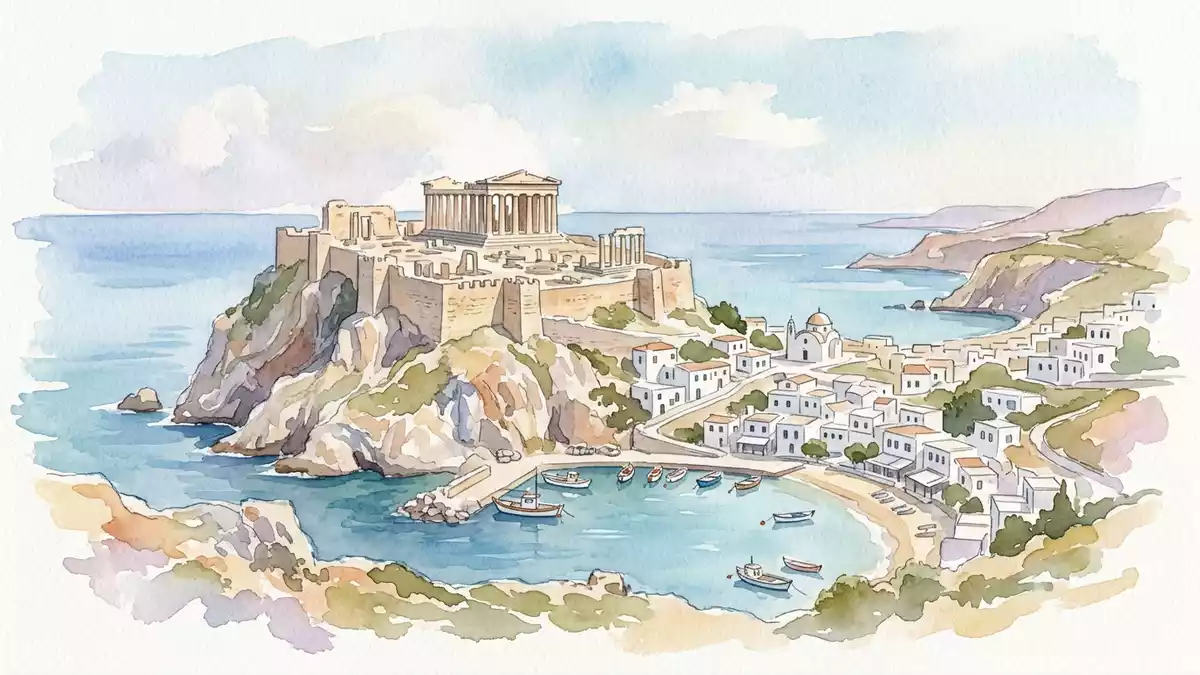
Akropoli Lindou rises above Lindos as a rocky citadel layered with Greek temples, medieval fortifications and open views across the coast of Rhodes. Its most recognisable monument is the Doric Temple of Athena Lindia, whose present form belongs to about 300 BC.
Akropoli Lindou and the cliff above Lindos
The acropolis occupies the summit of a limestone cliff rising 116 m (381 ft) above Lindos. The village gathers below the rock, while the archaeological remains extend across the upper plateau and its fortified approaches.
The height gives the site a clear physical identity. White buildings in Lindos sit beneath a darker band of rock, and the summit carries columns, walls, stairways and fragments from several periods. The setting joins settlement, sanctuary and fortress within one compact landscape.
Athena Lindia at the centre of the sanctuary
Worship of Athena Lindia is documented from the ninth century BC. The sanctuary became the principal ancient focus of the acropolis, with the Doric temple occupying the highest part of the site.
The temple’s surviving form dates to about 300 BC and belongs to the Hellenistic period. Its columns and foundations remain among the clearest ancient features on the summit, while the surrounding precinct preserves the scale of the former sanctuary. A layered archaeological site records Archaic, Classical and Hellenistic remains.
Greek sanctuary, Byzantine walls and Knights’ castle
Akropoli Lindou is not an ancient monument isolated from later history. Byzantine fortifications and the medieval castle associated with the Knights of St John occupy parts of the same summit.
The approach includes monumental stairs, gateways and surviving walls. The Hellenistic stoa formed part of the route into the sanctuary, while a Byzantine church dedicated to Saint John represents a later religious phase. The combination is visible in the masonry, layout and changing uses of the hilltop.
The Knights of St John fortified the acropolis during the medieval period. Their walls enclose and overlap the ancient remains, creating a site where Doric architecture, Hellenistic planning and medieval defensive construction share the same rock. The monuments of the acropolis include the temple, porticoes, towers, a church and a relief of a Rhodian ship.
The acropolis also belongs to the history of Lindos as an ancient Dorian city. Its sanctuary, fortifications and elevated position connect the town below with the wider history of Rhodes and the eastern Aegean. The Doric temple of Athena is dated to the fourth century BC in descriptions of the archaeological remains.
Visiting Akropoli Lindou: what travellers from Western Europe should know
- Akropoli Lindou stands above Lindos on the east coast of Rhodes. Lindos is reached by road from Rhodes Town, and the final approach to the summit continues on foot.
- The ascent follows a steep route over uneven ground and stone steps. The hilltop is exposed, with the archaeological remains spread across elevated rock.
- The site combines ancient ruins with medieval walls. Comfortable footwear suits the stone approach and the uneven surfaces around the sanctuary.
- The official language is Greek and the currency is the euro.
Searching for Akropoli Lindou on social platforms
These links open searches for Akropoli Lindou on each platform.
Frequently asked questions about Akropoli Lindou
Where is Akropoli Lindou?
Akropoli Lindou stands above Lindos on the east coast of Rhodes, Greece. The archaeological site occupies a rocky summit above the village.
What can visitors see there?
The remains include the Doric Temple of Athena Lindia, Hellenistic architectural elements, monumental stairs, Byzantine features and medieval fortifications.
What makes the site distinctive?
Ancient sanctuary remains and a castle associated with the Knights of St John share the same 116 m (381 ft) cliff above Lindos. The summit presents several historical periods within one elevated complex.


