
Akropoli Lindou rises above Lindos in layers of history
Published on 09/23/2026 at 21:31 | Editorial responsibility: Rafael Müller, Editor-in-Chief AD HOC NEWS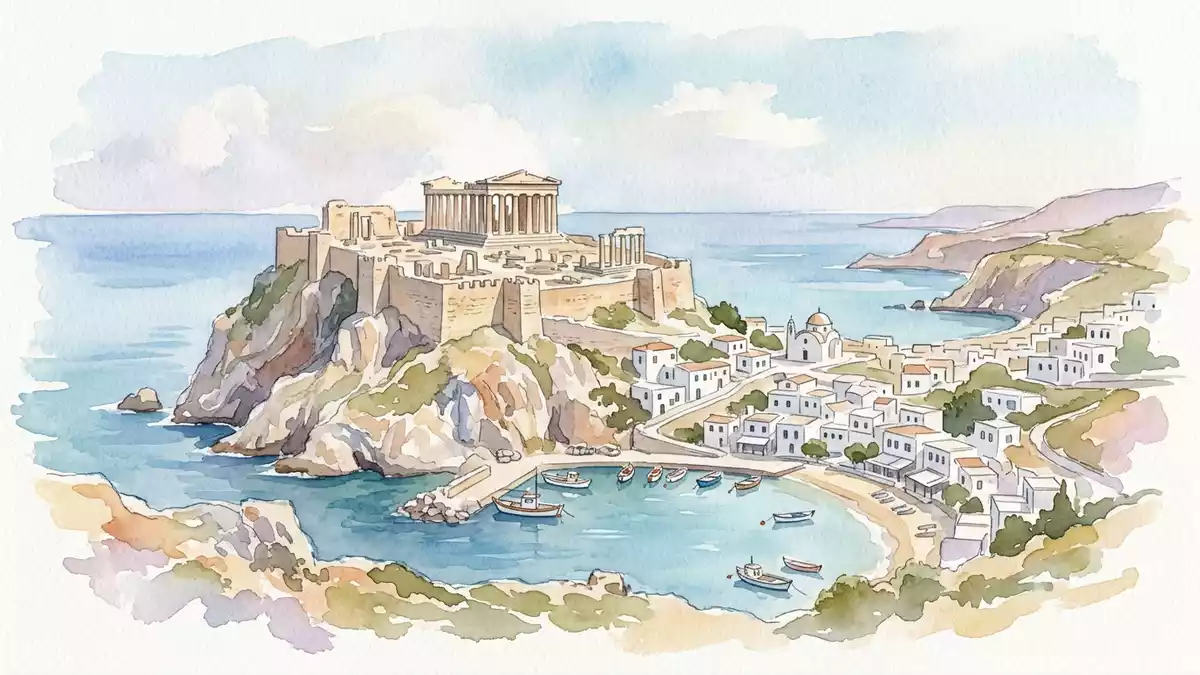
Akropoli Lindou crowns a steep rocky height above Lindos on the east coast of Rhodes. The summit gathers a Doric temple, a Hellenistic stoa, monumental gateways and a medieval fortress within one compact archaeological landscape.
Akropoli Lindou and the sanctuary of Athena Lindia
The sanctuary’s central monument is the Doric Temple of Athena Lindia, whose final form dates to about 300 BC. It occupies the highest part of the rock, above the terraces and gateways of the sacred precinct. Temple of Athena Lindia remains the defining name of the summit.
Lindos was one of the ancient cities of Rhodes, and Athena Lindia was worshipped at the acropolis across successive periods. The visible remains belong to an archaeological complex rather than a single building, with Archaic, Classical, Hellenistic, Roman and medieval elements occupying adjoining terraces.
From Propylaea to the Hellenistic stoa
The approach rises through a monumental staircase towards the Propylaea of the sanctuary. These formal entrance structures date from the fourth century BC and mark the threshold of the upper sacred area. A relief of a Rhodian trireme is cut into the rock below the main stairway.
The Hellenistic stoa forms another major surviving element. Built around 200 BC, it extended for 87 metres and had 42 columns. The long colonnaded building sits below the temple terrace, giving the acropolis a strong horizontal line beneath its highest point. Hellenistic stoa details help distinguish the sanctuary’s layered plan from the isolated image of a temple on a hill.
A medieval fortress around an ancient summit
The ancient sanctuary later shared the rock with Christian and Byzantine structures, followed by the Castle of the Knights of St John. The Knights fortified the acropolis in the fourteenth century, enclosing parts of the older archaeological complex with walls and defensive architecture.
This combination gives Akropoli Lindou its visible character. The temple belongs to the religious architecture of ancient Greece, the stoa and Propylaea express Hellenistic planning, and the castle walls belong to medieval Rhodes. Lindos historical layers record the sequence of occupations associated with the summit.
Visiting Akropoli Lindou: what travellers from Western Europe should know
- Lindos lies on the east coast of Rhodes. Public buses, cars and taxis reach the village, while the final approach to Akropoli Lindou continues on foot.
- The village is car-free, with narrow stepped lanes leading towards the archaeological site. The ascent includes steep paths and the monumental staircase beneath the Propylaea.
- The acropolis stands on a rocky height above Lindos, with views towards the village, the coast and St Paul’s Bay.
- The official language is Greek and the currency is the euro.
Searching for Akropoli Lindou on social platforms
These links open searches for Akropoli Lindou on each platform.
Frequently asked questions about Akropoli Lindou
Where is Akropoli Lindou?
Akropoli Lindou is above Lindos on the east coast of Rhodes, Greece. The archaeological site occupies a steep rocky height overlooking the village and the coast.
What can visitors see there?
The summit contains the Temple of Athena Lindia, the Propylaea, the Hellenistic stoa, a monumental staircase, rock-cut remains and medieval fortifications.
What makes the site distinctive?
Akropoli Lindou combines an ancient sanctuary with Hellenistic colonnades and a medieval castle on the same elevated rock. Its layered architecture is visible across the terraces above Lindos.


