
Akropoli Lindou: layered citadel above the harbour of Lindos
Published on 09/05/2026 at 18:41 | Editorial responsibility: Rafael Müller, Editor-in-Chief AD HOC NEWS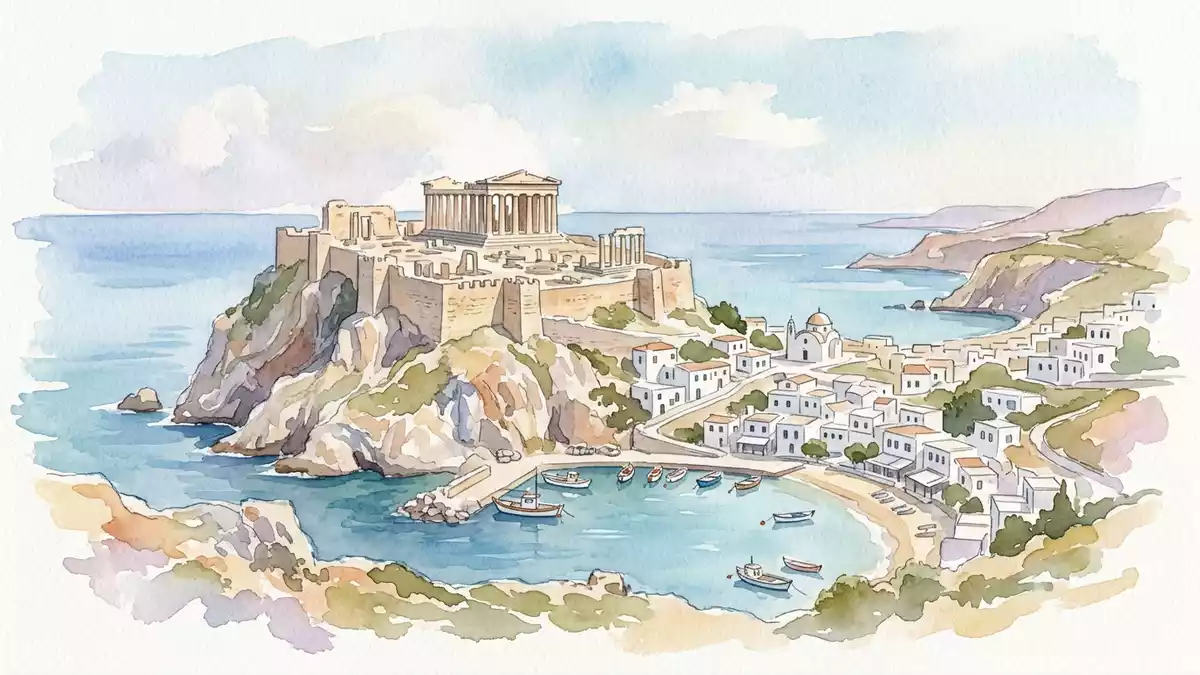
Akropoli Lindou crowns a rocky headland above the harbour of Lindos on the east coast of Rhodes in Greece, bringing together an ancient sanctuary and a medieval fortress on a single cliff.
A natural citadel on a sea cliff
The rock carrying Akropoli Lindou forms a steep headland that drops to the Aegean Sea and the small bay of Lindos, giving the site wide views in several directions over water and coast.a natural citadel The cliff reaches about 116 m (381 ft) above sea level according to several archaeological descriptions, and the summit area holds most of the visible remains.116 m high cliff From the modern village below, paths and stairways climb through whitewashed houses towards the rock, with the fortification walls and temple platform progressively entering view.
The overall impression on the summit is of an enclosed precinct where ancient walls, later defences and terraces form a compact ensemble on limited space. The approach from the town leads to a stair at the base of the citadel and then up to a gateway complex, beyond which the main sanctuary terrace opens. The headland falls away steeply to the north and east towards the sea, while inland slopes and hills frame the wider landscape.
Sanctuary of Athena Lindia and Hellenistic architecture
Akropoli Lindou is best known for the sanctuary dedicated to Athena Lindia, whose cult was central to the ancient city of Lindos from the Geometric and Archaic periods onwards.sanctuary dedicated to Athena Lindia The Doric Temple of Athena Lindia visible in ruins on the summit dates from about 300 BC and replaced an earlier Archaic temple destroyed by fire in the fourth century BC.Doric Temple of Athena Lindia dating from about 300 BC Its stone platform and column bases remain a focal point, framed by retaining walls and stairways that mark the sacred area.
The sanctuary complex grew into a major Hellenistic ensemble with a monumental stair and Propylaea, modelled in plan on the Propylaea of the Athenian Acropolis, leading up to the temple terrace.U-shaped Propylaea on the model of the Acropolis in Athens Beside the stair, a large stoa shaped as a Greek ? opened to the north, providing a long colonnaded frontage and symmetrical wings around the central staircase.large stoa shaped ? Greek Inscriptions and archaeological studies record further cult buildings, including areas linked to Zeus Polieus and other deities, although the principal focus remained Athena Lindia throughout the Hellenistic and Roman periods.principal deity of the sanctuary
Fortress walls and medieval layers
The natural strength of the cliff made Akropoli Lindou a defensive site long before the medieval period, and successive powers fortified it as a citadel above the harbour town. The summit carried fortifications used by Greeks, Romans and Byzantines, and later by the Knights Hospitaller and the Ottomans, who each added their own walls and towers.fortified successively by the Greeks, the Romans, the Byzantines, the Knights of St John and the Ottomans Present-day visitors encounter curtain walls and gateways that largely follow the lines of the medieval castle built under the Knights of St John, whose rule on Rhodes lasted from 1306 to 1522.Knights Hospitaller phase from 1306 to 1522
Among later structures, a small chapel dedicated to Saint John marks the Byzantine Christian presence within the ancient precinct, with its remains sitting near the temple terrace described in archaeological surveys.Byzantine chapel of Saint John Ottoman artillery defences were added after 1522, giving the summit a layered profile where ancient cult architecture, medieval ramparts and early modern military work stand close together.Ottoman artillery defenses The mix of periods is clear in the masonry: large blocks of Hellenistic stonework underlie crenellated walls from the time of the Knights, while later repairs appear in different construction techniques.
Visiting Akropoli Lindou: what travellers from Western Europe should know
- Akropoli Lindou stands directly above Lindos on the east coast of Rhodes in Greece; approaches start in the village streets and lead uphill to the archaeological entrance.
- The ascent from Lindos to the summit runs over stepped paths and stairways on a steep slope, with sections inside fortification walls and exposed areas near the cliff.
- The wider setting includes Lindos Bay below the headland and further coves and beaches along the Rhodes coastline, which are visible from the summit terraces in clear conditions.
- The official language is Greek and the currency is the euro.
Searching for Akropoli Lindou on social platforms
These links open searches for Akropoli Lindou on each platform.
Frequently asked questions about Akropoli Lindou
Where is Akropoli Lindou located?
Akropoli Lindou stands above the town of Lindos on the east coast of the island of Rhodes in Greece, on a high rocky headland facing the Aegean Sea.
What should visitors expect on a visit?
Visitors encounter archaeological remains of the sanctuary of Athena Lindia, Hellenistic terraces and stoas, medieval fortress walls and wide coastal views from the summit area.
What makes Akropoli Lindou distinctive?
Akropoli Lindou is distinctive for its combination of a Doric temple of Athena from about 300 BC, Hellenistic gateway architecture and later fortifications, all concentrated on a single sea cliff above Lindos.


