
Akropoli Lindou and the layered citadel above Lindos
Published on 08/21/2026 at 12:41 | Editorial responsibility: Rafael Müller, Editor-in-Chief AD HOC NEWS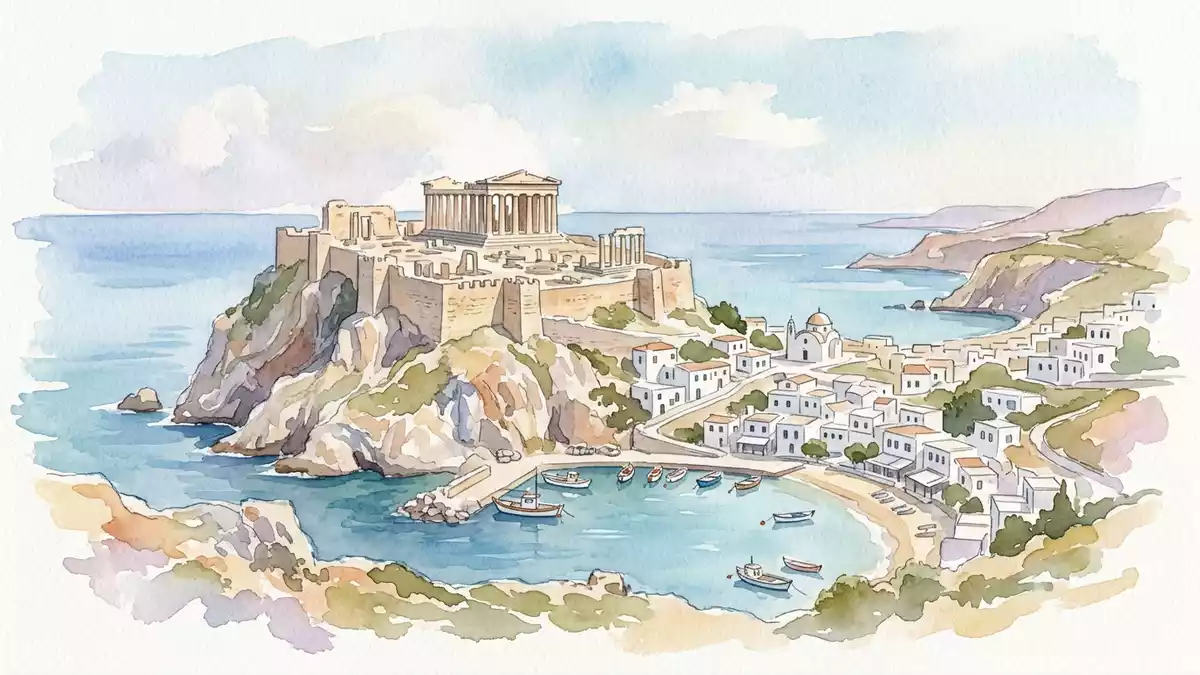
Akropoli Lindou crowns a rocky headland above the village of Lindos on the island of Rhodes, where an ancient sanctuary of Athena Lindia shares space with medieval fortifications in a single compact citadel. The site developed across the Archaic, Classical and Hellenistic periods and remained in use under Byzantine, crusader and Ottoman rule, turning one rock into a visible cross-section of Greek and Mediterranean history.
A rocky citadel shaped by sea and stone
The core of Akropoli Lindou stands on a natural promontory on the east coast of Rhodes, rising above the shoreline at an elevation given as about 116 m (381 ft) in several archaeological descriptions.a natural rock sanctuary The headland projects between bays and offers clear views along the Dodecanese coastline, with the clustered houses of Lindos directly below. From the village, the acropolis appears as a jagged crown of walls and columns set against the sky, emphasising its long-standing role as a landmark for sailors approaching this stretch of the Aegean.
Archaeological surveys record traces of human activity on the rock dating back to the Neolithic and Bronze Age, with more substantial settlement and cult structures emerging in the early first millennium BC.evidence of early occupation In the mid sixth century BC, the tyrant Kleoboulos of Lindos is associated with the first substantial stone buildings on the summit, anchoring the sanctuary to the political life of the ancient city. Later, under Hellenistic rulers, the rock was reshaped into a series of terraces, with retaining walls and staircases cut or built into the slope to create broad platforms for temples, stoas and gateways.
The sanctuary of Athena Lindia in stone and terrace
The religious heart of Akropoli Lindou is the Doric Temple of Athena Lindia, whose surviving form dates to around 300 BC and stands on the summit plateau.the Doric Temple of Athena Lindia The temple occupies the highest point of the acropolis, its foundations and column bases outlining a rectangular cella and surrounding colonnade in the familiar language of Greek temple architecture. Fragments of steps, stylobates and column drums mark where worshippers once approached the goddess, while blocks carved with mouldings hint at the decorative programme that framed the cult statue inside.
Access to this sanctuary is organised through a formal sequence typical of Hellenistic monumental design. A broad staircase climbs towards a set of propylaea, the ceremonial gateways that controlled movement between terraces, before leading visitors further up to the temple itself.monumental staircases and propylaea Along one side of the terrace, the remains of a long stoa indicate a sheltered colonnaded walkway that once framed views across the lower town and sea. Together, these elements give the acropolis a stepped, almost theatrical layout, in which processions and gatherings unfolded across a carefully ordered architectural landscape.
From ancient sanctuary to medieval stronghold
Beyond the sanctuary, Akropoli Lindou preserves the outlines of successive defensive works built by different powers that controlled Rhodes. The rock was fortified by classical Greek communities, then incorporated into the Roman world, before being adapted by Byzantine authorities as a fortified refuge above the coastal settlement.successive phases of fortification Later, the Knights of St John, who ruled Rhodes from the early fifteenth century until the Ottoman conquest in 1522, rebuilt and strengthened the acropolis as part of their defensive network in the eastern Mediterranean.
Visible today are curtain walls, bastions and gate structures attributed to these medieval and early modern phases, enclosing the ancient terraces and temples within a later shell.a multi-layered archaeological site Inside the enclosure, the footprint of the castle of the Knights of St John overlaps earlier foundations, while traces of a small Byzantine chapel dedicated to Saint John add a further religious layer to the already complex sacred landscape. The juxtaposition of Doric columns with crenellated walls and Christian masonry makes Akropoli Lindou a compact lesson in how sacred and military functions could intertwine on a strategically placed rock.
Visiting Akropoli Lindou: what travellers from Western Europe should know
- Akropoli Lindou stands above the village of Lindos on the east coast of the island of Rhodes in Greece, reached from the village by a steep pathway that climbs the rocky headland.
- The ascent from Lindos involves a sustained uphill walk over stone paving and steps, with limited shade on parts of the route and further staircases inside the archaeological site.
- Lindos lies south of Rhodes Town on the island road network, and buses and hire cars alike converge on the village before visitors continue on foot towards the acropolis.
- The official language is Greek and the currency is the euro.
Searching for Akropoli Lindou on social platforms
These links open searches for Akropoli Lindou on each platform.
Frequently asked questions about Akropoli Lindou
Where is Akropoli Lindou?
Akropoli Lindou is on the east coast of the Greek island of Rhodes, directly above the village of Lindos and facing the Aegean Sea.
What should visitors expect at Akropoli Lindou?
Visitors encounter a combination of ancient Greek temple remains, monumental staircases and medieval fortifications clustered on a rocky headland above a traditional village.
What makes Akropoli Lindou distinctive among ancient sites?
Akropoli Lindou combines the Doric Temple of Athena Lindia, Hellenistic terraces and later fortifications by powers such as the Knights of St John on a single compact rock plateau.


