
Akropoli Lindou and the layered acropolis above Lindos
Published on 08/27/2026 at 08:03 | Editorial responsibility: Rafael Müller, Editor-in-Chief AD HOC NEWS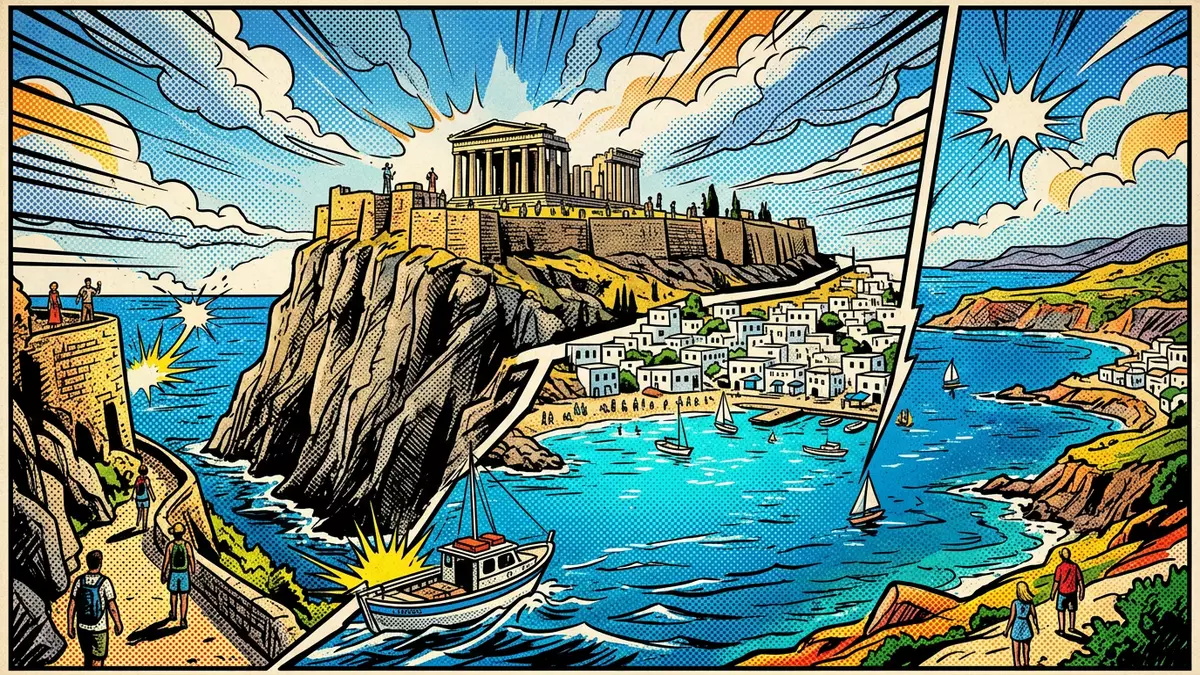
Akropoli Lindou rises above Lindos as a stacked archaeological site of Greek, medieval and Byzantine stone. The acropolis crowns the ridge above the town, with the Temple of Athena Lindia, the Knights of St John fortress and later religious remains in one compact complex.
Greek sanctuaries above Lindos
The earliest remains belong to the Greek sanctuary of Athena Lindia, whose temple reached its final form around 300 BC. Lindos preserves that classical core alongside later additions, so the site reads as a long sequence of occupation rather than a single monument.
On the acropolis, the Propylaea and stoa belong to the Hellenistic phase, and the rock-cut trireme relief lies below the approach steps. The relief of a Rhodian warship, the stairway and the colonnaded stoa give the hilltop an unusually dense arrangement of features.
Medieval fortifications on ancient foundations
The Knights of St John left the most visible medieval layer, with a fortress built on the acropolis in the fourteenth century. the island of Rhodes frames the site, while the castle walls follow the cliff edge and reuse the summit’s natural outline.
This later fortification sits over older structures without erasing them completely. The result is a place where column bases, stairways, walls and towers occupy the same hilltop and remain readable as separate phases.
The acropolis as a landscape of stone
Akropoli Lindou is as much a cliff-top landscape as an archaeological site. The height above Lindos is visible from the village, and the steep rock gives the acropolis a sharp edge against the sea.
The surviving fabric includes a Doric temple, a Hellenistic stoa, a fortress and a Byzantine church of St John. That variety, gathered on a single ridge, makes the site one of Rhodes’s clearest places for reading change in built form.
Visiting Akropoli Lindou: what travellers from Western Europe should know
- The acropolis stands above Lindos on Rhodes, on the island’s south-east coast. It is reached on foot from the village streets and the climb ends on exposed rock and stepped surfaces.
- The route includes stairways, uneven stone and narrow passages between surviving walls. Comfortable footwear matters more here than distance.
- The official language is Greek and the currency is the euro.
- Entry requirements depend on your nationality; UK travellers can check the FCDO travel advice at gov.uk/foreign-travel-advice, Irish travellers the Department of Foreign Affairs at ireland.ie.
Searching for Akropoli Lindou on social platforms
These links open searches for Akropoli Lindou on each platform.
Frequently asked questions about Akropoli Lindou
Where is Akropoli Lindou?
It sits above Lindos on Rhodes, on the eastern side of the island in Greece. The hilltop overlooks the town and the coastline.
What does a visit involve?
The route climbs through stone paths, steps and older masonry before reaching the summit area. The site combines open views with dense ruins and fortress walls.
What makes it distinctive?
Its value lies in the layering of periods: classical sanctuary, Hellenistic buildings, medieval fortifications and later church remains. Few hilltop sites on Rhodes present that sequence so clearly.
How does the acropolis relate to Lindos?
The town lies below the ridge, and the acropolis forms the most prominent part of the wider settlement. The two are read together, with the hill defining the approach to the village.


