
Akropoli Lindou above sea and village in Rhodes
Published on 09/12/2026 at 14:02 | Editorial responsibility: Rafael Müller, Editor-in-Chief AD HOC NEWS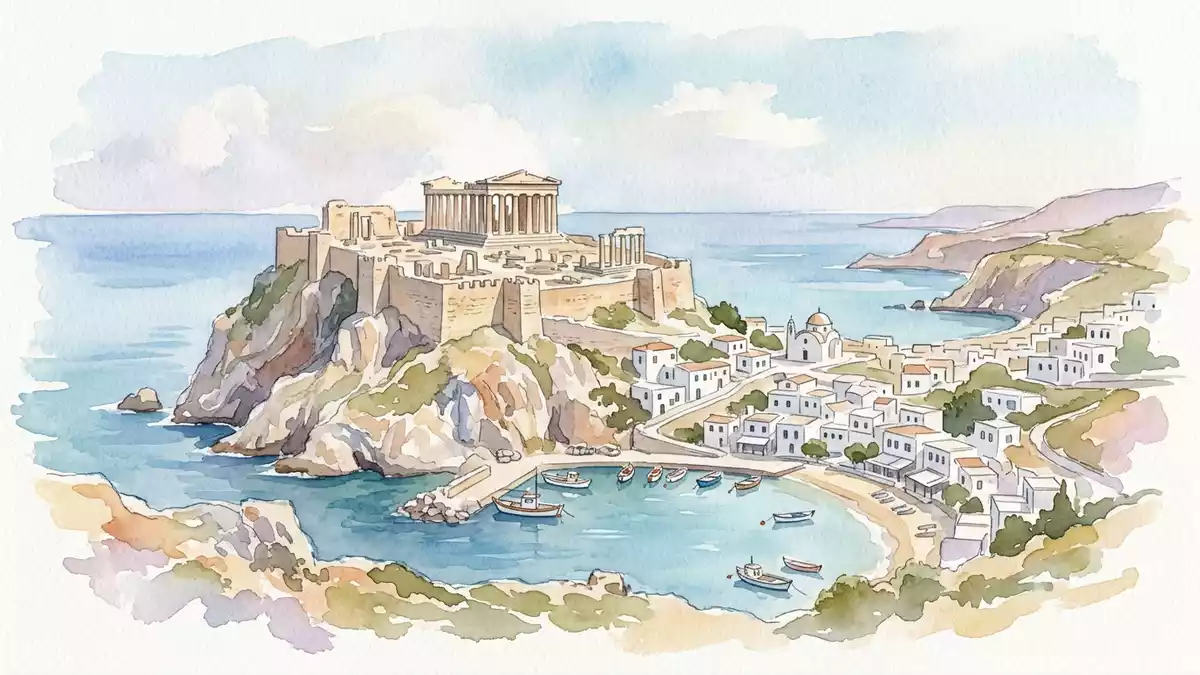
Akropoli Lindou is the high rocky headland that rises above the whitewashed village of Lindos on the east coast of Rhodes in Greece, combining an ancient sanctuary with later fortifications in one compact acropolis. The site is closely associated with the Doric Temple of Athena Lindia, whose surviving remains belong to the late classical and Hellenistic periods.
A cliff-top acropolis above the Aegean
The acropolis occupies the summit and upper slopes of a steep rock above Lindos, reaching around 116 m (381 ft) above the surrounding bays and the lower town.sits atop a 116-metre vertical cliff From the plateau, the terrain falls away sharply towards the sea, giving broad views over the east coast of Rhodes and the nearby coves that cut into the shoreline.built on a steep cliff 116 metres The rock itself forms a natural citadel, and the surviving walls follow the edges of the headland to enclose the sacred and defensive buildings.
Approaching Akropoli Lindou from the village, the contrast between the dense cluster of houses and the stark cliff above is immediate. Narrow lanes and stepped paths wind upwards through Lindos before reaching the medieval gateway, where masonry rises directly from the rock and the fortified outline of the acropolis becomes clear.rising above the town of Lindos on a steep rock Once inside, the summit opens into terraces linked by stairways, with remains of different eras arranged around the edges.
Sanctuary of Athena Lindia and Hellenistic terraces
The core identity of Akropoli Lindou lies in its ancient sanctuary dedicated to Athena Lindia, a cult attested from the early first millennium BC.Doric Temple of Athena Lindia The temple whose columns stand on the upper terrace belongs to around 300 BC and is part of the Doric architectural tradition of the period.temple visible today dates in its final form to around 300 BC Its platform is reached by a broad staircase and framed by retaining walls that support the sanctuary level above the lower works. Around the temple, fragments of colonnades and foundations suggest processional routes and viewing points along the edge of the cliff.
Below the main sanctuary terrace, visitors encounter structures from the Hellenistic period that shaped the acropolis as a monumental approach. One of the most striking elements is a carved relief of a warship, a trireme, dating to the second century BC and cut directly into the rock near the base of the acropolis.relief trireme of the 2nd century BC Higher up, the remains of Propylaea, galleries and stoas form a sequence of spaces that mark the transition from the outer approach to the inner sacred precinct. Together they show how the ancient builders turned the narrow summit into a layered sanctuary with distinct levels and vistas.
Medieval fortifications on an ancient summit
Akropoli Lindou carries not only classical remains but also fortifications from later powers that controlled Rhodes. The natural citadel was strengthened by Byzantine builders and then refortified by the Knights of St John in the fourteenth century, whose castle walls still dominate parts of the perimeter.fortified by the Byzantines, and finally refortified by the Knights of St John in the 14th century Towers, curtain walls and gateways from this period wrap around sections of the earlier sanctuary, binding the ancient terraces into a single fortified compound.
Inside the enclosure, medieval and later structures stand alongside the classical remains. There is a small Byzantine church dedicated to St John, built within the precinct, and buildings associated with the Knights’ headquarters arranged near the entrance.Byzantine church of St. John and the Headquarters of the Knights’ period Walking across the summit, the visitor moves between different stone fabrics and construction styles, reading the acropolis as a palimpsest of Greek, medieval and later interventions that all occupy the same confined rock.
Visiting Akropoli Lindou: what travellers from Western Europe should know
- Akropoli Lindou stands above the village of Lindos on the east coast of Rhodes in Greece, reached on foot from the car-free centre through stepped lanes and paths.
- The upper parts of the acropolis are accessed by stairways on the rock and within the fortifications, with sustained climbs over uneven stone and many steps.
- The terrain on the summit consists of exposed terraces and stone surfaces with little natural shade, so the acropolis feels markedly elevated over the bays and town below.
- Lindos is connected to Rhodes Town by road and scheduled buses, and motorists leave vehicles outside the village before walking up towards the acropolis.
- The official language in this part of Greece is Greek and the currency is the euro.
Searching for Akropoli Lindou on social platforms
These links open searches for Akropoli Lindou on each platform.
Frequently asked questions about Akropoli Lindou
Where is Akropoli Lindou located?
Akropoli Lindou rises above the village of Lindos on the east coast of Rhodes in Greece, on a steep cliff overlooking nearby bays and the Aegean Sea.
What can visitors expect on a visit?
Visitors encounter ancient terraces, the remains of the Doric Temple of Athena Lindia, medieval fortification walls and gateways, and broad views over Lindos and the surrounding coastline.
What makes Akropoli Lindou distinctive?
The acropolis combines a late classical sanctuary and Hellenistic reliefs with Byzantine and Knights of St John fortifications on a single narrow rock, creating a rare concentration of periods on one summit.


