Akropoli Lindou: a layered acropolis above Lindos
Published on 09/09/2026 at 20:15 | Editorial responsibility: Rafael Müller, Editor-in-Chief AD HOC NEWS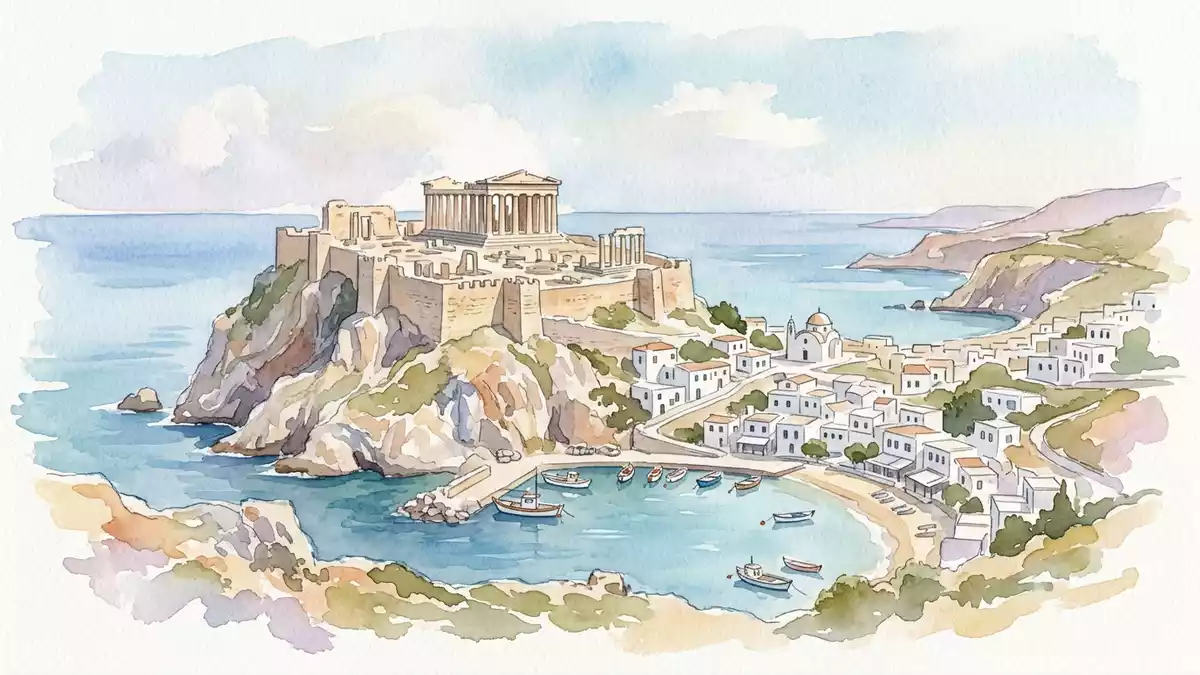
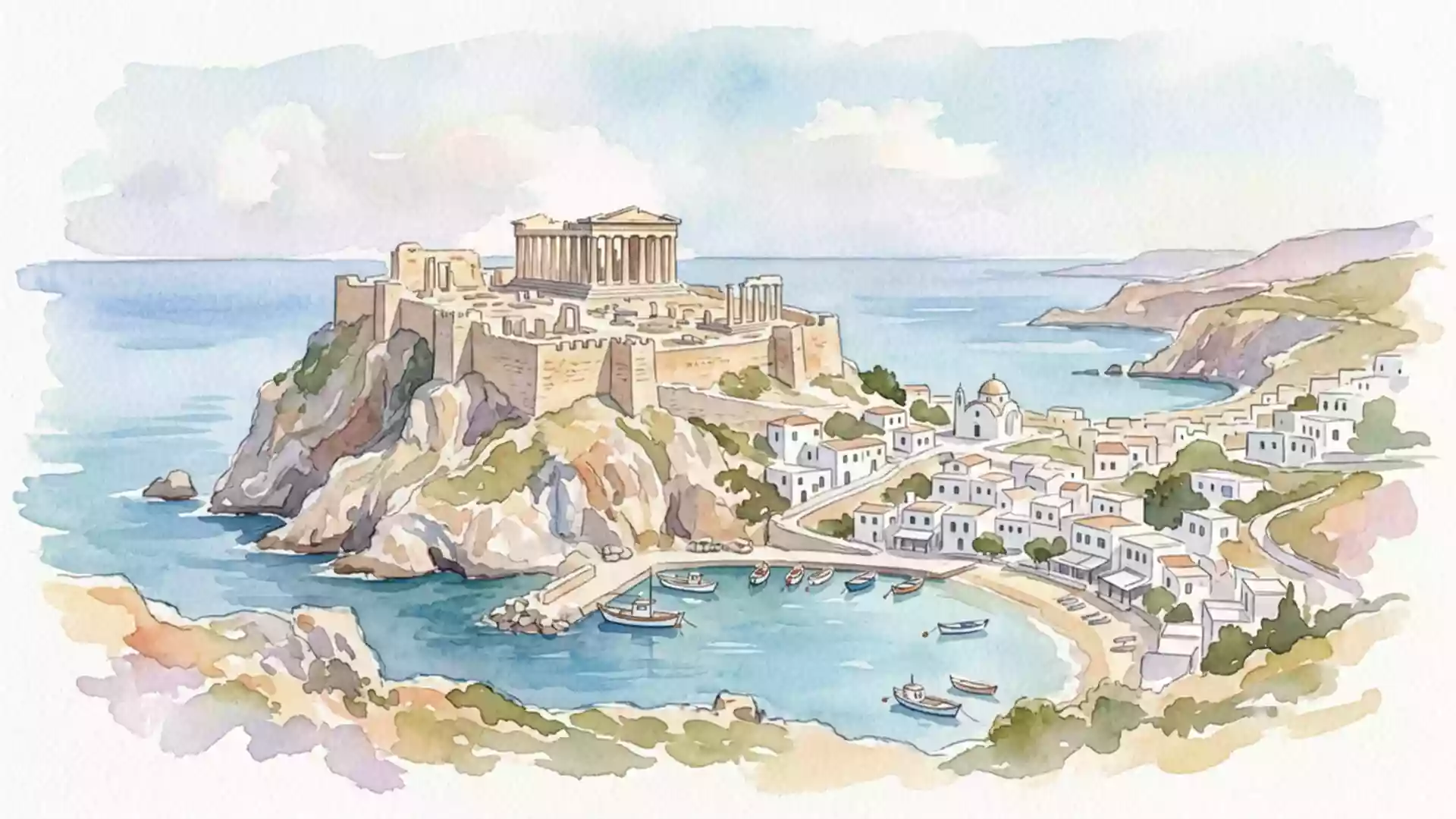
Akropoli Lindou crowns a rocky headland above the coastal town of Lindos on Rhodes, bringing together an ancient sanctuary of Athena and later fortifications in a single, compact site. The acropolis forms a natural citadel on a cliff above the Aegean Sea and preserves remains from the Archaic, Classical, Hellenistic and medieval periods in one concentrated panorama of Greek history.
A cliff-top sanctuary of Athena above the Aegean
The defining experience of Akropoli Lindou is its position on a high rock directly above Lindos and the bays on the island’s east coast. The acropolis occupies the summit and upper slopes of a steep cliff that rises around 116 m (381 ft) above the sea, with the whitewashed houses of Lindos clustered below and the coast stretching away towards the wider Dodecanese.116 m high cliff From the upper terraces the view reaches along the coastline and down into small coves, including St Paul’s Bay, which curves around a sheltered inlet to the south of the headland.
The cliff itself forms the base of the sanctuary, giving the acropolis a pronounced vertical character that visitors are aware of from the moment they see the rock from the village lanes. Paths and stairways climb through gateways and across terraces, linking the lower fortifications with the upper religious precinct. In the height of summer the stone is bright under the sun, while in the cooler months the rock and sea take on softer colours, but in every season the relationship between the high plateau, the settlement below and the surrounding water is the structure’s most immediate feature.steep cliff above Lindos
Temple, stoas and reliefs: the ancient remains
Akropoli Lindou is best known for the remains of the sanctuary of Athena Lindia, whose Doric temple stands on the highest part of the rock. The temple in its visible form dates to around 300 BC and replaced an earlier structure, placing it firmly in the Hellenistic period.Doric Temple of Athena Lindia Its foundations and restored elements give a clear sense of a compact, classical temple plan, with steps leading up to the platform and columns framing the main chamber that once housed the cult statue of Athena.
Below and around the temple lie other major components of the sanctuary. A formal gateway complex, or Propylaea, stands at the top of the main ceremonial stairway and dates from the fourth century BC, marking the transition from the outer terraces to the sacred precinct.Propylaea of the Sanctuary Nearby, the remains of a Hellenistic stoa run along one side of the terrace; this long colonnaded building was constructed in the second century BC and originally consisted of many Doric columns supporting a roof that framed the approach to the temple. Cut into the rock at the foot of the steps leading up to the acropolis is a relief of a Rhodian trireme, a warship carved in low relief directly into the cliff face, which underlines the maritime character of ancient Lindos.relief of a Rhodian trireme
Fortified by many powers: medieval walls and a natural citadel
Although the sanctuary of Athena gives Akropoli Lindou its ancient identity, the site is equally shaped by its role as a fortress. The rock forms a natural stronghold that was fortified by successive powers, including Greek city-state authorities, Roman administrators, Byzantine rulers, the Knights of St John and Ottoman forces, each adding layers of defence to the same cliff.fortified by successive powers Visitors walking up from Lindos enter the archaeological area through walls and gateways that reflect this later military use, with masonry from the medieval period clearly visible above and alongside the older foundations.
On the summit, the outlines of a castle built and refortified by the Knights of St John in the fourteenth century frame parts of the ancient sanctuary, creating a juxtaposition of classical religious architecture and medieval defensive structures. Bastions and curtain walls follow the edge of the rock, while towers and other fortification elements stand near the ancient buildings, showing how the acropolis continued to be adapted long after the sanctuary’s peak. This combination of a Hellenistic religious complex and a medieval castle, all sitting on a single cliff above the Aegean, is what gives Akropoli Lindou its distinctive character as both archaeological site and fortress.
Visiting Akropoli Lindou: what travellers from Western Europe should know
- Akropoli Lindou stands directly above the town of Lindos on the east coast of Rhodes in Greece, with the archaeological site reached from the village lanes that climb towards the rock.
- The approach from Lindos runs along stepped streets and then up a stone stairway to the acropolis gate, and the visit involves sustained climbing on uneven surfaces at a noticeable gradient.
- The terrain on the acropolis itself consists of stone paths, open terraces and further stairways, and the site is not wheelchair accessible; prams and pushchairs are difficult to manage on the ascent.
- Lindos lies south of Rhodes Town on the island’s east coast and is connected to the wider island by road and bus services, making Akropoli Lindou reachable from many resort areas on Rhodes.
- The official language is Greek and the currency is the euro.
Searching for Akropoli Lindou on social platforms
These links open searches for Akropoli Lindou on each platform.Frequently asked questions about Akropoli Lindou
Where is Akropoli Lindou located?
Akropoli Lindou rises above the town of Lindos on the east coast of Rhodes, an island in Greece, forming a prominent headland above the Aegean Sea.
What should visitors expect on a visit?
A visit involves climbing through the village and up stone stairways to reach ancient terraces, the remains of the Temple of Athena Lindia and medieval fortifications on a high cliff.
What makes Akropoli Lindou distinctive among Greek sites?
The combination of a Hellenistic sanctuary of Athena, medieval castle walls and panoramic sea views on a single, steep rock above Lindos gives Akropoli Lindou a layered character.