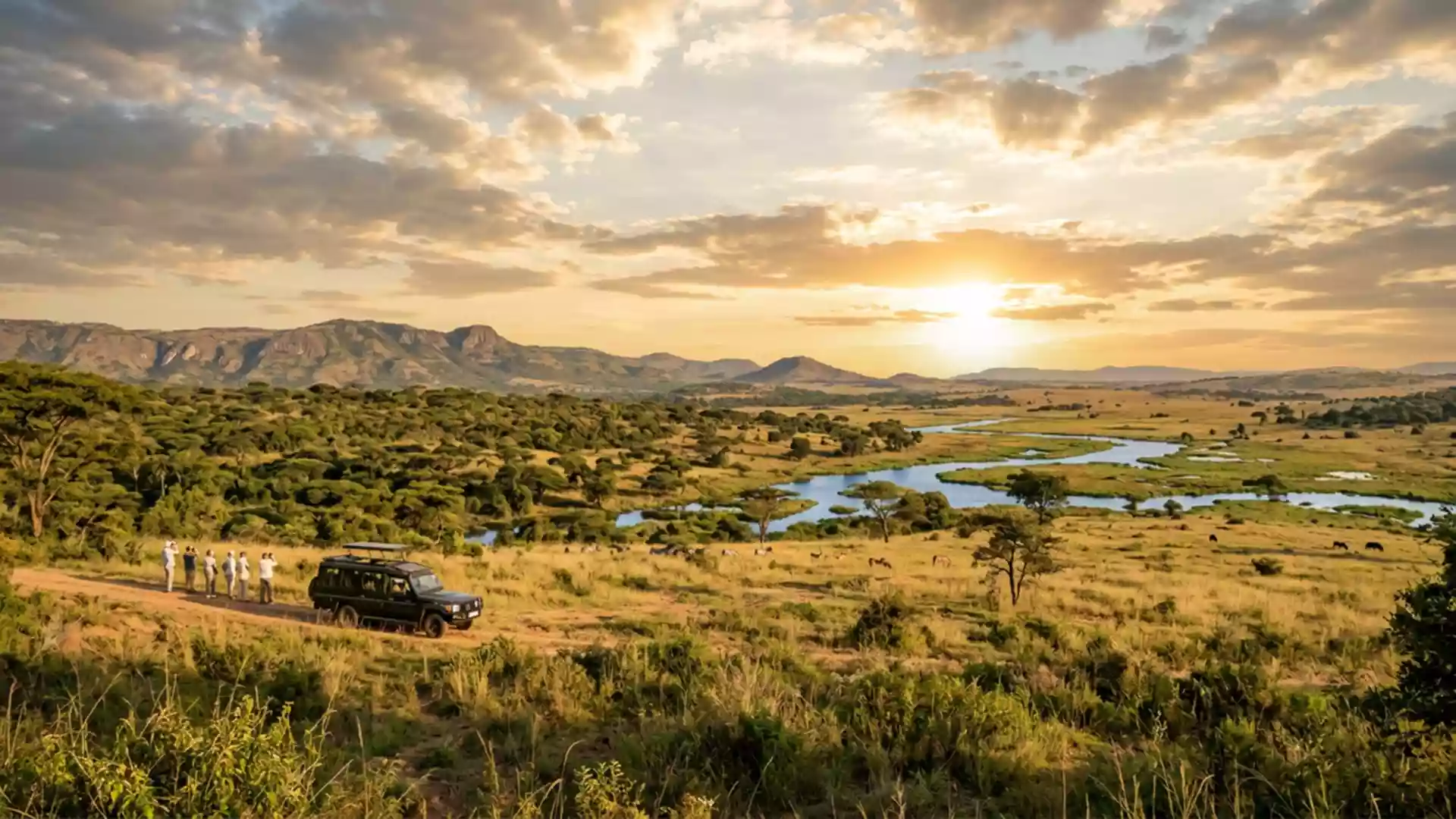
Akagera National Park where Rwandan savannah meets water and hills
Published on 09/07/2026 at 09:48 | Editorial responsibility: Rafael Müller, Editor-in-Chief AD HOC NEWS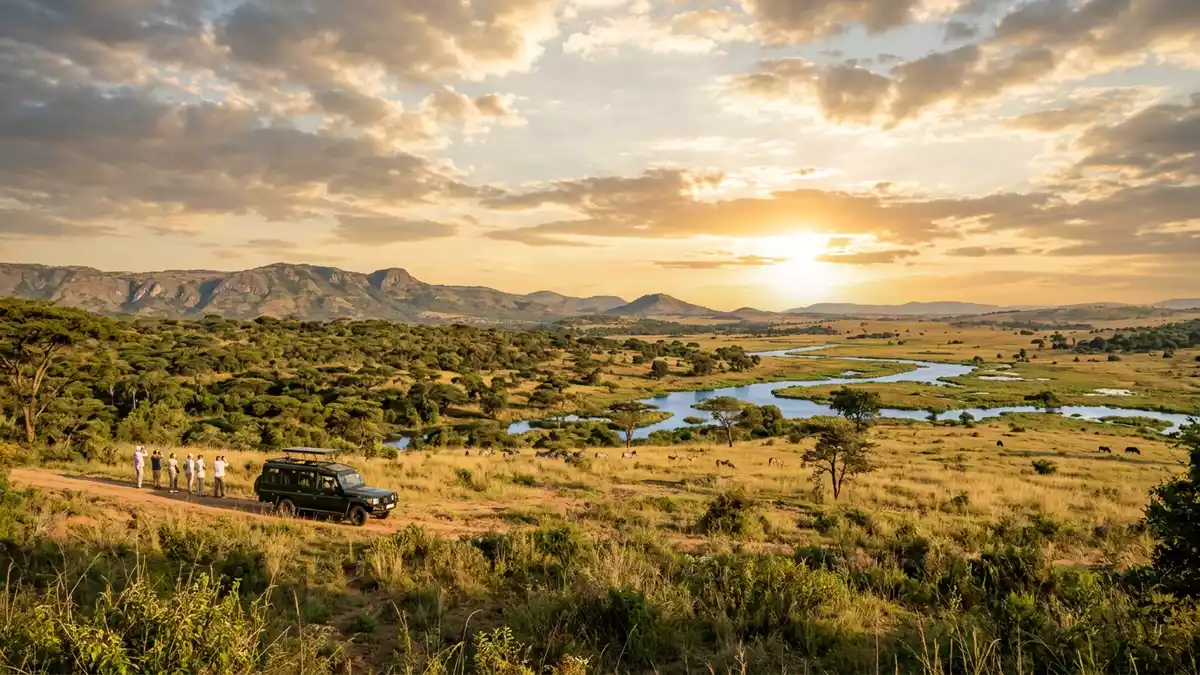
Akagera National Park in eastern Rwanda is a landscape where wide-open savannah, papyrus wetlands and chains of lakes run together along the border with Tanzania. It lies in the country’s Eastern Province and extends into the districts around Kayonza, creating a protected mosaic of plains, hills and water that gives Rwanda a very different face from its famous mountain forests.Akagera National Park
A park shaped by river, lakes and protected savannah
Akagera National Park takes its name from the Akagera River, which flows along the eastern fringe of the reserve and feeds into a chain of lakes and papyrus swamps. The park covers about 1,122 square kilometres (433 sq mi) and forms Rwanda’s largest protected area, running along the international frontier with Tanzania in the east.approximately 1,122 sq km Much of the landscape lies in the Akagera River basin south of Lake Victoria, and this constant presence of water gives the area its marshes, floodplains and lakeside scenes.River Akagera basin south of Lake Victoria
The park was founded in 1934 as a national park, making it one of Rwanda’s older protected landscapes in formal terms.founded in 1934 Within its boundaries, altitude ranges from roughly 1,200 m (3,937 ft) to around 1,800 m (5,906 ft) above sea level, enough variation to create contrasting belts of wetland, woodland and drier grassland.altitude ranging from about 1,200 metres The southern part carries broad lakes with papyrus-fringed shores, while further inland the land rises into rolling hills, ridges and open plains.
Wildlife on the meeting line between savannah and wetlands
Akagera National Park is Rwanda’s principal savannah wildlife destination, and it holds all members of the Big Five: lion, leopard, elephant, buffalo and both black and white rhinoceros. The park supports extensive populations of antelope, with species such as impala, topi, defassa waterbuck, eland, bushbuck and oribi recorded in its grasslands.impalas, topis, defassa waterbucks Plains zebra, Maasai giraffe and African buffalo move across the savannah areas, while hippos and Nile crocodiles occupy the quieter corners of lakes and connecting channels.
The park’s birdlife is one of its defining features. More than 480 bird species have been recorded, supported by wetlands, grasslands and woodland edges.over 480 species of birds Papyrus swamps form a significant habitat, and the wider wetland system in Akagera has been described as Central Africa’s largest protected papyrus area, giving rare species such as the shoebill stork suitable conditions.largest protected papyrus swamp Away from the water, wooded hillsides and acacia-dotted savannah support predators, smaller mammals and forest-edge birds, illustrating how several African ecosystems meet within one reserve.
Landscape contrasts and routes through Akagera from Kayonza
Akagera’s landscapes fall broadly into open savannah, lakes, papyrus wetlands and areas of acacia woodland, and visitors crossing the park experience this contrast over relatively short distances.across four eco-systems To the east, the Akagera River and an arc of lakes lie against the border with Tanzania, their surfaces edged by reedbeds and providing views across a chain of waterbodies.arc of interconnected lakes Inland from the river, gently rising ground turns into ridges and highlands where tracks cross open grassland and patches of bush, with long perspectives over plains and wetlands.
For travellers approaching from Kayonza and Kigali by road, the southern part of the park forms the usual entry area. Roads from Kigali head east through Rwamagana to Kayonza, then continue towards Kabarondo before reaching the main gate, while another route from the Kayonza roundabout leads towards Nyagatare and on to Mutumba Gate in the north.continue through Rwamagana to the roundabout at Kayonza Within the park, tracks run between lakes, savannah plains and hill country, and boat trips on the larger lakes provide a different perspective on Akagera’s mix of wildlife and landscape.
Visiting Akagera National Park: what travellers from Western Europe should know
- Akagera National Park lies in Rwanda’s Eastern Province along the border with Tanzania, reached overland from Kigali via Rwamagana and Kayonza towards the park gates.
- The terrain combines low-lying wetlands and lakes with rolling hills and open savannah, so road sections can include uneven surfaces and some routes rise to higher elevations.
- Akagera is in Rwanda, where the official language is Kinyarwanda alongside English and French, and the currency is the Rwandan franc.
- Entry requirements depend on your nationality; UK travellers can check the FCDO travel advice at gov.uk/foreign-travel-advice, Irish travellers the Department of Foreign Affairs at ireland.ie.
Searching for Akagera National Park on social platforms
These links open searches for Akagera National Park on each platform.Frequently asked questions about Akagera National Park
Where is Akagera National Park located?
Akagera National Park is in eastern Rwanda’s Eastern Province, extending through districts such as Kayonza along the international border with Tanzania.
What can visitors expect during a visit?
Visitors encounter a combination of savannah plains, lakes, papyrus wetlands and hill country, with chances to see Big Five mammals, antelopes, giraffes and extensive birdlife.
What makes Akagera National Park distinctive within Rwanda?
Akagera is Rwanda’s only major savannah reserve, where the Akagera River, protected wetlands and rolling plains create habitats and wildlife that contrast with the country’s mountain forests.