
Akagera National Park’s lakes and savannahs on Rwanda’s eastern frontier
Published on 09/05/2026 at 11:47 | Editorial responsibility: Rafael Müller, Editor-in-Chief AD HOC NEWS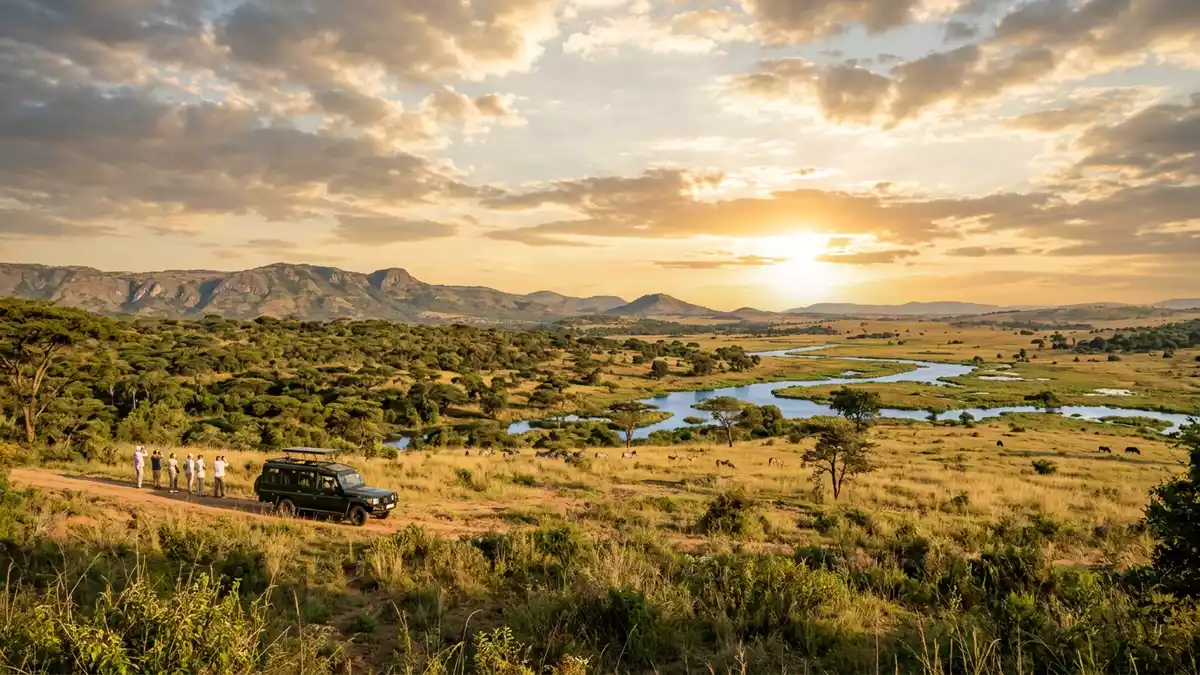
Akagera National Park in eastern Rwanda is defined by the way open savannah, wooded hills and strings of lakes run together along the border with Tanzania. Established as a national park in 1934, it protects a landscape where water, grassland and wetland sit side by side and support lions, rhinos, elephants and a striking diversity of birds.
Lakes, river and wetlands along the Tanzanian border
Akagera National Park stretches along Rwanda’s frontier with Tanzania in the country’s Eastern Province, reached from the direction of Kayonza and Kigali. The park takes its name from the Akagera River, which flows along its eastern boundary and feeds a network of lakes and papyrus swamps that form a continuous wetland belt.The park is named after the Akagera River These water bodies, including Lake Ihema and smaller lakes in the river basin, occupy much of the low ground and give the eastern side of the park a distinctly aquatic character.Lakes and papyrus swamps dominate the Akagera basin
To the west, the terrain rises into rolling highlands such as the Mutumba hills, where slopes look down over the lakes and swamps below. This contrast between higher ground and wet lowlands makes Akagera Central Africa’s largest protected wetland and Rwanda’s last refuge for species adapted to savannah and open country.Central Africa’s largest protected wetland Travellers see open plains broken by acacia trees, thick stands of papyrus along shorelines and broad stretches of water where hippos and crocodiles are part of the scene.
A savannah reserve with the Big Five and hundreds of bird species
Akagera National Park is Rwanda’s only savannah reserve, complementing the forests of Nyungwe National Park in the south and the volcanic highlands of Volcanoes National Park in the north.Rwanda’s only savannah reserve Its plains, woodlands and wetlands together support a full set of Big Five mammals – lions, leopards, elephants, rhinos and buffalo – alongside antelopes, giraffes, zebras and other species associated with East African grassland.Home to the Big Five mammals The mix of habitats makes the park an important stronghold for large mammals on a national scale.
Akagera is equally known for its birdlife, with several hundred species recorded across the wetlands, woodland edges and grassland. Figures from conservation and tourism sources place the number of bird species at well over 450, with some listings reaching above 500 depending on method and period of recording.Hundreds of bird species use the park’s habitats The combination of lakes, flooded reeds, savannah and hillside forest gives scope for everything from water birds and raptors to grassland specialists and species tied to papyrus swamps.
From 1934 protection to a reshaped modern park
Akagera National Park was founded in 1934 as a protected area covering around 2,500 km² of savannah, woodland and wetland in eastern Rwanda.Founded in 1934 and originally larger During the twentieth century, its boundaries were altered and its extent reduced, particularly in the late 1990s, when the formal area brought under park protection shrank to just over 1,100 km² to accommodate wider land-use changes and settlement.Reduction from 2,500 to 1,122 km² The resulting park remains Rwanda’s largest protected area and Central Africa’s largest protected wetland.
In the early twenty-first century, Akagera entered a phase of more intensive conservation management. Rwanda Development Board and African Parks formed a partnership in 2009, setting up Akagera Management Company to run the park under a long-term agreement.Joint management agreement in 2009 Under this framework, wildlife populations have been reinforced and monitored, and habitats ranging from wooded hills to papyrus swamps have been managed to maintain the mosaic of ecosystems that defines the park’s character.
Visiting Akagera National Park: what travellers from Western Europe should know
- Akagera National Park lies in Rwanda’s Eastern Province along the border with Tanzania, with road access from the direction of Kayonza and Kigali via routes across central Rwanda.
- The terrain combines lakeside plains, papyrus swamps and higher, undulating hills; visiting can involve driving on unpaved tracks and walking short distances on uneven ground.
- The official language of Rwanda is Kinyarwanda alongside French and English, and the national currency is the Rwandan franc.
- Entry requirements depend on your nationality; UK travellers can check the FCDO travel advice at gov.uk/foreign-travel-advice, Irish travellers the Department of Foreign Affairs at ireland.ie.
Searching for Akagera National Park on social platforms
These links open searches for Akagera National Park on each platform.
Frequently asked questions about Akagera National Park
Where is Akagera National Park and what kind of landscape does it protect?
Akagera National Park lies in eastern Rwanda along the border with Tanzania and protects a mix of lakes, papyrus swamps, open savannah and wooded hills.
What can visitors expect on a visit to Akagera National Park?
Visitors encounter an East African savannah setting with drives past lakes, wetlands and grassland where Big Five mammals and rich birdlife are part of the wider landscape.
What makes Akagera National Park distinctive among Rwanda’s protected areas?
Akagera is Rwanda’s only savannah reserve and Central Africa’s largest protected wetland, combining open plains and extensive lakes in a single, continuous protected landscape.


