
Akagera National Park’s lakes and savannahs in eastern Rwanda
Published on 09/15/2026 at 09:59 | Editorial responsibility: Rafael Müller, Editor-in-Chief AD HOC NEWS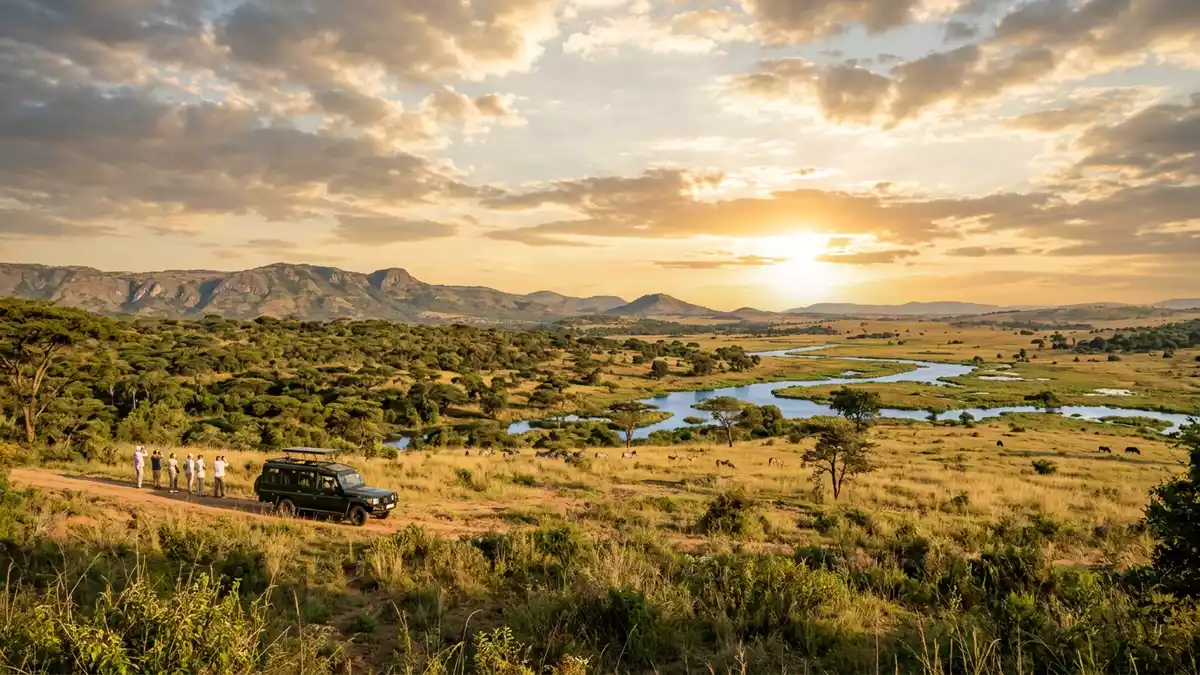
Akagera National Park stretches across Rwanda’s eastern border with Tanzania, a broad sweep of grassland, woodland and water that turns the idea of this compact country on its head. Established as a national park in 1934, it assembles lakes, papyrus swamps and open plains into one of Central Africa’s most distinctive protected landscapes.
Lakes, wetlands and the Akagera River
Akagera National Park lies in Rwanda’s Eastern Province, in a band of protected land that runs along the border shared with Tanzania. The park covers about 1,122 km² of terrain shaped by the Akagera River and a chain of lakes that pool behind its winding course.Akagera National Park lies in Rwanda’s Eastern Province The river gives the park its name and defines much of its character, feeding extensive wetlands and providing a clear eastern boundary.
This is not a single habitat but a patchwork. Sections of open savannah, with scattered trees and low shrubs, sit beside stretches of woodland and thickets. In the lower-lying areas, marshes and papyrus swamps spread out around the lakes, creating one of Central Africa’s largest protected wetland systems.one of Central Africa’s largest protected wetland systems From higher points in the park, the view often takes in this mix at once: bright strips of water, pale grassland and darker blocks of woodland rolling away towards the border.
Rwanda’s only savannah Big Five park
Within Rwanda, Akagera National Park holds a special status as the country’s only protected savannah reserve with Big Five wildlife. Herds of elephant move between woodland and lakeshore, buffalo gather on the grasslands, and antelope species such as impala and topi graze in open areas.Rwanda’s only savannah reserve with Big Five wildlife Lions and leopards form part of the predator line-up, and both black and white rhinoceroses have been reintroduced, restoring a full set of large mammal species that many travellers associate with East African safaris.
Akagera’s wildlife extends beyond headline mammals. The combination of wetlands, woodland and grassland creates habitat for hundreds of bird species, and the lakes support substantial populations of hippos and crocodiles.the combination of wetlands, woodland and grassland creates habitat for hundreds of bird species Boat trips on the larger lakes, including Lake Ihema, reveal a different angle on the park, with views back towards the rising hills and a closer look at birdlife on the water’s edge.
History and conservation in Akagera
Akagera National Park was created in 1934, at a time when many protected areas across Africa were being formally established to safeguard wildlife and landscapes.Akagera National Park was created in 1934 Over the decades that followed, its boundaries and management evolved in response to wider changes in Rwanda, but its core role as a refuge for savannah and wetland ecosystems remained central.
In 2010 the Rwanda Development Board entered a long-term management partnership with African Parks, a conservation organisation that works with governments to run protected areas.a long-term management partnership with African Parks Since then, Akagera has become a frequently cited example of a park where active management, reintroductions and close cooperation with neighbouring communities have helped rebuild wildlife populations and develop tourism in a way that supports local livelihoods.
Visiting Akagera National Park: what travellers from Western Europe should know
- Akagera National Park is in Rwanda’s Eastern Province, east of the town of Kayonza, and its main entrance lies near the southern end of the park on the road from Kigali.
- The terrain combines undulating hills, rough gravel tracks and areas of black-cotton soil around the wetlands, and vehicles share space with wildlife on unfenced game-viewing routes.
- The park sits at an elevation that brings warm daytime temperatures, and game drives and boat trips involve long periods in open vehicles or on open decks with limited shade.
- English, French and Kinyarwanda are widely used in Rwanda and the currency is the Rwandan franc.
- Entry requirements depend on your nationality; UK travellers can check the FCDO travel advice at gov.uk/foreign-travel-advice, Irish travellers the Department of Foreign Affairs at ireland.ie.
Searching for Akagera National Park on social platforms
These links open searches for Akagera National Park on each platform.
Frequently asked questions about Akagera National Park
Where is Akagera National Park?
Akagera National Park is in eastern Rwanda, in the country’s Eastern Province, along the international border with Tanzania and near the town of Kayonza.
What can visitors expect on a visit?
Visitors encounter a mixture of savannah, woodland, wetlands and lakes, with opportunities for classic game drives, boat trips and longer circuits through the park’s varied terrain.
What makes Akagera National Park distinctive?
Akagera National Park stands out as Rwanda’s only savannah Big Five park, combining large mammals, extensive wetlands and a long protected history dating back to 1934.


