
Ajanta Caves in Aurangabad: a hillside of painted Buddhist sanctuaries
Published on 08/30/2026 at 13:53 | Editorial responsibility: Rafael Müller, Editor-in-Chief AD HOC NEWS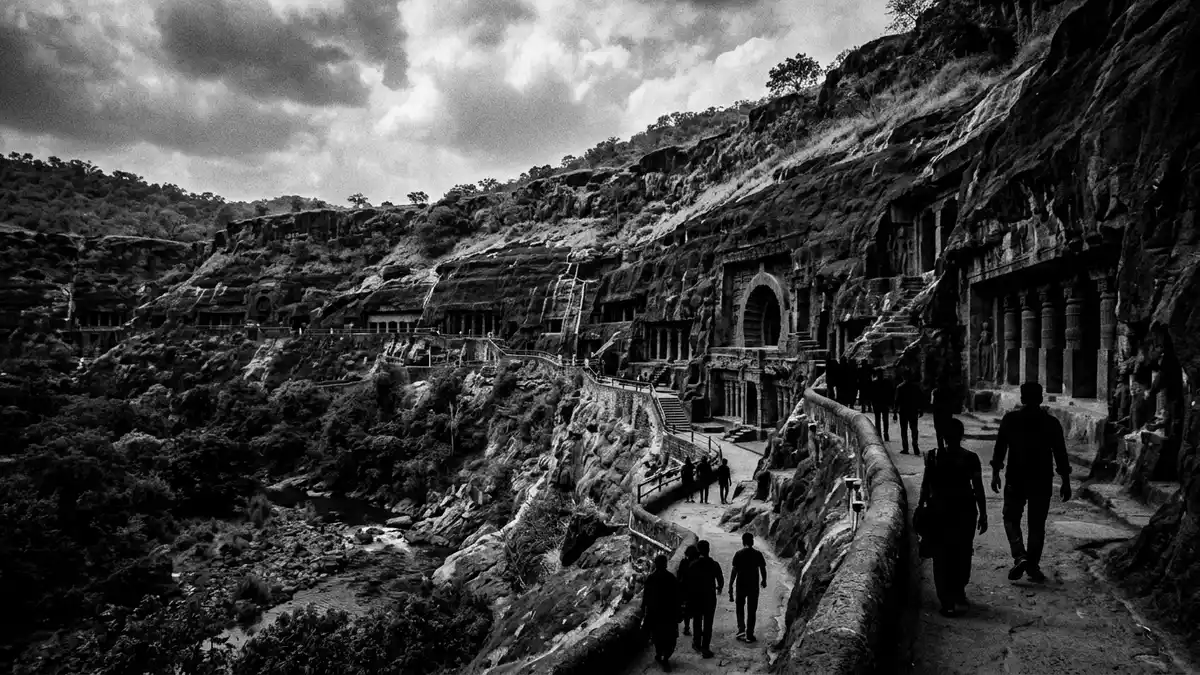
Ajanta Caves, in the Aurangabad district of Maharashtra in India, form a sweeping arc of Buddhist sanctuaries cut directly into a cliff above a river gorge. Dating from the second century BCE to about 480 CE, this hillside of rock-cut caves brings together architecture, sculpture and painting in one continuous, carved landscape of Buddhist devotion.
A horseshoe-shaped gorge of rock-cut caves
Ajanta Caves occupy a bend in the Satmala Hills where the rock face curves around the Waghora River, forming a horseshoe-shaped ravine with steep, wooded slopes rising above the water.granite cliffs on the inner side of a ravine The Buddhist caves are excavated into the vertical cliff on the left bank of the river, their facades opening along the curve of the rock and looking down over the stream below.caves excavated out of a vertical cliff above the left bank of the Waghora
The group comprises around thirty excavated caves, some complete and others left unfinished, forming a sequence of Buddhist spaces of different sizes and degrees of ornamentation.thirty in number, including the unfinished ones Pathways and rock-cut staircases link the cave entrances to each other and to the riverside below, so that the complex reads as a single, extended monastery carved into the hill rather than a series of isolated grottoes.connected with the river by rock-cut staircases
Buddhist chaityas and viharas in stone
The Ajanta excavations divide into two main types of space: chaityagrihas, which are sanctuary or prayer halls, and viharas, which are monasteries or residential caves.five chaityagrihas and the rest viharas Chaityagriha caves are characterised by long aisles leading to a stupa at the end, with internal colonnades that frame the central space for worship, while the vihara caves contain halls with side cells opening off them, forming living and meditating quarters for monks.
The earliest caves belong to the first phase of excavation, dated between the second and first centuries BCE and associated with the Satavahana dynasty, and the later group belongs to a second phase in the fifth century CE linked to the Vakataka dynasty and the period of Gupta art.excavated between the second century BCE and the fifth century CE Together these phases span several centuries of Buddhist practice, from early aniconic art with few human figures of the Buddha to later Mahayana imagery rich in sculpted Buddhas and bodhisattvas, all preserved in the same cliff-side complex.first period attributed to the Satavahana dynasty, second to the Vakataka dynasty and associated with Mahayana Buddhism
Murals, sculpture and rediscovery
Ajanta Caves are renowned above all for their wall paintings, which cover many inner walls and ceilings with narrative scenes from the life of the Buddha and stories of his previous births, along with floral and geometric motifs.Ajanta murals narrating stories of the life of the Buddha Among the sculptural highlights is a large seated Buddha in padmasana in Cave 1, framed by intricately carved pillars and architectural elements that combine structural function with ornament.large depiction of the Buddha seated on a throne in padmasana in Cave 1
The site’s history includes abandonment for many centuries and a rediscovery by a British officer named John Smith in 1819, after earlier written accounts of the caves by Chinese travellers Faxian and Xuanzang in the fifth and seventh centuries CE.earliest written records by Faxian and Xuanzang, rediscovered by John Smith in 1819 Ajanta Caves were inscribed as a UNESCO World Heritage Site in 1983, recognising their importance as a concentration of early Buddhist art and architecture in India and as a rare survival of extensive ancient wall painting.designated a UNESCO World Heritage Site in 1983
Visiting Ajanta Caves: what travellers from Western Europe should know
- Ajanta Caves lie in the Aurangabad district of Maharashtra in western India, near the village of Ajanta, with Aurangabad as the nearest major city with an airport and railway station.
- The caves are carved into a steep cliff above the Waghora River, and reaching many of the individual caves involves rock-cut staircases and walking along paths on the hillside.
- The terrain around the cave entrances includes stone steps and uneven surfaces, and exploring the complex requires walking between several caves along the curve of the gorge.
- The official language is Hindi and Marathi in the region and the currency is the Indian rupee.
- Entry requirements depend on your nationality; UK travellers can check the FCDO travel advice at gov.uk/foreign-travel-advice, Irish travellers the Department of Foreign Affairs at ireland.ie.
Searching for Ajanta Caves on social platforms
These links open searches for Ajanta Caves on each platform.
Frequently asked questions about Ajanta Caves
Where are Ajanta Caves and what is the landscape like?
Ajanta Caves are in the Aurangabad district of Maharashtra in western India, carved into a cliff above a horseshoe-shaped gorge of the Waghora River.horseshoe-shaped bend of the rock face overlooking a narrow stream
What should a visitor expect inside the caves?
Visitors encounter Buddhist sanctuaries and monastic halls cut from the rock, with stupas, sculpted Buddhas and extensive murals on walls and ceilings depicting scenes from Buddhist narratives.murals and finely detailed sculptures
What makes Ajanta Caves distinctive among historic sites in India?
The site combines around thirty rock-cut Buddhist caves spanning several centuries, a dramatic ravine setting and one of the largest surviving bodies of ancient Indian wall painting, recognised through UNESCO World Heritage inscription.30 rock-cut Buddhist cave monuments dating from the second century BCE to about 480 CE


