Ajanta Caves: Buddhist art carved into a horseshoe gorge
Published on 08/29/2026 at 17:18 | Editorial responsibility: Rafael Müller, Editor-in-Chief AD HOC NEWS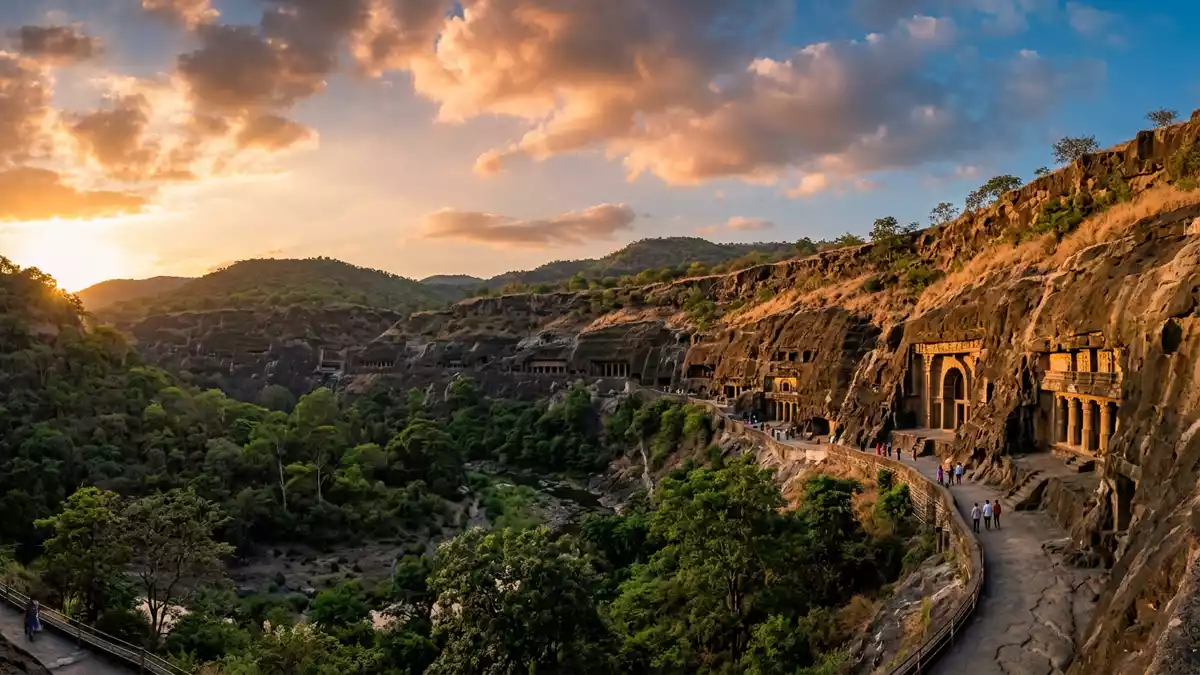
Ajanta Caves near Aurangabad in India form a crescent of Buddhist sanctuaries carved into a cliff above a river gorge, where painting, sculpture and architecture share one continuous rock face. The site brings together early Buddhist monuments from the second and first centuries BCE and a later flowering of excavation and decoration in the fifth century CE, all preserved in a remote valley in Maharashtra.
A cliff of caves on a river bend
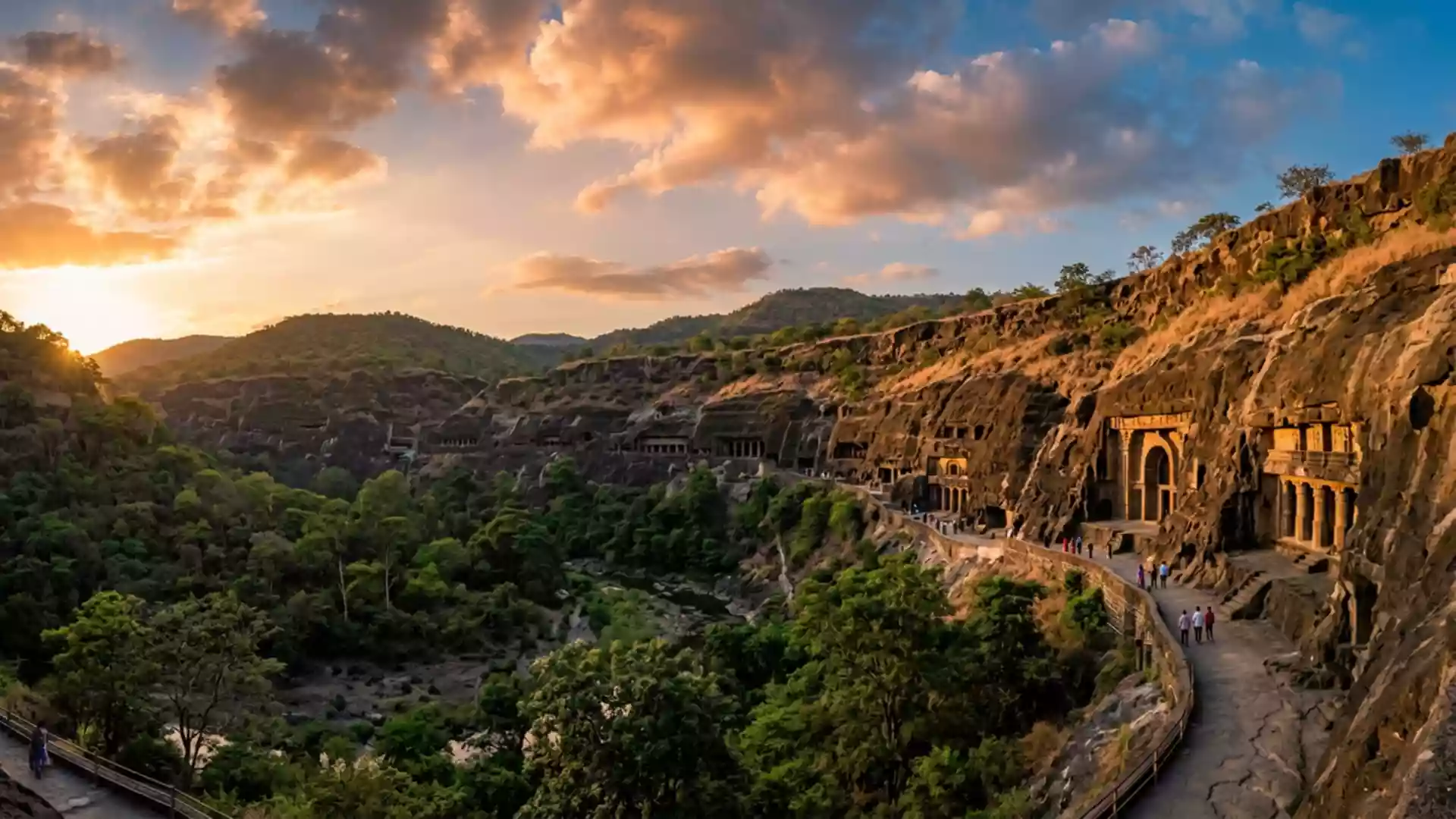
Ajanta Caves lie in the hills of northern Maharashtra, where the Waghora River cuts a ravine through volcanic rock and loops in a horseshoe-shaped bend below the cliff. The temples and monasteries are hollowed into the inner side of this arc, so a visitor looking down from the cave thresholds sees the river far below with forest along its banks.granite cliffs on the inner side of a ravine The rock face carries rows of openings at different levels, reached by paths and stairways cut into the slope.
The complex is described as a group of Buddhist rock-cut cave temples and monasteries, built directly into the cliff rather than as freestanding structures. The cliff lies in the Ajanta hills of Aurangabad district in the state of Maharashtra, placing the site in western India but some distance from the coast.Aurangabad District of Maharashtra The caves face into the gorge, and their verandas and halls step back into the rock, creating an interior world separate from the valley outside.
Buddhist phases carved over centuries
The caves at Ajanta were excavated in two major phases separated by several centuries. The earliest monuments, including prayer halls and simple monasteries, were created in the second and first centuries BCE under the Satavahana dynasty, marking an early chapter of Buddhist patronage in the Deccan.excavated between the second century BCE and the fifth century CE These early caves include long halls with colonnades leading towards a central shrine or stupa, carved out of the same rock as the walls.
A later phase in the fifth century CE brought more elaborate viharas, richly painted with narrative murals and lined with sculpted Buddha images. This phase is linked with the Vakataka dynasty and specifically with the reign of king Harisena, when excavation and decoration intensified along the cliff.excavation stretches from the third-second century BCE to the fifth-sixth century CE Walking along the arc of Ajanta Caves, the visitor passes entrances from both periods, so the rock face itself becomes a timeline of Buddhist art in western India.
Chaitya halls, monasteries and painted walls
Ajanta Caves consist of a series of chaityagrihas, or prayer halls, and viharas, or monastic residences, all carved into the cliff. The chaitya halls are elongated spaces with rows of pillars framing a central aisle that leads towards a sculpted stupa, the focal point of devotion. Their barrel-like roofs are cut into the rock and often carry carved ribs that echo timber construction. The viharas are squarer halls with side cells opening off the main space, forming living quarters around a central gathering area.chaityagrihas and viharas in the Ajanta cliff
The later viharas carry murals on their walls and ceilings, depicting episodes from the life of the Buddha and Jataka tales of his previous births. These paintings are rendered on prepared plaster applied to the rock and use mineral pigments to build up rich colours and subtle modelling. They provide a rare survival of large-scale Buddhist painting from ancient India and are often cited as some of the finest examples of early Indian wall art.among the finest examples of early Buddhist art Sculpted figures of the Buddha, bodhisattvas and guardians flank doorways and shrines, continuing the narrative and devotional themes in stone.
Ajanta Caves as a World Heritage landscape
Ajanta Caves were inscribed as a UNESCO World Heritage Site in 1983, recognising both the artistic richness of the paintings and sculptures and the way they are integrated into the natural setting of the gorge.inscription on the World Heritage List in 1983 The listing emphasises the cultural significance of the site for Buddhist art and its contribution to understanding the development of religious architecture in India. The combination of remote landscape, continuous cliff and concentrated sequence of caves gives Ajanta a distinctive spatial character.
The surrounding hills, forested slopes and river below frame the caves and reinforce the sense of a secluded monastic retreat. From the outside the rock face appears as a continuous sweep, but inside each cave has its own plan, proportion and decorative programme. The balance between landscape and excavation is central to how Ajanta Caves are experienced: the site is both a geological formation and a carefully carved architectural ensemble overseen by the Archaeological Survey of India.World Heritage Site maintained by the Archaeological Survey of India
Visiting Ajanta Caves: what travellers from Western Europe should know
- Ajanta Caves lie in the Ajanta hills north of Aurangabad in Maharashtra, with access by road to the plateau above the horseshoe-shaped gorge and paths leading towards the cave entrances.
- The terrain involves walking on rock-cut paths and stairways along the cliff, with uneven steps and changes in level between the parking area, viewpoints and the cave thresholds.
- The site stands in India, where the official language is Hindi alongside regional languages such as Marathi, and the currency is the Indian rupee.
- Entry requirements depend on your nationality; UK travellers can check the FCDO travel advice at gov.uk/foreign-travel-advice, Irish travellers the Department of Foreign Affairs at ireland.ie.
Searching for Ajanta Caves on social platforms
These links open searches for Ajanta Caves on each platform.
Frequently asked questions about Ajanta Caves
Where are Ajanta Caves located?
Ajanta Caves are in the Ajanta hills of Aurangabad district in Maharashtra, western India, above a gorge of the Waghora River.
What can a visitor expect inside the caves?
Inside Ajanta Caves, visitors encounter rock-cut halls, colonnades, shrines with Buddhas and stupas, and extensive wall paintings depicting Buddhist narratives.
What makes Ajanta Caves distinctive among Buddhist sites?
Ajanta Caves are distinctive for combining early and later phases of Buddhist excavation with a concentration of paintings and sculptures preserved along one horseshoe-shaped cliff.