Ajanta Caves and the painted cliff of the Waghora
Published on 09/04/2026 at 14:58 | Editorial responsibility: Rafael Müller, Editor-in-Chief AD HOC NEWS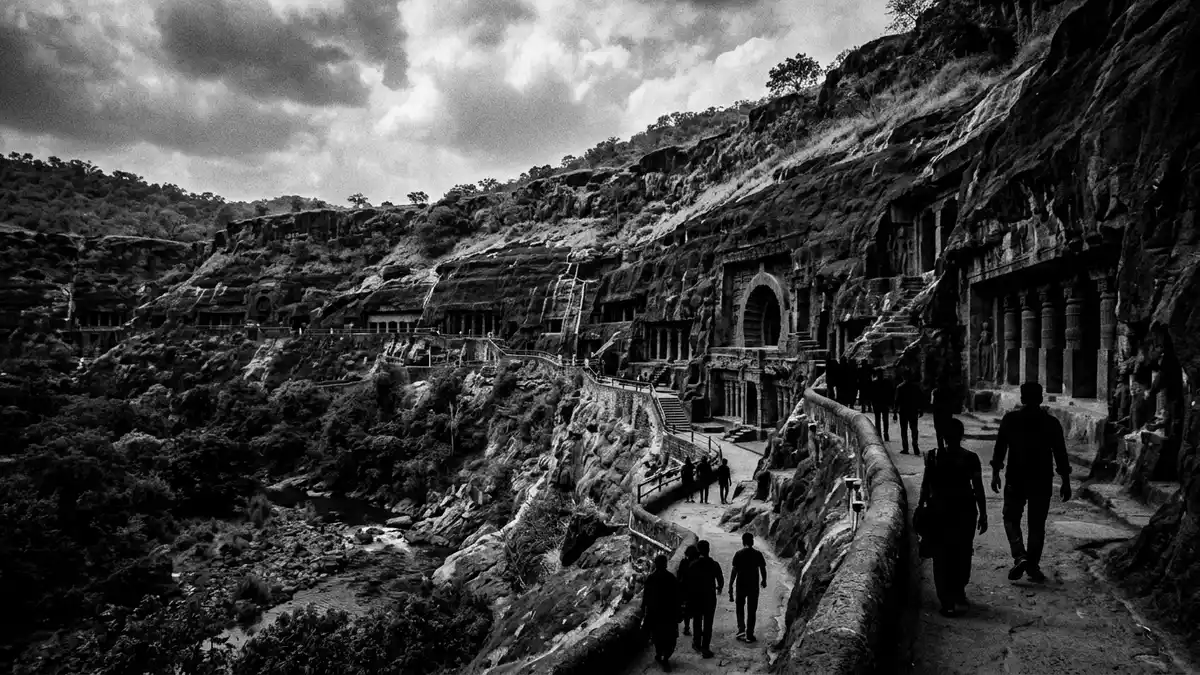
Ajanta Caves in the Aurangabad district of Maharashtra form a long arc of Buddhist rock-cut sanctuaries carved into a cliff above the Waghora River. The site brings together excavated architecture, sculpture and painting from several centuries of Buddhist patronage in western India.
A horseshoe of caves above the Waghora
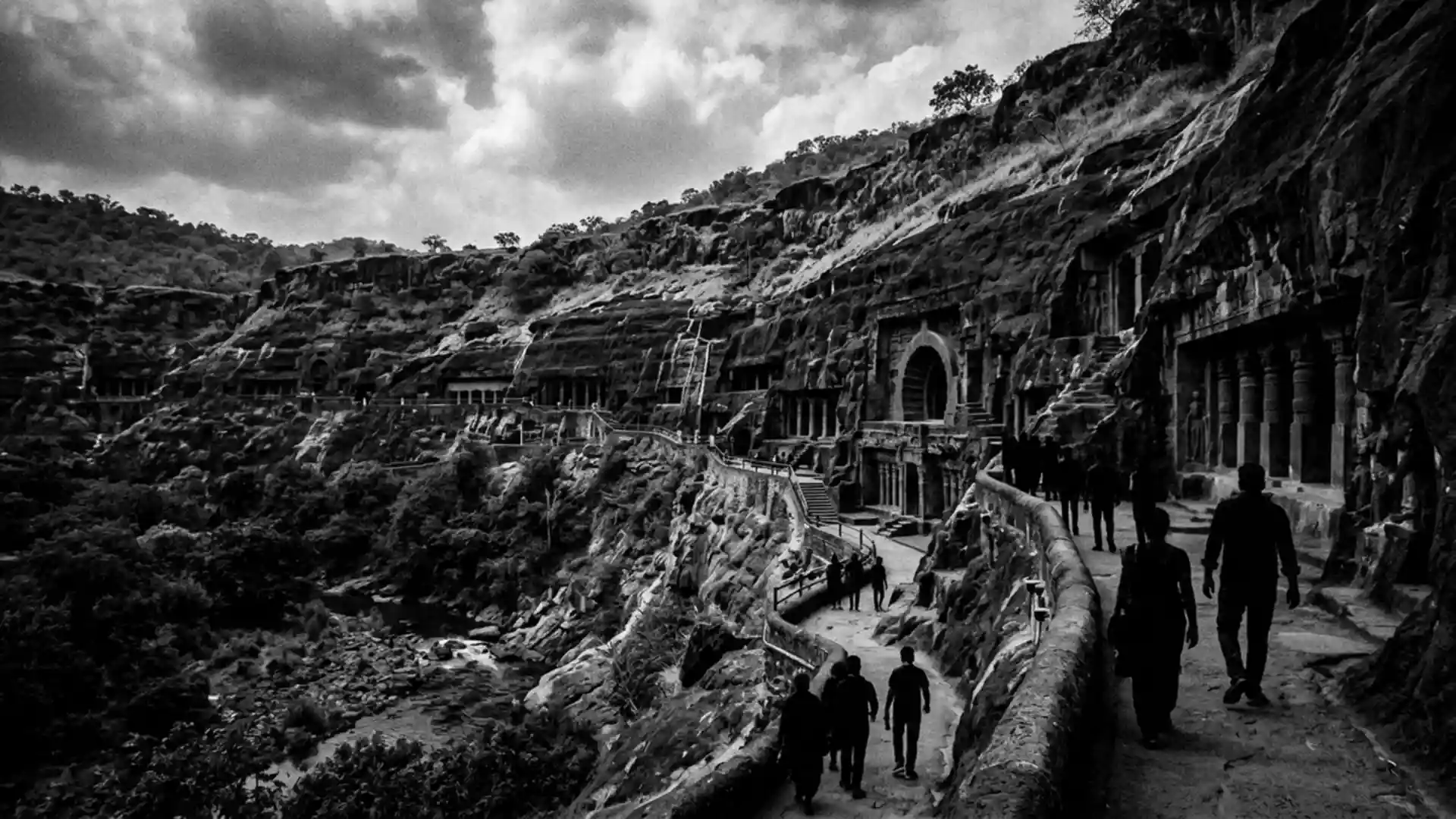
The Ajanta Caves sit in a ravine of the Waghora River, where the rock face curves in a broad horseshoe and rises above the riverbed.The 30 caves follow a 76 m high escarpment cut into the rock.The complex lies to the north of Aurangabad in the Indhyadri range of the Western Ghats and is approached along a path that runs parallel to the cliff.
The caves are hewn from the basalt of the Deccan plateau, their façades forming a near-continuous row of openings, porches and columned verandas along the bend of the gorge.The rock-cut temples and monasteries extend along a gorge about 550 m in length, and the entire site is framed by wooded slopes above and the river below.
Buddhist monasteries carved over centuries
Ajanta is a Buddhist monastic complex, with caves that served as temples and dwellings for monks following different phases of Buddhist practice.The excavations are dated from the second century BCE to about 480 CE, creating a spectrum of early Indian Buddhist architecture in one place.Scholars divide the caves into an earlier Hinayana phase and a later Mahayana phase, visible in the way images of the Buddha appear in the later shrines.
The earliest phase is linked to the Satavahana dynasty, which ruled parts of the Deccan in the second and first centuries BCE.Later excavations belong to the period of the Vakataka dynasty, including the reign of the Vakataka ruler Harisena in the fifth century CE.Caves such as 9 and 10 are early chaitya halls, while others are monasteries with cells arranged around a central hall, creating a repeated rhythm of communal and individual spaces along the cliff.
Murals, sculpture and a World Heritage inscription
Ajanta is renowned for its painting programme, which covers many of the interior walls and ceilings with narrative and decorative schemes.The murals depict stories from the life of the Buddha and past lives in the Jataka tales, alongside courtly scenes, celestial figures and patterned borders.The painted and sculpted programme is described as a major body of early Buddhist religious art, with figures carved in relief around the shrines.
In addition to the murals, many caves contain sculpted stupas, columns and shrine images that mark the development of Buddhist iconography in western India.Ajanta Caves were inscribed as a UNESCO World Heritage Site in 1983, placing the site among the protected cultural landscapes of India.The designation highlights both the architecture and the paintings as central to the site’s significance, bringing an added emphasis on conservation of the rock-cut interiors.
Visiting Ajanta Caves: what travellers from Western Europe should know
- Ajanta Caves lie north-east of Aurangabad in Maharashtra, with access by road towards the village of Ajintha and connections from Aurangabad city and Jalgaon.
- The approach from the visitor facilities to the cliff involves a walk along a path above the Waghora River and ascents by steps to the individual cave platforms.
- The caves themselves form a sequence along the rock face, and visiting multiple caves involves repeated staircases and walking on uneven stone floors inside the halls.
- The official language is Marathi alongside Hindi, and the currency is the Indian rupee.
- Entry requirements depend on your nationality; UK travellers can check the FCDO travel advice at gov.uk/foreign-travel-advice, Irish travellers the Department of Foreign Affairs at ireland.ie.
Searching for Ajanta Caves on social platforms
These links open searches for Ajanta Caves on each platform.
Frequently asked questions about Ajanta Caves
Where are Ajanta Caves located?
Ajanta Caves are in the Aurangabad district of Maharashtra in western India, in a ravine of the Waghora River north of Aurangabad city.
What can visitors expect inside the caves?
Visitors encounter rock-cut halls with columns, shrines and monastic cells, many of them lined with painted narratives and carved images linked to Buddhist traditions.
What makes Ajanta Caves distinctive among Indian sites?
Ajanta brings together an extended sequence of Buddhist rock-cut architecture and an extensive cycle of mural painting in one river gorge, recognised through its UNESCO World Heritage status.