Ajanta Caves and the painted cliff of Aurangabad
Published on 09/14/2026 at 20:02 | Editorial responsibility: Rafael Müller, Editor-in-Chief AD HOC NEWS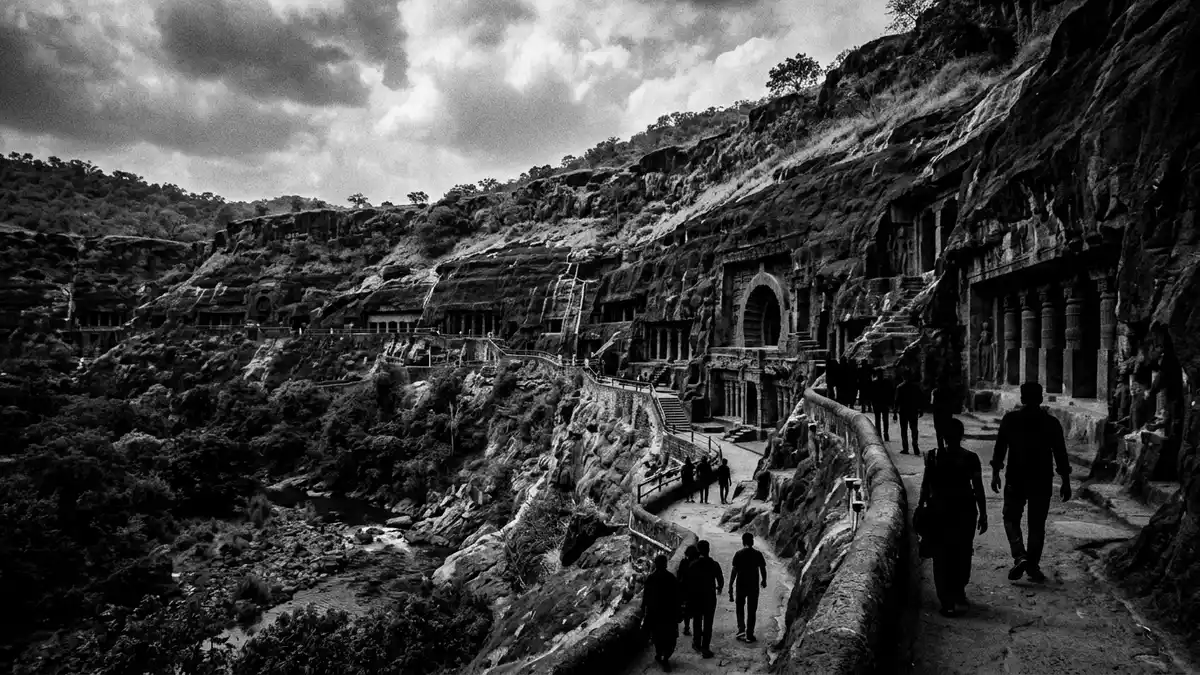
Ajanta Caves curve along a basalt cliff above the Waghora river in Maharashtra, north of Aurangabad, where a chain of early Buddhist sanctuaries turns a ravine into a painted cloister of rock-cut halls. Carved between the second century BCE and the fifth century CE, the caves bring together monasteries, worship halls and murals in a single sweep of stone that later secured inscription on the UNESCO World Heritage List in 1983.
A horseshoe of rock-cut monasteries
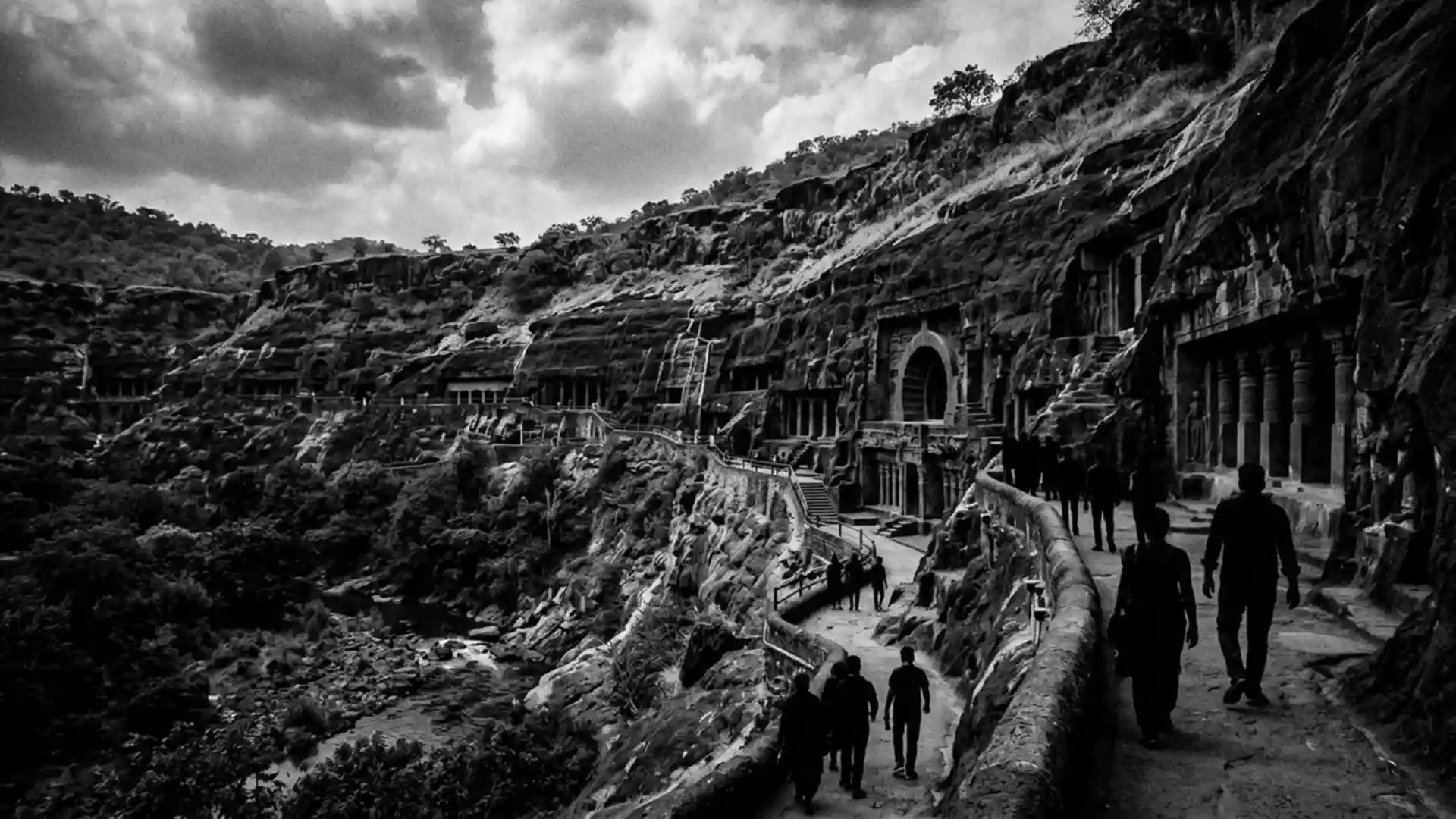
The most striking feature of Ajanta Caves is the way the monuments follow the line of a gorge, cut into a horseshoe-shaped wall of basalt above the left bank of the Waghora river. A visitor standing on the opposite slope sees a continuous row of façades punctuated by porches and colonnades, each cave opening directly into the rock face that frames the valley.The caves at Ajanta are hewn into this vertical cliff, creating a sheltered ledge where entrances, pillars and balconies read as a single architectural band despite belonging to different centuries.
Archaeologists identify around thirty excavations at Ajanta, including an unfinished one, spread along this arc of cliff. Five are **chaityagrihas**, or sanctuary halls, while the others are **viharas**, or monasteries, which combine communal halls with small cells cut into the rock for monks.The Archaeological Survey of India describes this mix of prayer halls and living quarters as a complete rock-cut Buddhist establishment, all contained within a single ravine.
Buddhist art from Satavahana to Vakataka times
Ajanta Caves trace a long arc of Buddhist history, from the early **Satavahana** phase in the second and first centuries BCE to a later flourishing under the **Vakataka** dynasty in the fifth and sixth centuries CE.Two main building phases are visible in the rock itself, with earlier caves tending to be plainer and later ones filled with elaborate carving and painting. The site belongs to a broader western Indian tradition of rock-cut architecture, yet its concentration of Buddhist material is distinctive.
Inscriptions and stylistic analysis link several of the later caves to the Vakataka court, whose realm overlapped in time with the Gupta Empire.The Indira Gandhi National Centre for the Arts notes that patrons such as Varahadeva and Upendragupta, associated with the Vakataka ruler Harisena, supported Mahayana Buddhist works here, adding richly decorated monasteries and sanctuaries. The result is a layered complex where older Hinayana caves, with their focus on stupa worship, stand alongside later Mahayana imagery.
Murals, sculptures and UNESCO recognition
Ajanta Caves are renowned for their mural paintings, which cover the interiors of several viharas and chaityagrihas with scenes from the life of the Buddha and earlier **Jataka** stories. These murals use mineral pigments on prepared rock surfaces and retain enough colour to show complex compositions of courts, forests and celestial figures.The Department of Tourism of Maharashtra describes them as among the finest surviving examples of Indian painting, matched by carved pillars, friezes and sculptures that share the same narrative themes.
International recognition followed when Ajanta Caves were inscribed as a UNESCO World Heritage Site in 1983 under cultural criteria including i, ii, iii and vi.The UNESCO listing emphasises both the artistic quality of the murals and the testimony they offer to Buddhist monastic life over several centuries. The protected area extends across more than 8,000 hectares, with a buffer zone around the gorge and its rock-cut monuments.
Visiting Ajanta Caves: what travellers from Western Europe should know
- Ajanta Caves lie in Maharashtra in western India, north-east of Aurangabad, reached by road towards the small settlement of Fardapur and the Waghora river valley.
- The approach to the site includes an ascent on foot along paved paths and steps cut into the hillside, with the caves arranged at different levels along the cliff.
- Ajanta Caves are in India, where the official language is Hindi alongside regional languages and the currency is the Indian rupee.
- Entry requirements depend on your nationality; UK travellers can check the FCDO travel advice at gov.uk/foreign-travel-advice, Irish travellers the Department of Foreign Affairs at ireland.ie.
Searching for Ajanta Caves on social platforms
These links open searches for Ajanta Caves on each platform.
Frequently asked questions about Ajanta Caves
Where are Ajanta Caves?
Ajanta Caves are in the Aurangabad district of Maharashtra in western India, cut into a basalt cliff along the Waghora river, north-east of the city of Aurangabad.
What should a visitor expect at Ajanta Caves?
A visitor encounters a series of rock-cut monasteries and sanctuary halls carved into a gorge, with murals, sculptures and stone pillars lining the interiors of several caves.
What makes Ajanta Caves distinctive among rock-cut sites?
Ajanta Caves combine a continuous arc of cliff-side excavations with an extensive cycle of Buddhist murals and sculptures, created between the second century BCE and the fifth century CE.