
Ajanta Caves and the Buddhist cliff monasteries of Aurangabad
Published on 09/08/2026 at 08:41 | Editorial responsibility: Rafael Müller, Editor-in-Chief AD HOC NEWS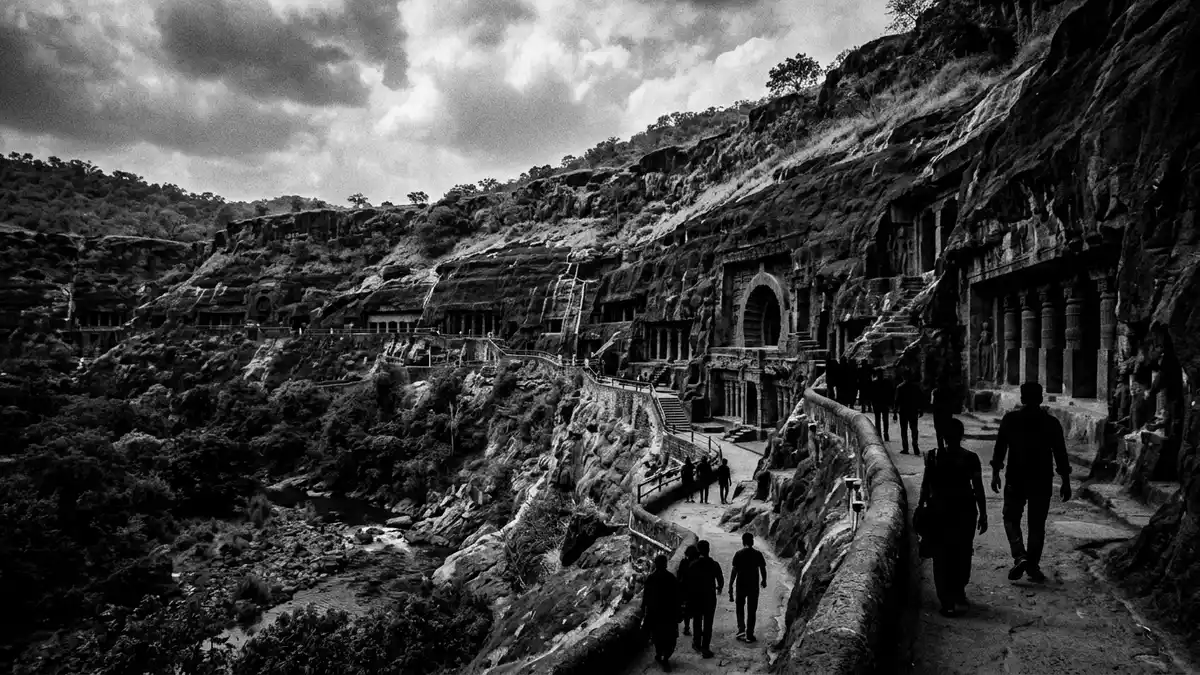
Ajanta Caves near Aurangabad in India form a curving line of Buddhist temples and monasteries cut directly into a basalt cliff high above the Waghora River. In this horseshoe-shaped gorge, craftsmen over many centuries turned a raw rock face into a sequence of chapels, halls and painted interiors that trace the development of Buddhism from early aniconic worship to richly figurative art.
A horseshoe gorge filled with rock-cut sanctuaries
Ajanta Caves occupy a semicircular ravine in the Aurangabad district of Maharashtra, where the Waghora River has cut into the Deccan plateau and exposed a band of basalt. The cliff rises above a bend in the river, and the caves line the inner wall of the gorge, facing the forested valley below.a semicircular gorge 550 metres long The position gives the complex a clear separation from the surrounding countryside: the approach climbs from the river valley to a ledge where the entrances open in sequence along the rock.
The group consists of around thirty excavations cut into the basalt cliff, forming a chain of Buddhist sanctuaries and monastic residences.some 30 caves hollowed out of granite cliffs Each cave is a man-made interior carved from the rock, not a natural cavern adapted later. The contrast between the rough exterior of the cliff and the worked interiors, with columns, shrines and painted surfaces, is one of the defining visual experiences of Ajanta.
Two great phases of Buddhist excavation
The history of Ajanta Caves is marked by two major periods of excavation separated by several centuries. The earliest group belongs to the second and first centuries BCE, under the Satavahana dynasty, when craftsmen created relatively austere sanctuaries and monastic halls associated with early Buddhism.rule of the Satavahana dynasty from about the 2nd century BCE These early caves include prayer halls, known as chaityas, and simpler vihara residences with minimal figurative carving.
A later wave of activity during the 5th and 6th centuries CE under the Vakataka dynasty transformed the site, adding more elaborate caves with richly carved façades and interiors.second period dated to the reign of the Vakataka dynasty This phase introduced Mahayana Buddhist imagery, with full human representations of the Buddha and bodhisattvas standing or seated in niches, as well as extensive mural programmes. Together, the two phases create a compressed timeline of Buddhist rock-cut architecture spanning roughly from the 2nd century BCE to the 6th century CE.period of activity continuing to around the 1st century CE and a later phase between 5th and 6th century CE
Monastic halls, prayer chambers and painted narratives
Architecturally, Ajanta Caves divide broadly into two types recognised in Buddhist monastic practice: vihara and chaitya. The vihara caves are monastic halls where monks lived and studied, laid out as square or rectangular chambers with side cells and rows of columns that support the rock ceiling.vihara monasteries and chaitya sanctuaries Many of these later viharas contain an inner shrine with a carved Buddha figure, turning the residence into a combined living and worship space.
The chaitya caves are prayer halls oriented towards a stupa, the symbolic focus of devotion. In these, a central aisle leads towards the stupa at the far end, flanked by colonnades that give the interior the rhythm of a pillared nave. The stupa itself is carved from the same rock as the hall, forming a solid mass around which devotees could circumambulate. In the later chaityas, the pillars carry carved ornament and figures, and the walls above them hold painted scenes that blend architecture and narrative art.paintings and sculptures considered masterpieces of Buddhist religious art
Mural cycles and the art of narrative painting
Ajanta is renowned for its murals, which cover large areas of the cave interiors with scenes drawn from Buddhist literature and courtly life. These paintings narrate episodes from the J?taka tales and other stories, showing previous lives of the Buddha and moral exemplars set in richly rendered environments.Ajanta murals narrating stories of the life of the Buddha Figures appear in flowing textiles, seated in pavilion-like spaces or moving through palace courts, with attention to gesture and expression that has made the murals a benchmark of early Indian painting.
The painted surfaces use mineral pigments applied to prepared rock walls, creating a dense layer of colour that has survived in fragments across many caves. Decorative motifs, including floral bands, geometric panels and halo-like discs behind important figures, frame the narrative scenes and articulate the architecture. The scale of the painting programme makes Ajanta one of the largest surviving bodies of early Buddhist mural art, and its compositions have influenced later religious painting across India.artworks dating from the 2nd century BCE to the 5th century CE
From cliff monastery to World Heritage site
After the main period of use, Ajanta Caves fell into neglect and were eventually abandoned, with the surrounding forest reclaiming the gorge. In the early 19th century the site entered wider awareness when a British hunting party encountered the cliff face and its carved openings, drawing attention to the caves and their paintings.rediscovery by John Smith in 1819 Subsequent surveys and conservation efforts established Ajanta as a key site for understanding Buddhist rock-cut architecture and early Indian painting.
Ajanta Caves were inscribed on the UNESCO World Heritage List in 1983, recognising both the architectural ensemble and the artistic value of the sculptures and murals.inscribed as a World Heritage Site in 1983 The listing emphasises the importance of the site as a record of Buddhist monastic life and religious art across several centuries, anchored in the specific landscape of the Waghora gorge.
Visiting Ajanta Caves: what travellers from Western Europe should know
- Ajanta Caves lie in the Aurangabad district of Maharashtra in western India, reached overland from Aurangabad via the road network that follows the Waghora River valley.
- The caves stand in a cliff above a river gorge, and visiting the complex involves walking on rock-cut paths and stairways along the face of the ravine.
- The site lies in a region of India where the official language is Marathi alongside Hindi, and the national currency is the Indian rupee.
- Entry requirements depend on your nationality; UK travellers can check the FCDO travel advice at gov.uk/foreign-travel-advice, Irish travellers the Department of Foreign Affairs at ireland.ie.
Searching for Ajanta Caves on social platforms
These links open searches for Ajanta Caves on each platform.Frequently asked questions about Ajanta Caves
Where are Ajanta Caves located?
Ajanta Caves are in the Aurangabad district of Maharashtra in western India, above a bend in the Waghora River in a basalt gorge.
What can visitors expect on a visit to Ajanta Caves?
Visitors encounter a sequence of rock-cut Buddhist temples and monasteries, with carved columns, shrines and extensive mural painting inside the cliff-side halls.
What makes Ajanta Caves distinctive among rock-cut sites?
Ajanta combines a large group of excavated monastic halls and prayer caves with an extensive body of early Buddhist mural painting anchored in a single river gorge landscape.


