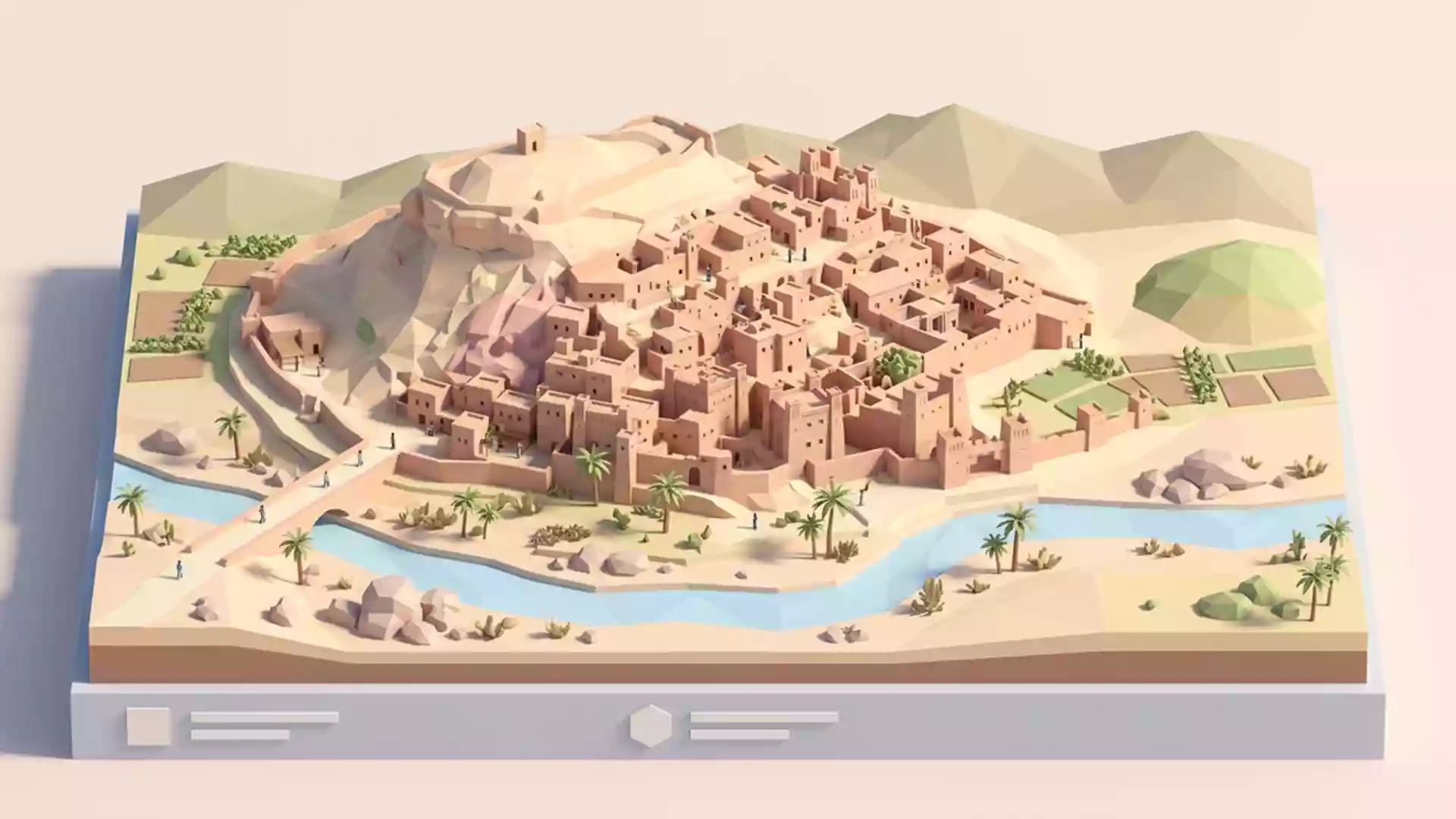
Ait Ben Haddou, the earthen ksar above the Ounila river
Published on 08/31/2026 at 21:19 | Editorial responsibility: Rafael Müller, Editor-in-Chief AD HOC NEWS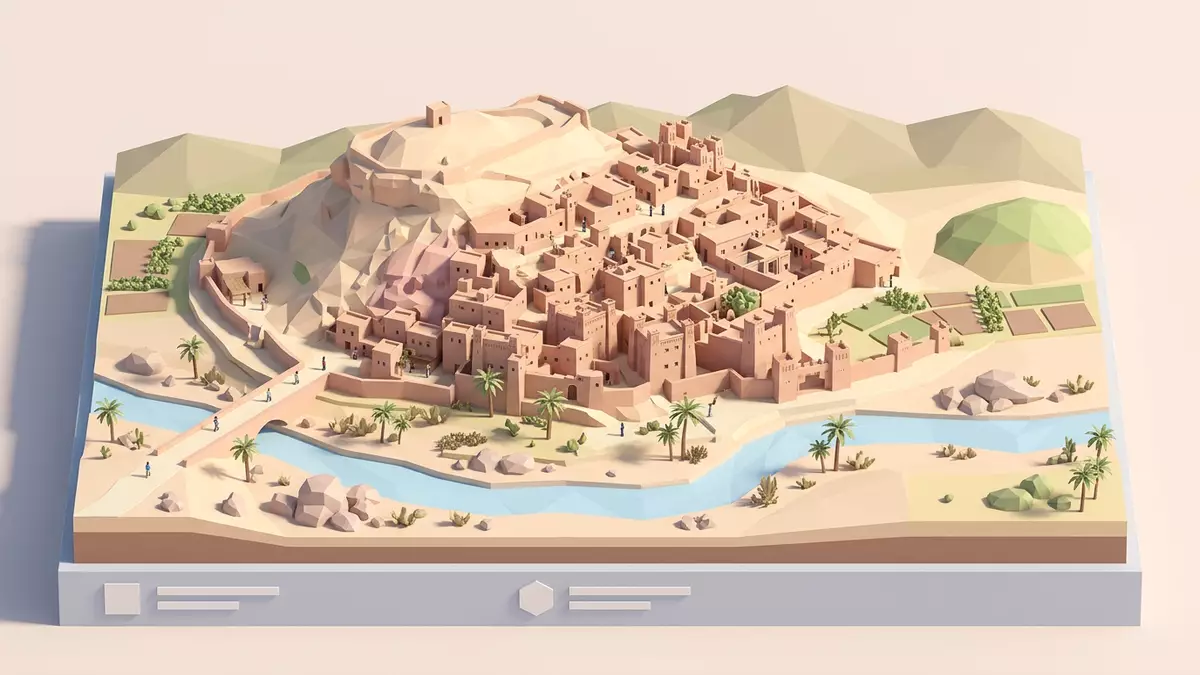
Ait Ben Haddou, on the southern slopes of the High Atlas near Ouarzazate, is a historic earthen ksar whose clustered towers rise above the Ounila river on an old caravan route between the Sahara and Marrakech.
An earthen fortress-village in the High Atlas foothills
Ait Ben Haddou is a fortified village, or ksar, in Ouarzazate Province in Morocco, set on a hillside overlooking the valley of the Ounila river.Ouarzazate Province ksar The settlement lies on the southern slopes of the High Atlas Mountains, where the range begins to fall away towards the pre-Saharan plains.southern slopes of the High Atlas Ait Ben Haddou stands along a former caravan route that linked the Sahara and the oases beyond with Marrakech across the mountains, making it one among several fortified stops on a wider trading corridor.route between the ancient Sudan and Marrakech
The ksar itself is a compact cluster of earthen houses and communal buildings pressed together within a single enclosure, with defensive walls reinforced by towers marking its outer edge.group of earthen buildings surrounded by high walls Inside, the pathways climb steeply up the slope, threading between tall houses, granaries and small courtyards, and eventually reach higher terraces overlooking the river and the newer settlement on the opposite bank. Many of the traditional houses are built from rammed earth and mud brick faced in local red clay, with flat roofs and high corner turrets that give the village its stepped silhouette against the sky.rammed earth and mud brick
Architecture in earth: towers, walls and kasbah houses
Ait Ben Haddou is recognised as an outstanding example of Moroccan earthen architecture, where most structures are built from earth, timber and plant materials gathered locally in the pre-Saharan valleys.earthen construction techniques Its houses range from modest dwellings to larger kasbah-like residences that resemble small castles, with high tower corners and upper walls decorated with geometric patterns in mud brick.little urban castles with high corner towers These tower-houses cluster tightly together, sharing walls and rooflines, so that the village reads as a continuous mass of earthen forms rising from the slope.
The core of the standing fabric is dated to the seventeenth century onwards, although the architectural forms and building techniques belong to an older tradition of pre-Saharan valleys in southern Morocco.none of the oldest surviving buildings appear to date from before the 17th century Defensive walls surround the ksar and are reinforced with towers at the corners, while a narrow entrance passage gives access to the interior, emphasising control of movement and protection for the community within.defensive walls reinforced by corner towers Communal areas such as open spaces, religious buildings and storage structures are integrated among the houses, illustrating the way a ksar combines everyday domestic life with collective functions.
World Heritage status and the earthen landscapes of southern Morocco
The Ksar of Ait Ben Haddou has been inscribed on the UNESCO World Heritage List since 1987 as a cultural site under criteria (iv) and (v).inscribed on the UNESCO World Heritage List in 1987 Under these criteria, the ksar is recognised both as an outstanding example of a traditional fortified village illustrating principal types of earthen construction from the seventeenth century onwards, and as a testimony to interaction between human settlement and the pre-Saharan environment of southern Morocco.criteria (iv) and (v) The World Heritage designation covers the historic core of the ksar, whose area is a little over 3 ha (about 0.01 sq mi), with a larger buffer zone around it.area of 3.03 ha and buffer zone
The surrounding region belongs to a wider network of earthen settlements in the valleys fed by the High Atlas, where similar ksour and kasbah complexes mark historic routes towards the desert.fortified towns of the trans-Sahara trading route Ait Ben Haddou is frequently cited as one of the most internationally recognised sites within this earthen heritage, in part because its steep profile of mud-brick towers and its river setting have made it a recurrent backdrop for film productions.most internationally recognised earthen heritage site in Morocco The combination of compact earthen architecture, mountainous horizon and river valley gives a clear sense of how communities in southern Morocco adapted to their terrain with clustered, defensible villages built almost entirely from the ground on which they stand.
Visiting Ait Ben Haddou: what travellers from Western Europe should know
- Ait Ben Haddou lies north-west of the town of Ouarzazate in southern Morocco, on the Ounila river and on the road route that connects Ouarzazate with Marrakech across the High Atlas.
- The historic ksar climbs a hillside above the river; reaching the upper terraces involves walking up steep alleys and stairways within the earthen village.
- The modern settlement and access road lie across the river from the ksar, so a short crossing over the riverbed or a small bridge is part of most approaches.
- The official language is Arabic and the currency is the Moroccan dirham.
- Entry requirements depend on your nationality; UK travellers can check the FCDO travel advice at gov.uk/foreign-travel-advice, Irish travellers the Department of Foreign Affairs at ireland.ie.
Searching for Ait Ben Haddou on social platforms
These links open searches for Ait Ben Haddou on each platform.
Frequently asked questions about Ait Ben Haddou
Where is Ait Ben Haddou and what kind of place is it?
Ait Ben Haddou is a historic earthen ksar in Ouarzazate Province in southern Morocco, set on the southern slopes of the High Atlas above the Ounila river.
What should visitors expect when walking through the ksar?
Visitors walk through narrow alleys and stairways between closely spaced earthen houses and towers, with views from higher terraces across the river valley and the surrounding hills.
What makes Ait Ben Haddou distinctive among Moroccan heritage sites?
Ait Ben Haddou is distinctive for its seventeenth-century earthen architecture, compact fortress-village layout and recognition as a UNESCO World Heritage Site illustrating pre-Saharan settlement in southern Morocco.