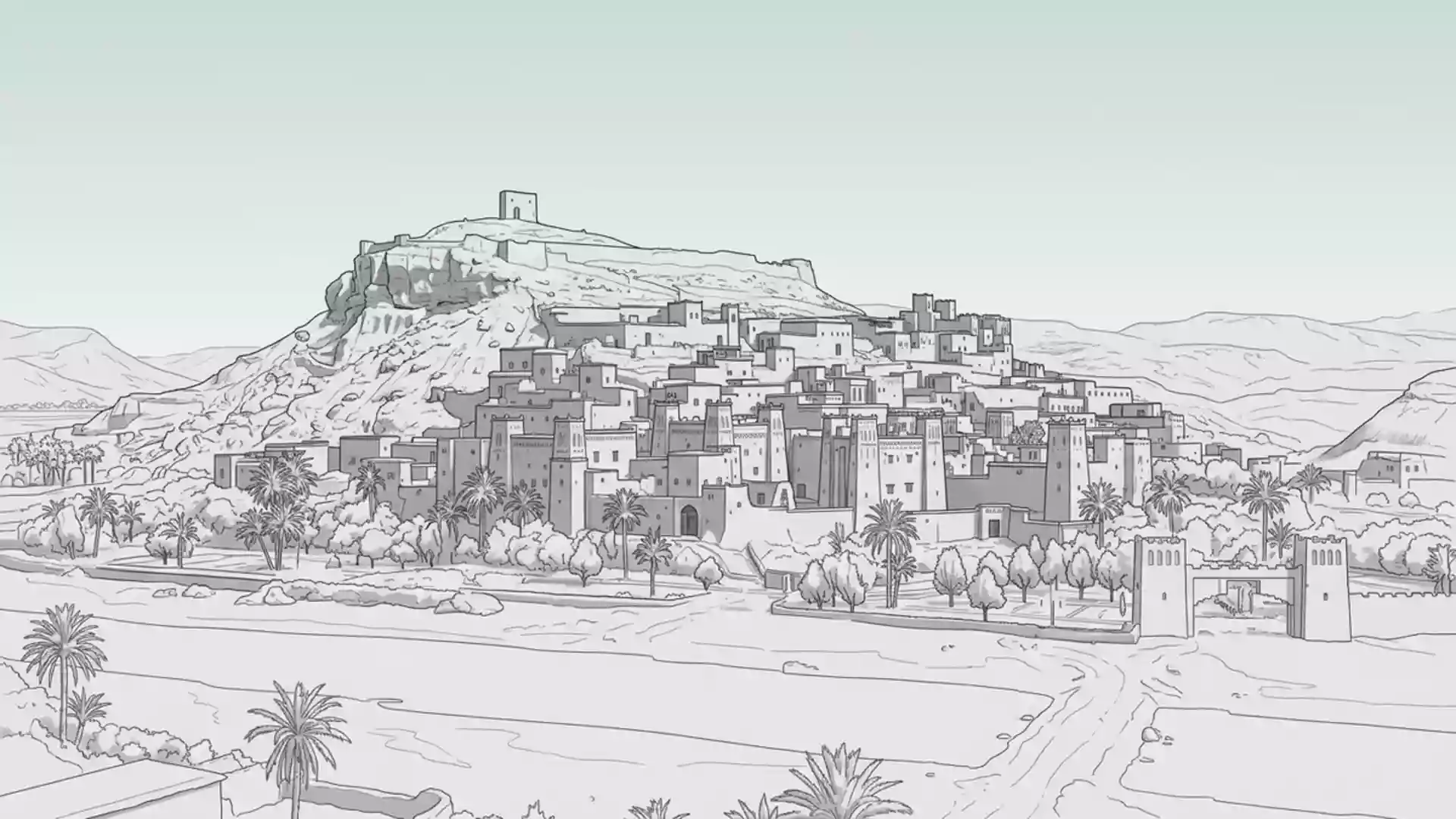
Ait Ben Haddou and the earthen ksar above the Ounila river
Published on 09/05/2026 at 12:11 | Editorial responsibility: Rafael Müller, Editor-in-Chief AD HOC NEWS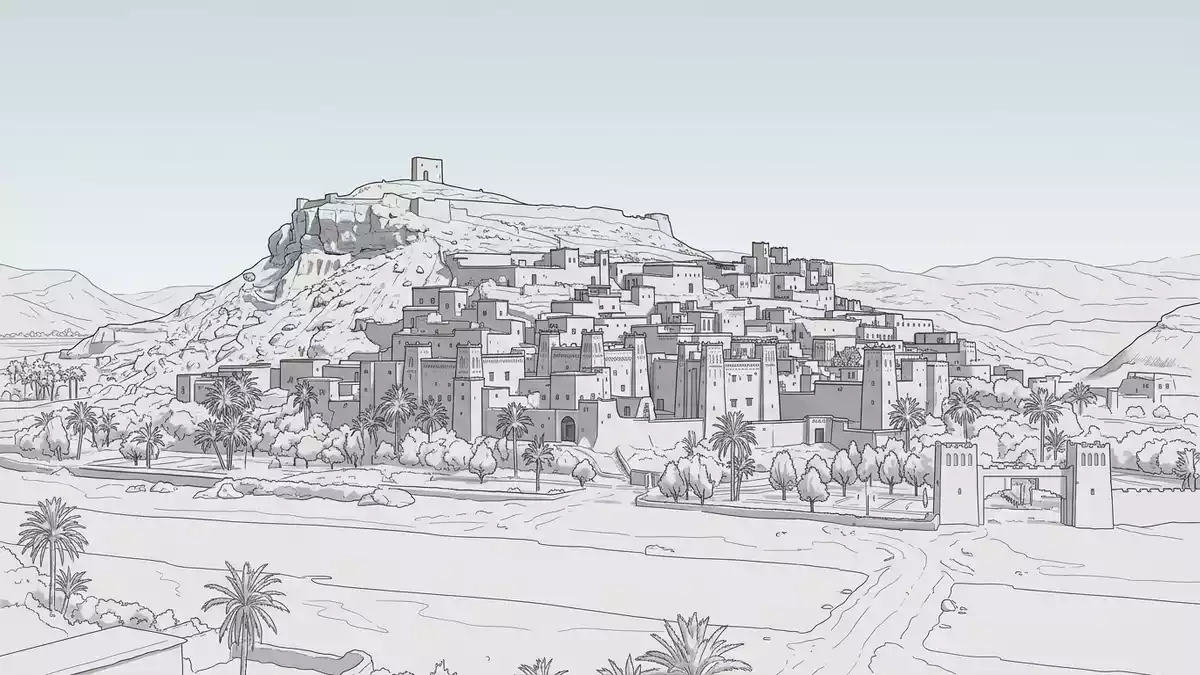
Ait Ben Haddou in Ouarzazate Province is a historic ksar of clustered earthen houses rising above the Ounila river on the southern slopes of the High Atlas in Morocco. Built largely in the seventeenth century and later, it is recognised as the Ksar of Ait-Ben-Haddou on the UNESCO World Heritage List, inscribed in 1987 for its earthen architecture and traditional settlement form.
A hillside ksar of red earth and defensive walls
Ait Ben Haddou is a ksar, a fortified village rather than a single building, with houses and tower-like kasbahs pressed together behind high defensive walls. The settlement climbs a hillside on the east bank of the Ounila river, so that the outer walls of one house form the outer walls of the next and the whole ksar reads as a continuous mass of red earth seen from the valley below.fortified earthen village The surrounding ramparts are reinforced by corner towers, and passage between the interior spaces runs through covered alleys, gateways and stepped lanes rather than broad streets.earthen buildings surrounded by high walls
The built fabric of the ksar is made primarily from rammed earth and adobe brick, faced with local clay that gives the settlement its strong red colour against the paler hills around it.rammed earth and adobe Timber elements support floors and roofs, and decorative detail on the upper parts of the kasbahs is worked directly into the clay, forming patterns in relief along parapets and cornices. Within the walls, communal granaries, dwellings and small squares stand at different levels on the slope, with a crowned summit giving the settlement a clear focal point above the river.
Caravan route, High Atlas foothills and UNESCO recognition
The ksar of Ait Ben Haddou occupies a position along a former caravan route linking the Sahara with Marrakesh via the passes of the High Atlas, and the Ounila valley around the site carried trading traffic through southern Morocco.former caravan route between the Sahara and Marrakesh The settlement lies in Ouarzazate Province on the southern slopes of the High Atlas range, within the wider region of Morocco’s pre-Saharan valleys where a tradition of earthen fortress-settlements developed along rivers such as the Drâa, Dadès and Ounila.southern slopes of the High Atlas in Ouarzazate Province
UNESCO inscribed the Ksar of Ait-Ben-Haddou on the World Heritage List in 1987 as a cultural site under criteria (iv) and (v), recognising it as an eminent example of ksar architecture and traditional pre-Saharan human settlement.Ksar of Ait-Ben-Haddou on the World Heritage List The listed area covers just over 3 ha (about 3.03 ha) with a larger buffer zone of surrounding land, and the inscription emphasises the way the earthen construction illustrates building techniques dating from the seventeenth century in the valleys of southern Morocco.World Heritage identification number and criteria
Architecture of kasbahs, lanes and river setting
Within Ait Ben Haddou, the individual kasbahs are tower-like houses with several storeys, small openings and parapeted rooflines, arranged in irregular clusters along the slope. Shared walls, stepped platforms and terraces allow the compact settlement to occupy the hillside while keeping the footprint tight behind the ramparts, and from outside the vertical rhythm of towers and plain wall surfaces gives the ksar its distinctive silhouette.clustered kasbah tower-houses Inside, lanes and stairways pass between houses, connecting small open spaces and giving access to higher levels of the settlement.
The ksar stands by the Ounila river, with cultivated terraces and modern village structures lying nearby across the water. Its position at the edge of the High Atlas foothills places earthen walls, riverbank and mountain backdrop within a single view, and the contrast between the compact fortified cluster and the wider landscape is one of the defining visual qualities of Ait Ben Haddou.ksar sits on the southern slopes of the High Atlas The site has also served as a setting for film productions, which has drawn wider attention to its earthen architecture and landscape, though its World Heritage status rests on its form and construction rather than on screen appearances.celebrated film location
Visiting Ait Ben Haddou: what travellers from Western Europe should know
- Ait Ben Haddou lies in Ouarzazate Province in southern Morocco, near the Ounila river and the road corridor linking Ouarzazate with Marrakesh across the High Atlas.
- The historic ksar rises on a hillside, and access to the upper parts involves walking up earthen lanes and stepped passages that can be steep in places.
- The river sits directly below the ksar, and reaching the fortified area requires crossing the riverbed or a bridge before entering the defensive walls.
- The official language is Arabic and the currency is the Moroccan dirham.
- Entry requirements depend on your nationality; UK travellers can check the FCDO travel advice at gov.uk/foreign-travel-advice, Irish travellers the Department of Foreign Affairs at ireland.ie.
Searching for Ait Ben Haddou on social platforms
These links open searches for Ait Ben Haddou on each platform.
Frequently asked questions about Ait Ben Haddou
Where is Ait Ben Haddou located?
Ait Ben Haddou is in Ouarzazate Province in southern Morocco, on the southern slopes of the High Atlas beside the Ounila river.
What can visitors expect when exploring the ksar?
Visitors encounter a compact hillside settlement of earthen houses, kasbah towers, stepped lanes and defensive walls overlooking the river and surrounding valley.
What makes Ait Ben Haddou distinctive among Moroccan sites?
Ait Ben Haddou is distinctive for its earthen ksar form, its concentration of kasbahs on a single hillside and its recognised World Heritage status for traditional pre-Saharan architecture.